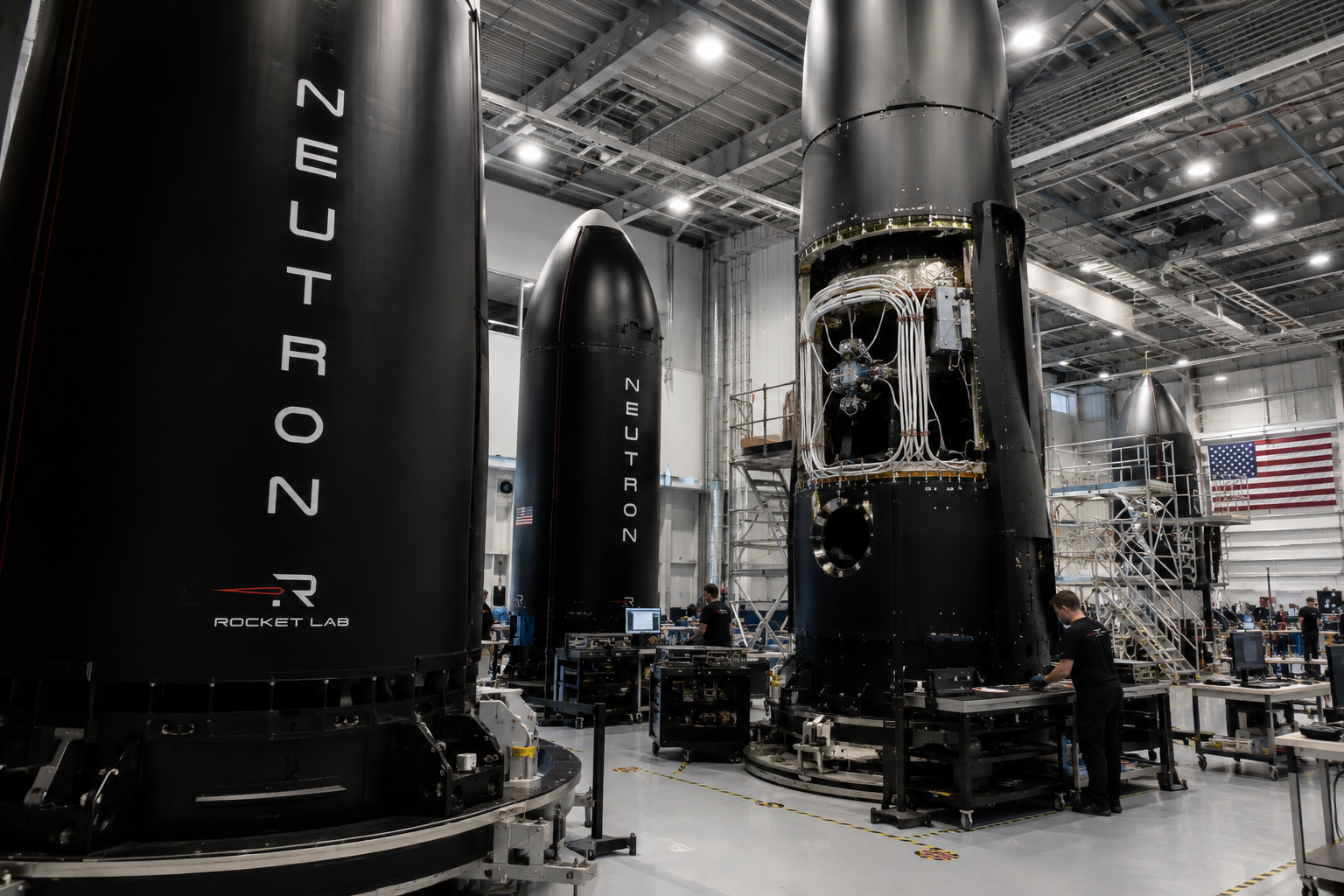
In the Rocket Lab vs SpaceX debate, the fundamentals underneath RKLB are getting stronger in ways that are easy to miss. Rocket Lab builds much of what it flies, and that structure matters more as Neutron, its medium and large rocket, moves toward flight. Below I cover three things: how Rocket Lab keeps costs down, why its all in one package is different from other space companies, and where it sits in the market against SpaceX (SPCX).
Why Rocket Lab vs SpaceX Is Closer Than It Looks
Most space companies do one or two things well. Rocket Lab makes its own rockets, spacecraft and components. When a company controls its own manufacturing, it does not stack supplier margins on top of its costs, and it can improve a design and fix a problem without waiting on a vendor. That control came largely from acquisitions like SolAero, GEOST and Mynaric, which I broke down in my Rocket Lab acquisitions timeline.
You can see this in the economic profile. Raymond James research estimates 2028 capex as a share of revenue at 6.6% for RKLB, compared with 92.5% for SpaceX and 66.0% for ASTS. Rocket Lab is projected to reach a 2028E EBITDA margin of 30.0% while spending far less of each revenue dollar on capital.
Neutron Launch Costs Fall as Cadence Scales
The clearest picture of the cost story is the Neutron chart from Raymond James and Rocket Lab. It splits the cost burden into two parts: an $80M stand up cost allocation and a $50M booster cost allocation. With one launch in 2026E, that burden is $130M per launch. As launches scale, the same fixed costs are spread across more flights:
- 2026E: 1 launch, $130M per launch
- 2027E: 3 launches, $39M per launch
- 2028E: 5 launches, $22M per launch
- 2029E: 9 launches, $12M per launch
- 2030E: 13 launches, $8M per launch
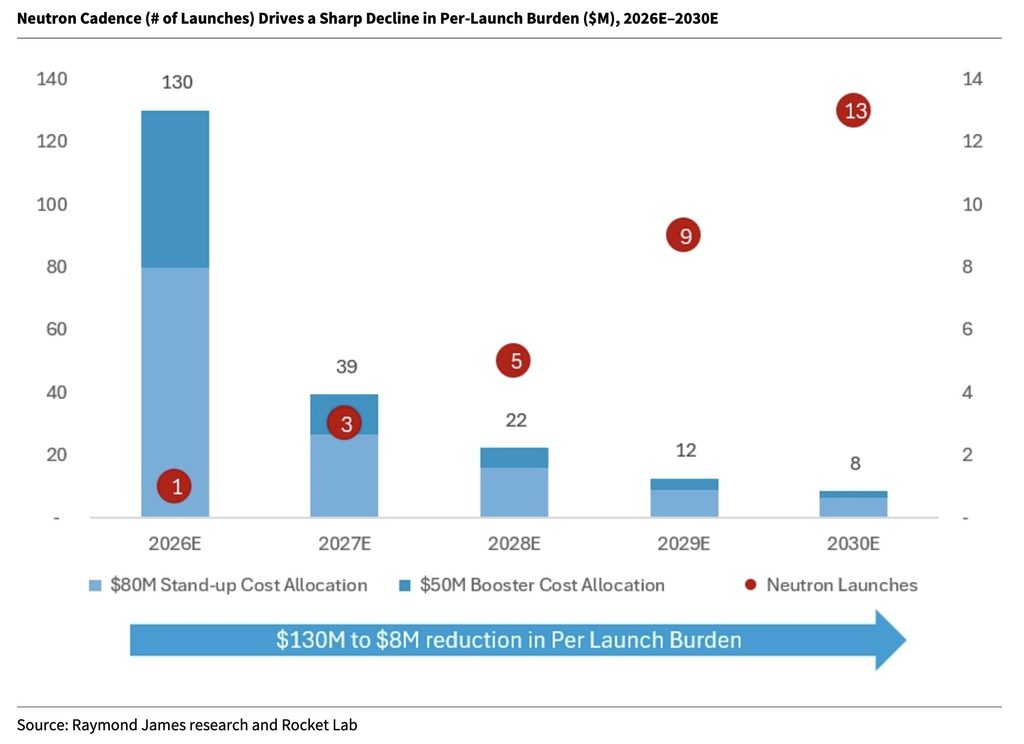
That is the move from $130M to $8M per launch. Some investors argue that at roughly $50M per launch, Neutron could become a highly profitable alternative to SpaceX for defense and commercial constellations. These are projections, not results, but the logic is simple: fixed costs shrink per launch as cadence grows.

The All in One Package Across the Space Value Chain
The Raymond James comparison rates ten companies on launch, spacecraft manufacturing, merchant components, payloads, constellations, spectrum rights, services and distribution. RKLB plus IRDM is marked in green on merchant components, owned and operated constellation, spectrum rights and distribution partners. Merchant components stands out because SpaceX shows no position there.
ASTS and SpaceX are the other names in the table with spectrum access, but ASTS spends 66.0% of revenue on capex in 2028E, which I cover in my ASTS space-based cellular analysis. Planet is another company with its own constellation, and I broke down its data business in my Planet Labs analysis.
Owning several layers means Rocket Lab can sell to customers at more than one point and keep more of the value inside the company. A pure launch company or a pure satellite company can’t do that.
Market Size and the Medium and Large Rocket Race
Because Rocket Lab spans launch, spacecraft, components and services, its addressable market is wider than a launch only business. Neutron is what moves it into the medium and large rocket class, where SpaceX has dominated. (For a closer look at the incumbent, see my SpaceX (SPCX) breakdown on reusable launch and Starlink.) If Neutron reaches the cadence in the chart, Rocket Lab becomes a credible rival there, not just the small launch specialist.
What Could Go Wrong
SpaceX is projected to grow faster, with a 108.0% CAGR from 2025 to 2028 against 25.0% for RKLB, and at a higher 2028E EBITDA margin of 66.8%. Neutron also has to launch on schedule and ramp as planned, and the cost chart depends on that. Neutron has already slipped once, after a tank rupture in January 2026, as covered in my Rocket Lab stock analysis. Rocket Lab’s edge is capital efficiency and breadth, not raw growth.
Final Thoughts on Rocket Lab vs SpaceX
The case for RKLB stock rests on vertical integration, falling Neutron costs and a package that covers more of the value chain than most rivals. Rocket Lab doesn’t need to beat SpaceX everywhere. It needs to execute on Neutron and keep its costs low.
More space coverage on BullionLabs: Rocket Lab stock analysis, SPCX, ASTS and Planet Labs.
Disclosure: The author holds a long position in $RKLB stock at the time of writing
Source: Raymond James Research, Rocket Lab
Leave a Reply