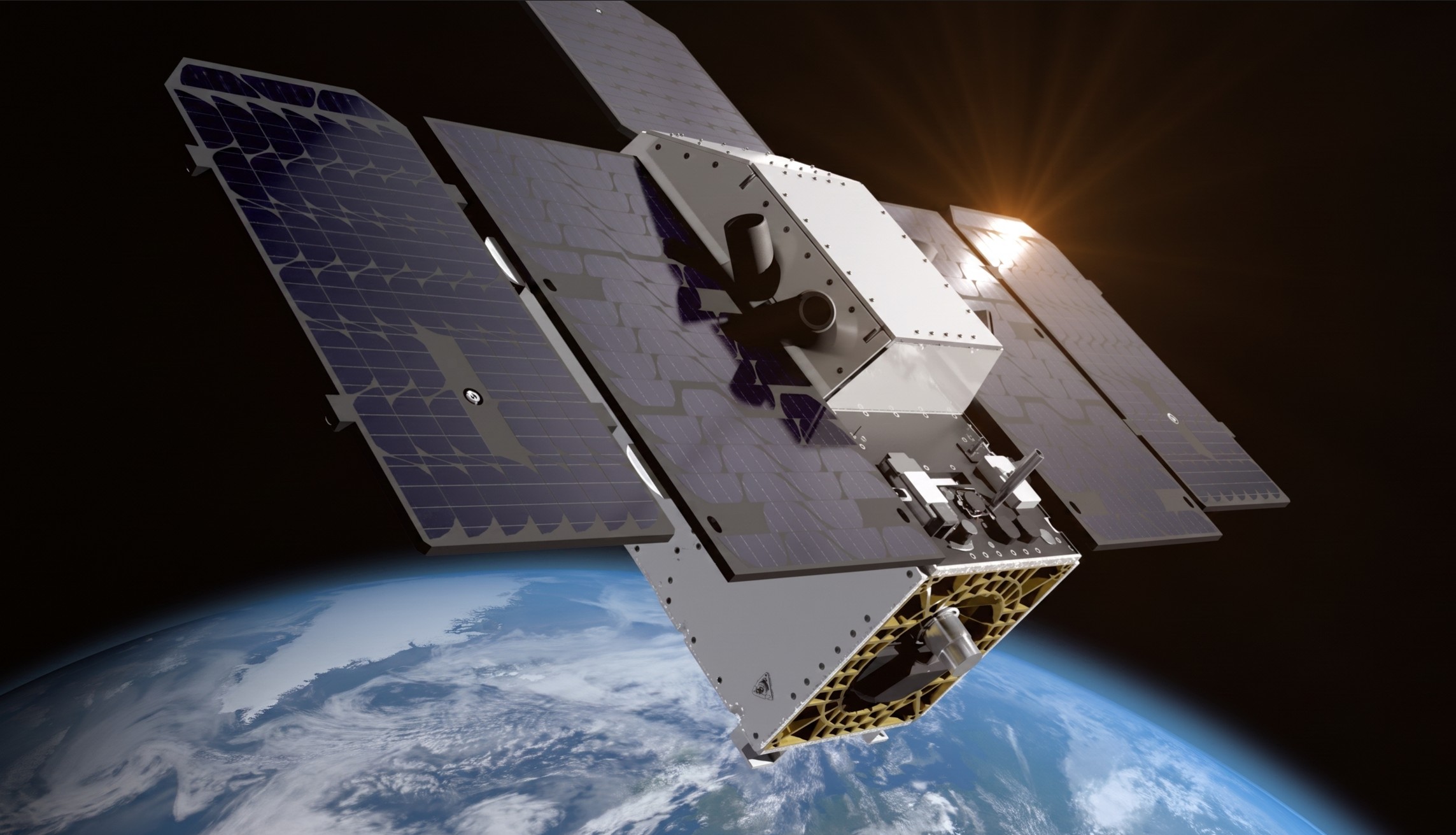
Analyzing the gap between Planet Labs’ fundamentals and its stock price from a 268% backlog surge to Wall Street targets implying triple-digit upside.
Planet Labs (NYSE: PL) has quietly built one of the most compelling setups in the small-cap space sector — and the market doesn’t seem to have caught up yet. Shares closed at $18.03 on September 5, 2026, even as five major analyst firms hold BUY ratings with price targets ranging from $35 to $51. That’s a gap of roughly 94% to 183% between where the stock trades today and where Wall Street thinks it should be.
That kind of gap usually means one of two things the market is missing something, or the story is more complicated than the headline. To figure out which, it helps to understand what Planet Labs actually does, and why it’s built differently from any other satellite company out there.
1. Technology: SuperDove (PlanetScope) & SkySat Constellations
The company has launched over 460 satellites since 2013. It currently operates an active fleet of approximately 200 to 220 satellites in orbit, with 263 cameras active in space.
- SuperDove: Each satellite is equipped with a 47-megapixel multispectral camera system (200 total cameras across the fleet).
- SkySat: A constellation of 21 high-resolution satellites equipped with 63 total cameras.
Next-Generation Satellites:
- Pelican: 10 active satellites deployed (1 camera per satellite).
- Tanager: 1 active satellite deployed (1 camera per satellite).
![[pl]compactsize](https://bullionlabs.net/wp-content/uploads/2026/09/PLCompactSize-1024x478.jpg "Capturing the Earth Every Second: The Planet Labs Breakdown")
Historically, satellites were massive and heavy, requiring significant capital and time to build and launch. Planet Labs disrupted this paradigm by pioneering a compact form factor—ranging from the size of a retail shipping box to a small appliance:
- Smallest: 10 cm × 10 cm × 30 cm | 5 kg
- Largest: 60 cm × 60 cm × 95 cm | 110 kg
- Camera width: Under 10 cm
By comparison, traditional satellites ranged from the size of an SUV (2,000 kg) to a full-sized school bus (up to 20,000 kg).
Launch & Infrastructure Partner: SpaceX ($SPCX)
To deploy and maintain its constellation in orbit, Planet Labs relies heavily on SpaceX as its primary launch provider.
- Rideshare Model: Planet utilizes SpaceX’s Falcon 9 Transporter missions, allowing dozens of compact satellites (SuperDoves, Pelican, and Tanager) to piggyback into Low Earth Orbit on a single rocket.
- Rapid Replenishment: This partnership enables Planet to maintain an aggressive deployment cycle, quickly replacing de-orbited hardware and continuously upgrading fleet camera sensors without the immense capital cost of dedicated launches.
2. What They Do: Continuous Imagery Captured Every 1–2 Seconds
Planet Labs provides persistent Earth observation data across multiple industries:
- Agriculture: Tracking changes in field color, crop health, pest infestations, disease spread, and optimal harvest timing.
- Disaster Management & Climate: Wildfire prevention, flood and tsunami monitoring, property damage assessment, snow accumulation tracking, and analyzing long-term climate trends.
- Defense & Intelligence: Detecting missile launches, terrorist activities, territorial intrusions, nuclear tests, and military troop movements.
- Geospatial Tracking: Monitoring remote or inaccessible regions, including deserts and glaciers.
Resolution Capability: High-resolution imagery captures spatial detail down to 30 cm × 30 cm per pixel, enabling the identification of vehicle shapes, makes, and colors from low Earth orbit.
![[pl]client](https://bullionlabs.net/wp-content/uploads/2026/09/PLClient-1024x788.jpg "Capturing the Earth Every Second: The Planet Labs Breakdown")
3. Client Base: Government & Public Sector (80%) | Commercial Enterprises (20%)
Defense & Intelligence Agencies:
- U.S. National Reconnaissance Office (NRO): Awarded Planet a multi-year Electro-Optical Commercial Layer (EOCL) contract for high-resolution imagery.
- U.S. Department of Defense / NGA: Leverages daily SuperDove imagery feeds to monitor activity across airfields, maritime ports, and contested military zones.
- Swedish Armed Forces (FMV): Strategic customer utilizing Pelican satellite data integrated with edge AI for real-time threat detection.
- NATO & Allied Nations: Allied Command Transformation uses Planet imagery for persistent space-based surveillance and unclassified intelligence sharing among member states.
Civil & International Ministries:
- NASA: Subscribes to PlanetScope data for climate research, glacier tracking, and land-use analysis.
- State & Local Agencies: Fire departments and forestry services utilize real-time imagery for rapid burn-mapping during active wildfires and flood damage assessments.
- Non-Profit & Policy Coalitions: Partners like Carbon Mapper leverage Tanager hyperspectral satellites to track point-source greenhouse gas emissions globally.
Agriculture & Agribusiness:
- Key Clients: Corteva, Bayer, Farmers Edge.
- Use Cases: Crop health monitoring, yield forecasting, drought stress detection, and field-level variable fertilizer application.
Energy, Oil & Gas:
- Key Clients: Utility operators, pipeline managers, and renewable energy developers.
- Use Cases: Inspecting pipeline right-of-ways for encroachments, monitoring refinery stockpiles, and detecting methane leaks via Tanager satellites.
Finance, Trading & Insurance:
- Key Clients: Commodity trading desks, hedge funds, and reinsurance firms (e.g., Swiss Re).
- Use Cases: Container counts at major shipping ports, oil storage tank volume estimation, and automated post-hurricane property damage claims processing.
Mapping, Tech & Logistics:
- Key Clients: Google Maps and global supply chain logisticians.
- Use Cases: Updating basemaps, monitoring infrastructure development, and tracking port congestion or supply chain bottlenecks.
4. Geographical Revenue Breakdown
| Region | Share of Revenue |
|---|---|
| United States | 40.00% |
| EMEA (Europe, Middle East, Africa) | 22.00% |
| Japan | 12.35% |
| Ukraine | 11.67% |
| Asia-Pacific | 7.09% |
| Latin America | 3.97% |
| Rest of North America | 2.64% |
5. Contract Durations & Revenue Realization
- Annual & Multi-Year Dominance: Approximately 94% of Planet’s business is generated from annual or multi-year agreements.
- Average Contract Duration: ~1.5 to 2 years.
- Revenue Realization Schedule:
- ~50% converts to revenue within 12 months.
- ~70% converts to revenue within 24 months.
- ~30% is recognized across longer multi-year horizons (3 to 5+ years).
![[pl]revenuandeps](https://bullionlabs.net/wp-content/uploads/2026/09/PLRevenuandEPS-1-1024x630.jpg "Capturing the Earth Every Second: The Planet Labs Breakdown")
6. Revenue Trajectory (YoY Growth)
- 2022: $191.3M (+45.8%)
- 2023: $220.7M (+15.4%)
- 2024: $244.4M (+10.7%)
- 2025: $307.7M (+25.9%)
- 2026 (Est.): $430M–$441M (+40–43% revised upward)
- 2027 (Est.): $572.5M (+31.2%)
- 2028 (Est.): $742.6M (+29.7%)
7. EPS Trajectory
- 2022: -$0.31 (+16.6%)
- 2023: -$0.25 (+3.1%)
- 2024: -$0.20 (-19.5%)
- 2025: -$0.04 (+49.2%)
- 2026 (Est.): -$0.05 to $0.00 (Approaching potential breakeven)
- 2027 (Est.): $0.01 (Pivot to profitability)
- 2028 (Est.): $0.12 (+833.1%)
8. Management Guidance
- Revenue: $430M to $441M
- Adjusted EBITDA: $3M to $10M
- Non-GAAP Gross Margin: 55% to 57%
- Capital Expenditures (CapEx): $100M to $115M

9. Backlog Growth
- 2023: $221M (+15.7%)
- 2024: $244M (+10.4%)
- 2025: $900M (+268.8%)
- 2026: $815M (+11.0% YoY)
10. Client Retention (Net Dollar Retention Rate)
- Net Dollar Retention (NDR): 109% — Existing clients spent 9% more year-over-year, accounting for contract downgrades and churn.
- NDR including Winbacks: 110% — Factoring in returning former clients, net expansion reaches 110%.
11. Debt Trend (3-Year Horizon)
- 2023: $24.9M
- 2024: $21.6M
- 2025: $462.5M
- 2026: $462.6M
12. Cash Position
- 2023: $298.9M
- 2024: $249.0M
- 2025: $640.1M
- 2026: $865.4M
13. Debt-to-Equity (D/E) Ratio: 1.49
14. Common Shares Outstanding
- 2023: 268.12M
- 2024: 278.94M
- 2025: 312.42M
- 2026: 363.80M
15. Major Shareholders & Ownership Structure
- Alphabet Inc. (Google): 9.7% – 10.6%
- Vanguard Group: 6.5% – 7.1%
- BlackRock Inc.: 4.9% – 5.1%
Ownership Breakdown:
- Institutional: 55% – 60%
- Public / Retail: 35% – 40%
- Insiders: 2% – 3%
16. Key Strategic Growth Initiative: Orbital AI Computing
Planet Labs is partnering with Google on an orbital AI computing project built around Google’s Project Suncatcher.
- Objective: Evaluate whether space-based, solar-powered satellite constellations can effectively run AI hardware in low Earth orbit (LEO). The mission will test Google Tensor Processing Units (TPUs) in space for solar power efficiency, thermal dissipation, radiation tolerance, and optical inter-satellite links for high-bandwidth machine learning workloads.
- Planet Labs’ Role: Utilizing its satellite manufacturing and constellation management capabilities, Planet is building two prototype demonstration satellites designed to host Google’s TPU hardware.
- Target Launch: Scheduled for early 2027.
- Project Status: Currently an early stage R&D moonshot rather than an active commercial revenue driver but one worth watching.
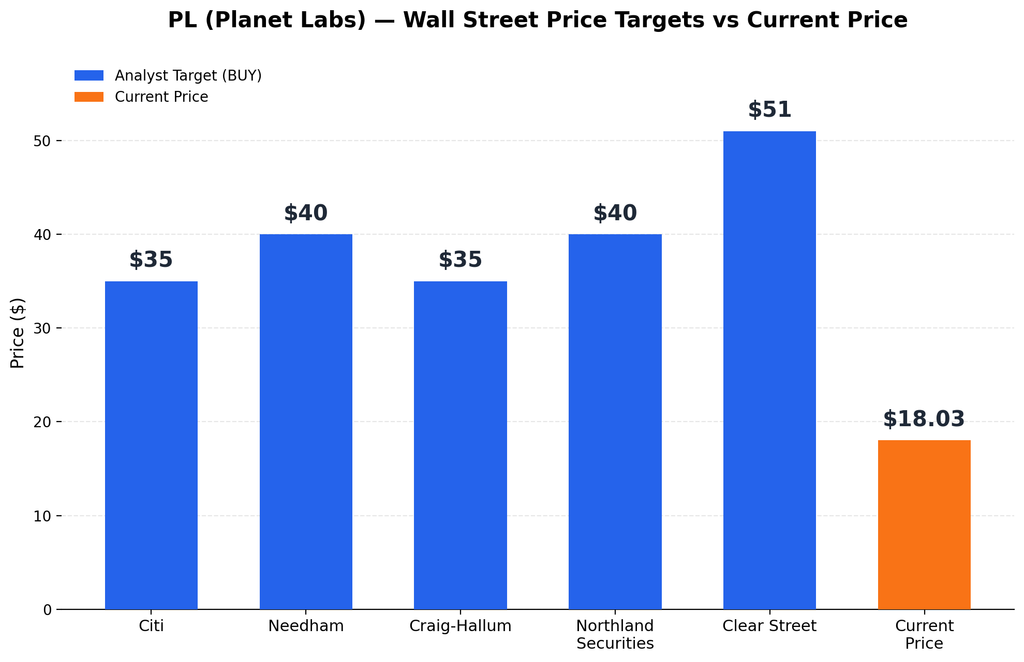
17. Wall Street Price Targets
- Citi: $35 (BUY)
- Needham: $40 (Adjusted from $53, BUY)
- Craig-Hallum: $35 (Adjusted from $49, BUY)
- Northland Securities: $40 (Adjusted from $50, BUY)
- Clear Street: $51 (Adjusted from $53, BUY)
Disclosure: The author holds a long position in $PL stock at the time of writing.
Sources: TradingView, TipRanks, Seeking Alpha, Planet Labs
Leave a Reply