Alphabet Q3 2026 earnings gave investors a strange mix of signals. Revenue jumped 25%. Cloud revenue doubled. Yet the stock fell about 13% in two days. It closed at $279.84 on October 30, down from $323.32 on October 27.
So, is Google’s business going down? By the numbers, no. The core business is growing faster than it has in years. But cash flow turned negative, spending keeps climbing, and AI is changing how Google earns money from each search.
Key takeaways from Alphabet Q3 2026 earnings
- Revenue grew 25% to $127.6 billion.
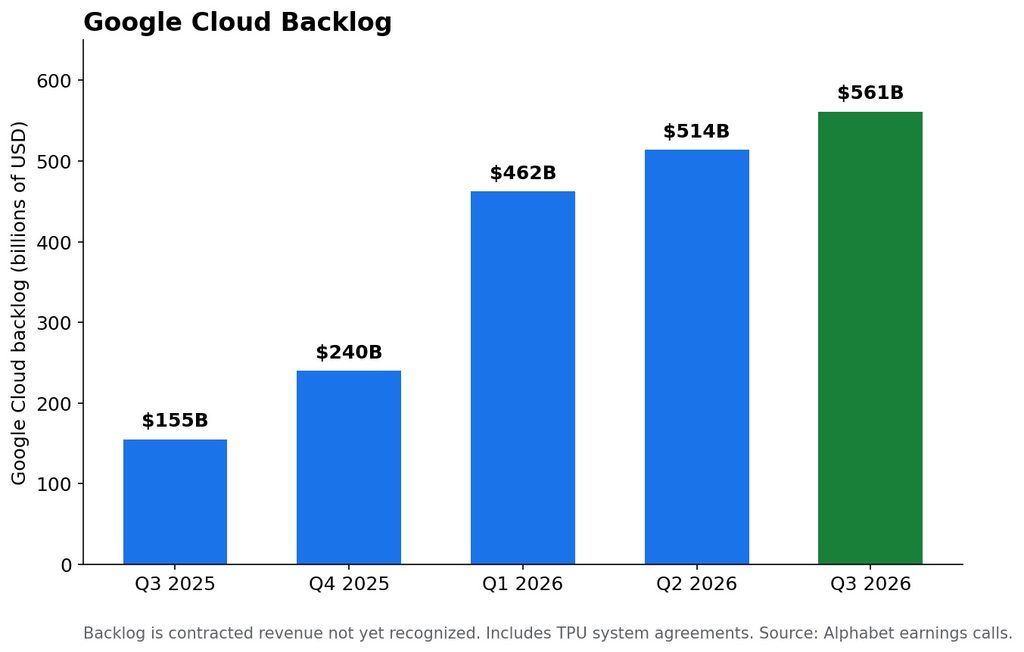
- Google Cloud revenue grew 103% and its backlog hit $561 billion.
- EPS missed, mostly because of an investment loss.
- Free cash flow was negative for the second quarter in a row.
- Search is changing, and each AI question earns less than the old results page.
- Analysts cut price targets, but most still rate the stock a buy.
What does Alphabet do?
Alphabet is the parent company of Google. Most of its money still comes from ads on Google Search, YouTube and the ad network.
Its second engine is Google Cloud. Cloud rents computing power, AI tools and Google’s own AI chips, called TPUs, to businesses. The third piece is Other Bets, a group of long shot projects. Waymo, the self driving car unit, is the best known.
Alphabet Q3 2026 earnings at a glance
Revenue came in at $127.6 billion, up 25% from $102.3 billion a year earlier. Operating income rose to $40.6 billion, and operating margin edged up to 32%.
Growth is also speeding up. Here is the year over year growth by quarter:
- Q3 2025: up 16%
- Q4 2025: up 18%
- Q1 2026: up 22%
- Q2 2026: up 24%
- Q3 2026: up 25%

Why did Alphabet’s EPS miss?
The EPS miss was the headline that scared investors. EPS was $2.12, well short of the roughly $3 analysts expected, and net income fell about 25% to $26.2 billion.
However, the cause was not the core business. Other income swung from a gain of $12.8 billion a year ago to a loss of $8.2 billion this quarter. Reports tie an unrealized loss on Alphabet’s SpaceX stake to about $0.55 per share. Alphabet itself did not name the investment.
Add that $0.55 back and EPS is about $2.67. That is still below expectations, so it was a real miss. It just was not as bad as the headline.
Here is the EPS history:
- Q3 2025: $2.87
- Q4 2025: $2.82
- Q1 2026: $5.11
- Q2 2026: $9.11
- Q3 2026: $2.12
Q1 and Q2 were inflated by big paper gains on investments. Q3 went the other way. Therefore, operating income is the better guide, and it rose about 30%.

Is Google Search going down? How AI changes Google’s business
Many people assume Google Search is fading because users now ask AI. The data says something different.
CEO Sundar Pichai said Search query growth was the strongest in five years. Also, Search and other revenue rose 12% to $63.35 billion. People are not leaving Google. They are changing how they ask.
Users now type full questions and expect an answer, not ten links. AI Mode in Search has passed one billion monthly users, and the Gemini app has reached one billion users.
The catch is money per question. Management said AI Mode monetizes at a lower level than traditional search. As a result, Search revenue missed estimates for the second quarter in a row. Google’s business is not shrinking, but each AI answer earns less than the old results page, at least for now.
Advertisers now want to be recommended
This is the biggest shift in the ad business. Before, a brand paid to rank on a results page. Now brands want the AI to name them inside the answer.
That has created two separate budgets:
- Paid placement. Google is expanding ads inside AI Mode worldwide, and it made its biggest update to product listing ads in a decade.
- Earned visibility. Brands also invest in making their content easy for AI to read and cite. This is called generative engine optimization, or GEO. It is a separate investment from buying AI ads.
Rivals are in the game too. OpenAI began showing ads in ChatGPT on February 9, 2026, with more than 600 advertisers signed up. Still, agency executives are not yet convinced brands need dedicated AI visibility budgets. The spending is real but early.
For Alphabet, the bull case is that these ads still run on Google’s ad system, so Google gets paid either way. The bear case is that AI answers must earn as much per question as the old results page did.
Google’s data is the quiet advantage
AI answers still depend on information that people created. Google holds one of the largest collections of it: a web index built over decades, plus YouTube, Maps, Shopping data and years of feedback on what people click and trust.
There are two limits. First, rival AI models also learn from the open web, so the data is an edge, not a lock. Second, publishers want to be paid or sent traffic. Five French publisher groups recently filed a complaint with the EU over AI Overviews. That is a legal risk to watch.
Google Cloud: the growth engine behind Alphabet Q3 2026 earnings
Google Cloud is the star. Cloud revenue was $30.71 billion, compared with $15.16 billion a year ago. That is a 103% jump. Growth has sped up every quarter this year: 34%, then 48%, 63%, 82% and now 103%.
Profit is growing too. Cloud operating income rose from $3.6 billion to $11.1 billion in a year. That works out to a margin of about 36%.
The best forward signal is the Google Cloud backlog. It reached $561 billion in Q3. It was $155 billion a year ago. Backlog is contracted revenue that Alphabet has not yet recognized. Management said earlier in the year that just over half of it should turn into revenue within 24 months.
Cash flow and capex: the weak spot
Profit is up, but cash is not. Operating cash flow fell 13% to $42.3 billion, while spending on property and equipment more than doubled to $51.4 billion. That left free cash flow at negative $9.1 billion.
This is the second negative quarter in a row. Trailing twelve month free cash flow dropped 73% to $19.7 billion. So cash flow did not improve. It got worse.
One small positive: over nine months, operating cash flow is still up 13%. Part of the Q3 drop came from working capital, including a big jump in inventory.
Capex keeps rising. It went from $24.0 billion in Q3 2025 to $51.4 billion in Q3 2026, which is about 40% of revenue. Full year 2026 guidance stayed at $195 to $205 billion, and management expects spending to rise significantly in 2027. To hit that range, Q4 would need $63 to $73 billion. That is a calculation from the guidance, not a company figure.

How is Alphabet funding the spending?
Alphabet is not close to running out of money. However, it is now paying for growth with outside capital.
- Cash and debt. Cash and securities were $265.1 billion, and long term debt rose from $46.5 billion to $125.1 billion in nine months.
- Fundraising. Over nine months, Alphabet raised about $142 billion from debt, new shares and preferred stock. In Q3 alone it sold $28.7 billion of notes and $12.4 billion of stock.
- No buybacks. Alphabet bought back no shares this year, and the share count is up 1.7%.
Here is a rough illustration. If operating cash flow stays near $42 billion and Q4 capex lands in the guided range, the gap could be $21 to $31 billion in Q4, before dividends. At a gap near $30 billion a quarter, $265 billion would cover about eight quarters on paper. That is a back of the envelope figure. It ignores new borrowing and bigger 2027 capex.
As for profit, Alphabet is already profitable. The real question is when free cash flow turns positive again. Management has said it will stay under pressure while it invests in AI infrastructure, and there is no date.
Technology roadmap, is Google on track?
Short term. Alphabet just launched Gemini 4 Argon and Carbon. Pichai said they lead at the frontier, and model APIs now process nearly 32 billion tokens per minute, more than four times last year. Alphabet also sells TPU chip systems directly, which is a new revenue line.
Long term. The bigger bets are Waymo, Google’s own chips and AI inside every product. Other Bets still loses money. It lost $2.04 billion this quarter, versus $1.4 billion a year ago.
The goal. Pichai calls it a full stack approach. Alphabet builds the chips, the models, the cloud and the products people use, all in one company.
On track? On tech and Cloud, yes. Cloud growth has sped up five quarters in a row, and Gemini usage is exploding. On cash discipline, less so. Capex guidance was raised twice this year, and Search missed estimates again.
Guidance: what does Alphabet expect?
In the short term, 2026 capex guidance is $195 to $205 billion, unchanged. Alphabet does not give revenue or EPS guidance. More Q4 detail comes on the next call.
In the longer term, capex rises significantly in 2027. The CFO also said more TPU system revenue is expected in 2027. The $561 billion backlog is the best signal of future revenue.
Fundamental check: is Alphabet fairly priced?
Headlines can mislead here, so start with the earnings. Alphabet trades at a P/E of about 14.6. That looks cheap. But reported EPS is full of investment gains. In Q2 alone, gains added $6.26 per share.
I stripped those swings out. Q1 core EPS was roughly $2.76, Q2 was roughly $2.60 to $2.75, and Q3 is about $2.67. With Q4 2025’s $2.82, trailing core EPS is about $10.90. That puts the stock at roughly 26 times core earnings. These are my estimates.
A few more valuation angles:
- PEG ratio. The reported PEG is 0.94. On my core numbers it is about 0.85. Both are under 1.
- Enterprise value. It is about $3.28 trillion, or about 7 times trailing revenue and 21 times trailing operating income.
- Free cash flow yield. It is only about 0.6% of market cap, because of the capex bill.
Business quality is high. Trailing operating margin is about 33%. My EBITDA proxy is up about 33% year over year. The balance sheet is strong, with about $140 billion of net cash. The current ratio is 2.72.
The weak points are the debt trend, the paused buybacks and the negative free cash flow. As a rough payback check, Cloud earned about $7.5 billion more operating profit this quarter than a year ago. Times four, that is about $30 billion a year, against about $160 billion of capex over twelve months. It is not a true return on capital, but it shows payback takes time.
So the stock is not a deep bargain on core earnings. It is a fair price for a fast growing, high margin business.
What is Alphabet’s moat?
Five things protect this business:
- Distribution. Search, Chrome, Android and YouTube reach billions of people daily.
- Own chips. TPUs lower Alphabet’s cost to run AI and now bring in revenue from other customers.
- Contracted demand. A $561 billion backlog means customers have already committed.
- Full stack. Few rivals own the chips, models, cloud and consumer products at once.
- Data. Decades of web, video, map and shopping data, plus user feedback on what works.
What could go wrong?
- Cash burn. Free cash flow is negative and capex keeps rising.
- Dilution. New shares and new debt are paying for the buildout.
- Search monetization and publisher pushback. AI Mode earns less per query, and publishers are fighting over how AI uses their content.
- Customer concentration. UBS projections put OpenAI and Anthropic at 27% of Cloud revenue in 2026 and over 48% in 2027. That is a projection, not a reported number.
- Noisy earnings. Investment gains and losses make reported EPS jump around.
GOOGL price target after Alphabet Q3 2026 earnings
Wall Street cut targets after the report, but most analysts stayed positive. The consensus target is $410.46, with five Strong Buy ratings, 46 Buy ratings and five Hold ratings.

FAQ: Alphabet Q3 2026 earnings
Is Google’s business going down?
No. Revenue grew 25% and operating income grew about 30%. However, free cash flow is negative, and AI is changing how Search earns money.
How much did Alphabet make in Q3 2026?
Revenue was $127.6 billion, operating income was $40.6 billion, and net income was $26.2 billion.
Why did Alphabet stock fall after earnings?
EPS missed, free cash flow turned negative again, and capex keeps rising. Search also missed revenue estimates for the second quarter in a row.
What is the Google Cloud backlog?
It is contracted revenue not yet recognized. It reached $561 billion in Q3 2026.
What is the GOOGL consensus price target?
It is $410.46, according to MarketBeat as of October 30, 2026.
The bottom line: is Google’s business going down?
Alphabet Q3 2026 earnings show a strong business with a costly habit. Revenue, operating income and Cloud all grew fast. Cash flow, EPS and the stock did not.
Google’s business is not going down. It is changing. Search usage is growing, but AI answers earn less per question for now. Cloud is doubling, but capex is outrunning cash. The price asks you to believe Cloud profits will catch up with the spending.
The next few quarters come down to one question: does Cloud profit growth catch up with the cost of building all that capacity?
Disclosure: The author holds a long position in $GOOGL stock at the time of writing
Related articles:
SpaceX Stock Analysis: Reusable Orbital Launch and Starlink Broadband: Reports tie Alphabet’s Q3 EPS hit to an unrealized loss on its SpaceX stake, so this gives readers the background.
CoreWeave’s $104B Backlog and the Path Through the Refinancing Window: It covers the same trade off as Google Cloud’s $561 billion backlog, where big contracted demand meets heavy funding needs.
Nvidia’s CEO Says Memory and Neocloud Demand Are Fine. Here Is What Investors Should Weigh: This is the wider AI infrastructure demand story behind Alphabet’s capex.
NBIS Stock Analysis: Is Nebius Worth Buying in 2026?: It is another AI cloud name, useful for comparing against Google Cloud.
S&P 500 Valuation 2026: Room to Run or Topping Out?: It gives market wide valuation context for a mega cap like Alphabet.
Celestica (CLS): The Company Solving the Demand for AI Compute Systems: It looks at the suppliers who benefit from the $195 to $205 billion capex Alphabet plans.
Sources:
- Q3 2026 earnings release (PDF): https://s206.q4cdn.com/479360582/files/doc_financials/2026/q3/2026q3-alphabet-earnings-release.pdf
- Q3 2026 8-K, financial highlights: https://www.sec.gov/Archives/edgar/data/0001652044/000165204426000080/googexhibit991q32026.htm
- Q3 2026 earnings call transcript: https://singjupost.com/alphabet-googl-q3-2026-earnings-call-transcript/ and https://www.fool.com/earnings/call-transcripts/2026/10/29/alphabet-googl-q3-2026-earnings-call-transcript/
- Alphabet investor relations: https://abc.xyz/investor
Leave a Reply