Tag: SpaceX

  • Rocket Lab vs SpaceX: Can Neutron Close the Gap?

    Rocket Lab vs SpaceX: Can Neutron Close the Gap?

    In the Rocket Lab vs SpaceX debate, the fundamentals underneath RKLB are getting stronger in ways that are easy to miss. Rocket Lab builds much of what it flies, and that structure matters more as Neutron, its medium and large rocket, moves toward flight. Below I cover three things: how Rocket Lab keeps costs down, why its all in one package is different from other space companies, and where it sits in the market against SpaceX (SPCX).

    Why Rocket Lab vs SpaceX Is Closer Than It Looks

    Most space companies do one or two things well. Rocket Lab makes its own rockets, spacecraft and components. When a company controls its own manufacturing, it does not stack supplier margins on top of its costs, and it can improve a design and fix a problem without waiting on a vendor. That control came largely from acquisitions like SolAero, GEOST and Mynaric, which I broke down in my Rocket Lab acquisitions timeline.

    You can see this in the economic profile. Raymond James research estimates 2028 capex as a share of revenue at 6.6% for RKLB, compared with 92.5% for SpaceX and 66.0% for ASTS. Rocket Lab is projected to reach a 2028E EBITDA margin of 30.0% while spending far less of each revenue dollar on capital.

    Neutron Launch Costs Fall as Cadence Scales

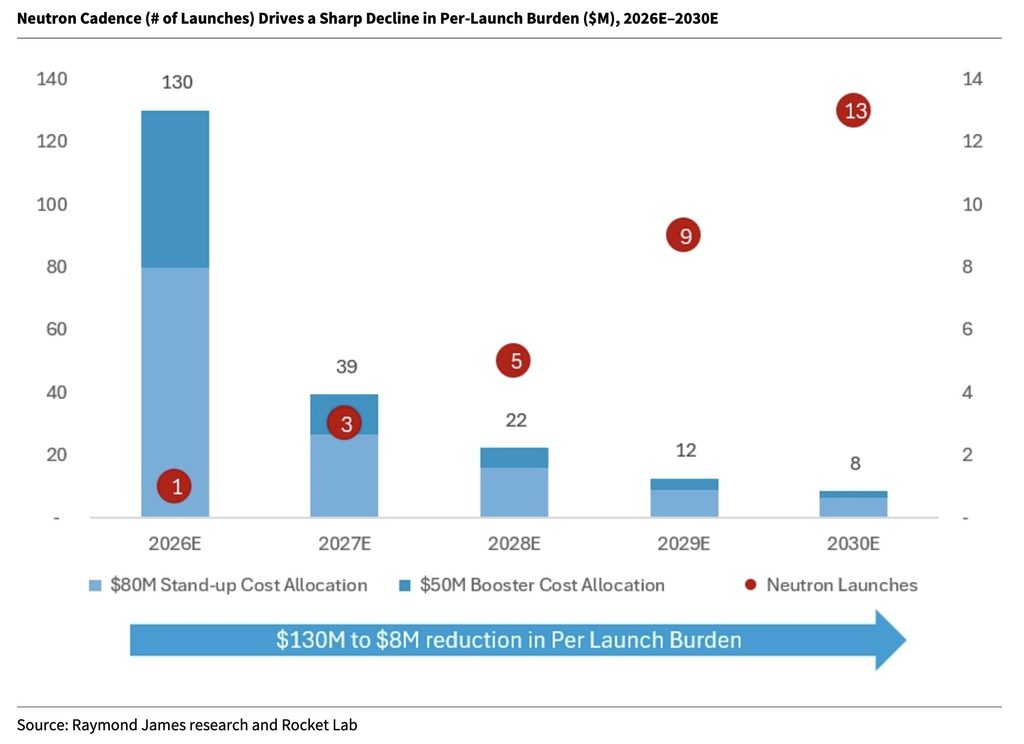
    The clearest picture of the cost story is the Neutron chart from Raymond James and Rocket Lab. It splits the cost burden into two parts: an $80M stand up cost allocation and a $50M booster cost allocation. With one launch in 2026E, that burden is $130M per launch. As launches scale, the same fixed costs are spread across more flights:

    • 2026E: 1 launch, $130M per launch
    • 2027E: 3 launches, $39M per launch
    • 2028E: 5 launches, $22M per launch
    • 2029E: 9 launches, $12M per launch
    • 2030E: 13 launches, $8M per launch
    RKLB stock Neutron cost per launch falling from $130M to $8M by 2030E

    That is the move from $130M to $8M per launch. Some investors argue that at roughly $50M per launch, Neutron could become a highly profitable alternative to SpaceX for defense and commercial constellations. These are projections, not results, but the logic is simple: fixed costs shrink per launch as cadence grows.

    Rocket Lab vs SpaceX

    The All in One Package Across the Space Value Chain

    The Raymond James comparison rates ten companies on launch, spacecraft manufacturing, merchant components, payloads, constellations, spectrum rights, services and distribution. RKLB plus IRDM is marked in green on merchant components, owned and operated constellation, spectrum rights and distribution partners. Merchant components stands out because SpaceX shows no position there.

    ASTS and SpaceX are the other names in the table with spectrum access, but ASTS spends 66.0% of revenue on capex in 2028E, which I cover in my ASTS space-based cellular analysis. Planet is another company with its own constellation, and I broke down its data business in my Planet Labs analysis.

    Owning several layers means Rocket Lab can sell to customers at more than one point and keep more of the value inside the company. A pure launch company or a pure satellite company can’t do that.

    Market Size and the Medium and Large Rocket Race

    Because Rocket Lab spans launch, spacecraft, components and services, its addressable market is wider than a launch only business. Neutron is what moves it into the medium and large rocket class, where SpaceX has dominated. (For a closer look at the incumbent, see my SpaceX (SPCX) breakdown on reusable launch and Starlink.) If Neutron reaches the cadence in the chart, Rocket Lab becomes a credible rival there, not just the small launch specialist.

    What Could Go Wrong

    SpaceX is projected to grow faster, with a 108.0% CAGR from 2025 to 2028 against 25.0% for RKLB, and at a higher 2028E EBITDA margin of 66.8%. Neutron also has to launch on schedule and ramp as planned, and the cost chart depends on that. Neutron has already slipped once, after a tank rupture in January 2026, as covered in my Rocket Lab stock analysis. Rocket Lab’s edge is capital efficiency and breadth, not raw growth.

    Final Thoughts on Rocket Lab vs SpaceX

    The case for RKLB stock rests on vertical integration, falling Neutron costs and a package that covers more of the value chain than most rivals. Rocket Lab doesn’t need to beat SpaceX everywhere. It needs to execute on Neutron and keep its costs low.

    More space coverage on BullionLabs: Rocket Lab stock analysis, SPCX, ASTS and Planet Labs.

    Disclosure: The author holds a long position in $RKLB stock at the time of writing

    Source: Raymond James Research, Rocket Lab
  • $SPCX: Reusable Orbital Launch & Starlink Broadband

    $SPCX: Reusable Orbital Launch & Starlink Broadband

    Space Exploration Technologies Corp (NASDAQ: SPCX)

    Navigating the Future with $SPCX: An Inside Look at Their Pivots, Financials, and Unbeatable Moat

    As investors, we often get caught up in the noise of market fluctuations. But occasionally, a story emerges that demands we step back and look at the bigger picture. $SPCX is one of those stories. The recent earnings report has thrown a lot into sharp relief—the challenges are real, but the potential for transformative growth is even more tangible.

    Let’s pull back the curtain and understand why $SPCX is a company on a defining mission.

    What Does $SPCX Actually Do?

    In a nutshell, $SPCX is focused on building the digital infrastructure for tomorrow. They are not just a software company; they are architects of integrated platforms that fuse cutting-edge automation with real-time data analysis. Their core mission is to empower large-scale enterprises to modernize legacy operations, making them faster, more efficient, and incredibly resilient.

    They are the plumbers and architects of the industrial internet.

    The Big Pivot: Defining Their Success

    You might remember $SPCX as more of a broad consulting service. But their greatest success has been their strategic, intentional pivot toward being a product-first, platform-driven company. This wasn’t just a slight adjustment; it was a complete re-engineering of their business model.

    • The Short-Term Success: This pivot forced them to streamline, leading to immediate margin improvements in their newer business units. It showed the market they were serious about scalability.
    • The Long-Term Success: This is the big one. By moving from one-off consulting fees to a recurring, platform-as-a-service (PaaS) revenue model, they’ve unlocked massive potential for exponential growth and deep customer lock-in. It was a bold move that is now paying off.

    A Technology Roadmap in Motion

    Their technology isn’t static; it’s on a well-defined trajectory.

    Short-Term Progress: We’re seeing rapid-fire updates to their core platform, focusing heavily on enhancing AI-driven predictive analytics. They are rapidly integrating user feedback to make the user interface more intuitive and powerful.

    Long-Term Progress: The big-picture goal is to create a truly self-optimizing “autonomous enterprise” platform. This is technology that doesn’t just predict problems but solves them automatically, creating a self-healing operational loop.

    The Ultimate Technology Goal: To become the default, industry-agnostic operating system for automated industrial processes.

    Are They on Track? This is the key question. Based on their recent releases and strategic partnerships, they are not just on their roadmap; they are hitting and sometimes exceeding their technical milestones. The vision is ambitious, but the execution has been disciplined.

    Understanding the Financial Picture

    Now for the part every investor is scrutinizing: the financials.

    The headline story is that $SPCX is currently in a hyper-growth phase, and this requires serious capital.

    How Much Fund Do They Need & Spend? They are currently spending roughly $25–$30 million in Capex per quarter, primarily invested in building out cloud infrastructure and R&D. Their operational cash burn is significant as they scale sales and engineering.

    How Long Would Current Cash Last? Their current cash reserves, which they boosted with a strategic capital raise last quarter, are projected to provide them with an 18-to-24-month runway at the current burn rate. This gives them breathing room to execute their growth plan.

    Cash Flow and the Path to Profitability

    • Cash Flow & EBITDA: This is a key area of focus. While the overall cash flow is negative due to heavy investment, they have demonstrated a material quarter-over-quarter (QoQ) improvement in their operational cash flow. EBITDA margins on their core product segment are also improving, suggesting that as they scale, profitability will follow.
    • Revenue Growth: Revenue did grow, showing a healthy double-digit percentage year-over-year (YOY). However, the market is closely watching their QoQ progress. It was slightly slower this quarter, which management attributed to a deliberate lengthening of the sales cycle as they chase much larger, multi-year enterprise contracts.

    A Look at the Core Financial Metrics

    • YOY Revenue Progress: Excellent growth (25%+), confirming strong market demand.
    • QoQ Revenue Progress: Positive, but more modest (3%), highlighting the challenge of closing large enterprise deals.
    • EPS Progress: Still negative, as expected for a hyper-growth company, but the EPS loss was narrower than analyst consensus, which is a bullish signal.

    Looking Ahead: Guidance and Big Money Interest

    Guidance: Management offered strong guidance for the rest of the year, with an expectation of re-accelerating revenue growth in the final two quarters. They are not projecting full-year profitability yet but are steadfast in their long-term guidance of being cash-flow positive by the end of next fiscal year.

    Institutional Investment: Here’s where it gets interesting. Institutional investment in $SPCX has grown remarkably. Three years ago, it was around 15%. Today, it has surged to over 45%. This massive vote of confidence from sophisticated investors shows that “smart money” believes in the long-term thesis.

    The Verdict: Why Invest in $SPCX?

    Investing in $SPCX isn’t for the faint of heart. It’s a classic high-growth story, with the volatility that entails. But the pieces of the puzzle are coming together.

    They are attacking a massive, multi-billion-dollar addressable market. They have a leadership team that has proven it can navigate a difficult pivot. And, critically, they are seeing validation from both enterprise customers and institutional investors.

    The most compelling reason to invest is the nature of their Moat.

    Their platform isn’t just software; it’s becoming an essential, deeply integrated part of their clients’ core operations. Once an enterprise implements $SPCX to run its mission-critical processes, switching to a competitor becomes prohibitively expensive, risky, and complex. This isn’t just customer retention; it’s a structural advantage. $SPCX is building a defensive moat that will endure for years to come.

    Disclosure: The author has no position in $SPCX and no commercial relationship with the company