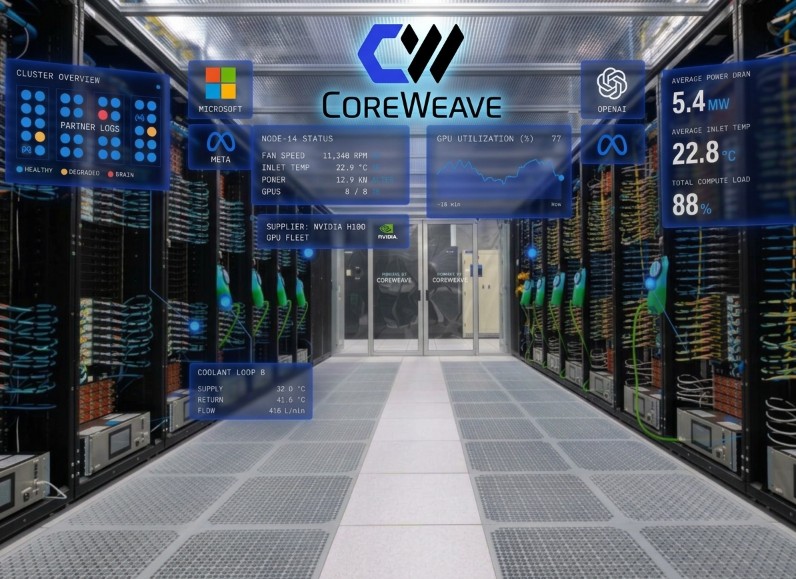
The AI infrastructure market is showing a split. Equity investors are focused on hypergrowth, while credit markets are pricing in near term financing costs. For CoreWeave (CRWV), a leader in the specialized AI cloud space, that gap raises a clear question: how does a company with massive demand turn it into financial strength?
The answer is already visible. CoreWeave reported a $104 billion contract backlog, and the company has several practical tools to convert that backlog into a stronger balance sheet.
1. Why CoreWeave Demand Is Not the Problem
Few companies can say their growth is already contracted years ahead.
- Record backlog: Contracted revenue reached $104 billion at the end of Q2, with more than $25 billion in new commitments added shortly after.
- Capacity nearly sold out: Management says capacity through 2027 is almost fully booked, and customers are already reserving space for 2028 to 2030.
- Top tier customers: Multibillion dollar commitments from Microsoft, Meta, and OpenAI validate the demand.
When customers line up years in advance, a company has real leverage in how it structures its financing.
2. Turning Backlog Into Cash Flow
Multi year compute contracts turn into revenue gradually, over 3 to 5 years, as data center capacity comes online. As more capacity goes live, the revenue base grows and the financing picture improves with it. The $51.9 billion in total debt and lease obligations funded the buildout of that capacity, and the contracts behind it support the repayment.
3. The CoreWeave Toolkit for the 2026 to 2027 Window
CoreWeave has several ways to bridge the gap between near term maturities and long term contract payoffs:
- Customer prepayments: Large upfront cash from customers, a model peers like IREN use, can fund buildouts without adding more high yield debt. With demand this strong, CoreWeave is well positioned to ask for it.
- Nvidia ecosystem support: As a key hardware partner, Nvidia has a stake in a healthy GPU market, so collateral support or equity linked financing is a realistic option.
- Equity and convertibles: Share offerings or convertible bonds dilute existing holders, but they offer a direct way to pay down senior debt and reduce interest costs.
- Refinancing on better terms: As contracted revenue turns into reported cash flow, lenders get more evidence that the backlog is real, which can open the door to lower cost debt over time.
The $10.6 billion due over the next 24 months is sizable, but it sits against a $104 billion backlog.
4. Looking at CoreWeave Through a Fundamental Lens
Credit matters, but it helps to separate two kinds of problems.
Credit is something every company has to manage. It is a controllable element, handled through refinancing, prepayments, equity raises, and better contract terms. A business with strong demand has more ways to fix it than a business without demand.
What actually breaks a long term investment case looks different:
- Fraud or accounting problems: Trust in the numbers is gone.
- Revenue and growth rolling over: Demand is fading.
- Earnings per share falling quarter after quarter: The business is getting weaker, not just more expensive to finance.
- Rising debt with no progress: More borrowing, but no new capacity, customers, or revenue to show for it.
Right now, none of these is the story. Revenue is growing, backlog is expanding, and new debt is going toward capacity that customers have already contracted for.
The current credit stress also looks more like a macro problem than a company problem. High inflation and high interest rates put pressure on any high growth company that funds expansion with debt. That pressure tends to ease as rates settle, and it hits fast growers hardest before the cash flows arrive.
So I do not see this as the time to sell. The signals that would change my mind are about the business itself, not the temporary cost of financing it.
5. Why the Market Is Still Moving in CoreWeave’s Favor
CoreWeave is part of a broader shift in AI cloud infrastructure, where scarce capacity is gaining value.
| Leveraged neoclouds (e.g., CoreWeave) | Vertically integrated infrastructure (e.g., NBIS, IREN) | |
|---|---|---|
| Strength | Fast deployment and deep customer relationships | Direct control of power and data center capacity |
| Growth driver | Hyperscalers leasing capacity as fast as it comes online | Premium pricing on scarce megawatt capacity |
| Next step | Convert backlog into cash flow and lower financing costs | Scale within grid interconnection timelines |
Both models benefit from the same trend: demand for compute is outrunning supply.
The Bottom Line
Demand for CoreWeave is clear, and hyperscalers are leasing capacity as fast as it can be deployed. A $104 billion backlog gives the company real negotiating power with customers, partners, and lenders.
Credit is a real element to watch, but it is a solvable one. The things that would make me sell are fraud, shrinking revenue and growth, steadily falling earnings, or more debt without progress. Until I see those, I treat the credit stress as a high rate environment problem, not a broken business.
For long term investors, the key things to watch are how much of the backlog converts into revenue, whether customer prepayments become part of new deals, and how the refinancing window plays out. If CoreWeave executes, the same backlog that looks heavy today could become the foundation of a much stronger balance sheet.
Disclosure: The author has no position in $CRWV and no commercial relationship with the company
Sources: CoreWeave
Leave a Reply