Tag: AI

  • Nvidia’s CEO Says Memory and Neocloud Demand Are Fine. Here Is What Investors Should Weigh

    Nvidia’s CEO Says Memory and Neocloud Demand Are Fine. Here Is What Investors Should Weigh

    Nvidia neocloud demand is “off the charts,” according to Jensen Huang, who spoke with CNBC at GTC Berlin on Thursday. He also took on fears of a memory glut. His message on both was that demand is strong, though investors should remember he runs the company selling into both markets.

    Memory: no glut in sight

    Huang said a surplus of memory supply is unlikely by 2029, despite a sell off in memory stocks over the past week. SK Hynix, Samsung and Micron took a hit after a South Korean opinion column warned of a “red ocean” of excess supply, meaning tougher competition and slimmer profits. The selloff was also driven by China’s CXMT announcing a new design architecture that could lead to greater efficiencies. Nvidia’s Jensen Huang says he sees no sign of a 2029 memory glut: ‘You can always use more’ +2

    Huang’s answer was simple: memory is something you can always use more of. He said HBM will stay in use for many years and that Nvidia plans to keep using large amounts of LPDDR, the memory type found in phones, in data centers. He said that LPDDR approach delivers performance at half the energy per unit of work of any alternative. Jensen Huang pushed back on 2029 memory glut fears amid stock selloff +2

    Asked about CXMT specifically, he said Nvidia is open minded and noted that nearly the whole world works with Chinese companies somewhere in the supply chain. He also said U.S. regulations have accelerated China’s efforts to build domestic chips.

    The takeaway for investors: a glut call is really a supply call. Huang is a big buyer vouching for demand, but the bear case rests on new capacity, including from Chinese producers. Memory has always been a cyclical business, and one CEO’s forecast three years out does not change that.

    Nvidia neocloud demand: money is the bottleneck

    On the neocloud side, Huang said the demand for neoclouds is off the charts and their capabilities are extraordinary, but the working capital to fund that growth is missing. In his words, the demand for capital is much greater than its availability, and he expects that to get solved. He framed it as a scarcity of capital rather than weak demand, because so many AI sectors are competing for the same money. Nvidia’s Jensen Huang Wants AI Chips To Be A ‘Financeable Asset,’ Says Neocloud Demand Is ‘Off The Charts’ +2

    He also pointed to a second constraint. Power is a limiting factor, especially in Europe where electricity costs more, and he argued scarce power should go to companies like Nebius and Mistral if they are to scale.

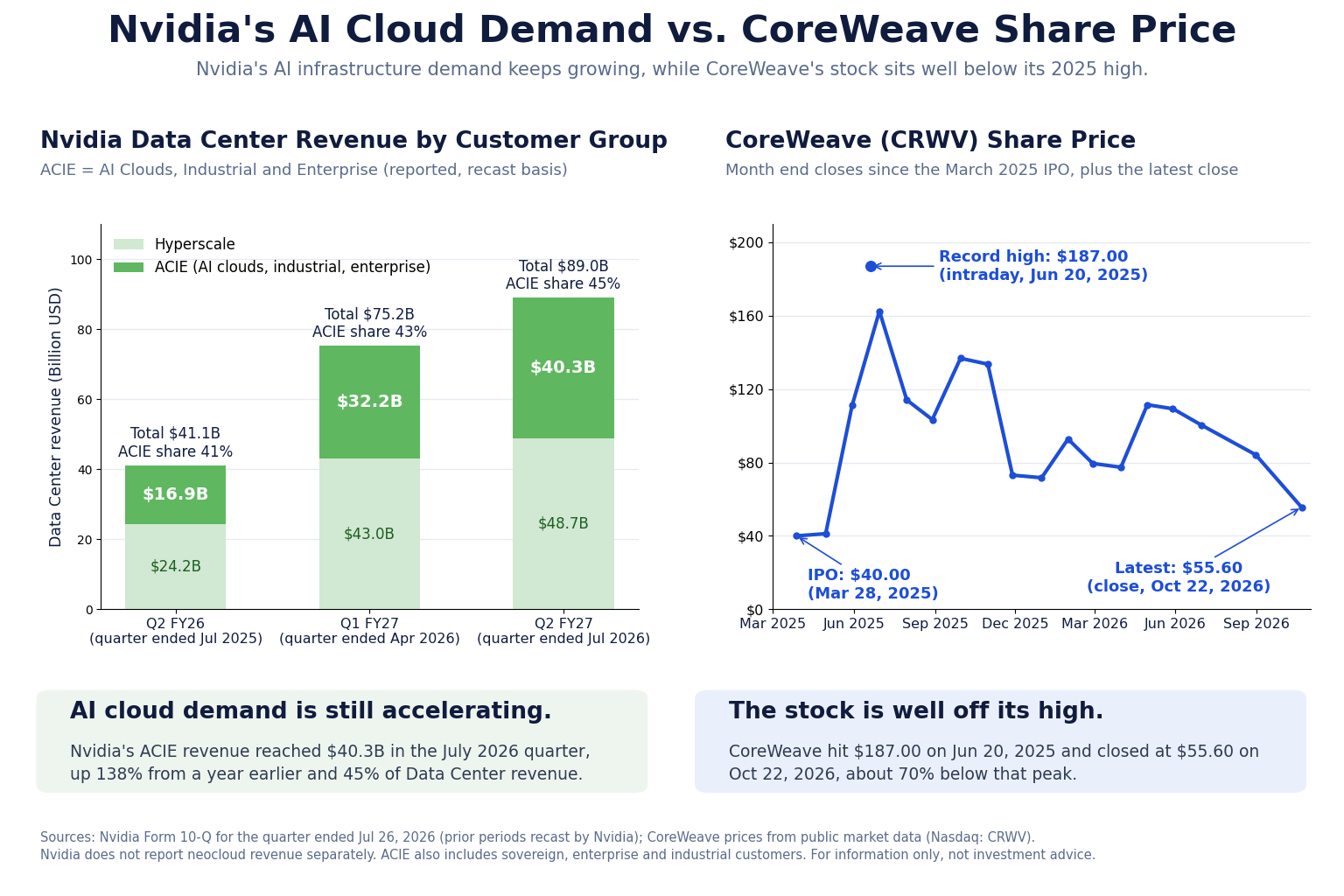
    The market was not reassured. Ahead of Thursday’s open, Nebius fell 3.6%, CoreWeave slipped 4%, and Iren and Applied Digital each dropped nearly 4%. CoreWeave shares are down 50% over six months, even as Nvidia invested another $2 billion in the company in January.

    Huang’s bigger pitch is about financing itself. He said Nvidia is trying to establish its compute as a financeable asset, because its residual value is durable enough to become an asset class. If lenders buy that, the capital gap narrows. If they do not, the gap stays.

    The other side of the story

    Critics see a circular loop. The Information reported that Nvidia is increasingly acting as lender and backstop for the neoclouds that buy its chips, that its AI Compute Partnership is being restructured after established neoclouds such as Nebius pushed back, and that its credit default swap spreads have roughly doubled in recent months, though its credit rating remains near the top.

    One widely shared critique compares Nvidia to GE Capital rather than Enron, arguing that its customers are driven by fear of missing out and that its growth requires perpetual acceleration. That is an opinion piece, not a finding, but it names the risk. Huang himself said in April that these neoclouds would not exist without Nvidia’s support.

    What I am watching

    First, whether lenders accept GPUs as collateral worth financing, since that is the stated fix for the capital gap. Second, credit signals around Nvidia and the neoclouds, such as spreads and bond pricing, which often move before equities do. Third, how fast new memory supply actually arrives compared with what Huang expects.

    Huang can be right about demand and investors can still lose money if the financing breaks first. Strong demand does not guarantee that every company serving it survives its debt.

  • CoreWeave’s $104B Backlog and the Path Through the Refinancing Window

    CoreWeave’s $104B Backlog and the Path Through the Refinancing Window

    The AI infrastructure market is showing a split. Equity investors are focused on hypergrowth, while credit markets are pricing in near term financing costs. For CoreWeave (CRWV), a leader in the specialized AI cloud space, that gap raises a clear question: how does a company with massive demand turn it into financial strength?

    The answer is already visible. CoreWeave reported a $104 billion contract backlog, and the company has several practical tools to convert that backlog into a stronger balance sheet.

    1. Why CoreWeave Demand Is Not the Problem

    Few companies can say their growth is already contracted years ahead.

    • Record backlog: Contracted revenue reached $104 billion at the end of Q2, with more than $25 billion in new commitments added shortly after.
    • Capacity nearly sold out: Management says capacity through 2027 is almost fully booked, and customers are already reserving space for 2028 to 2030.
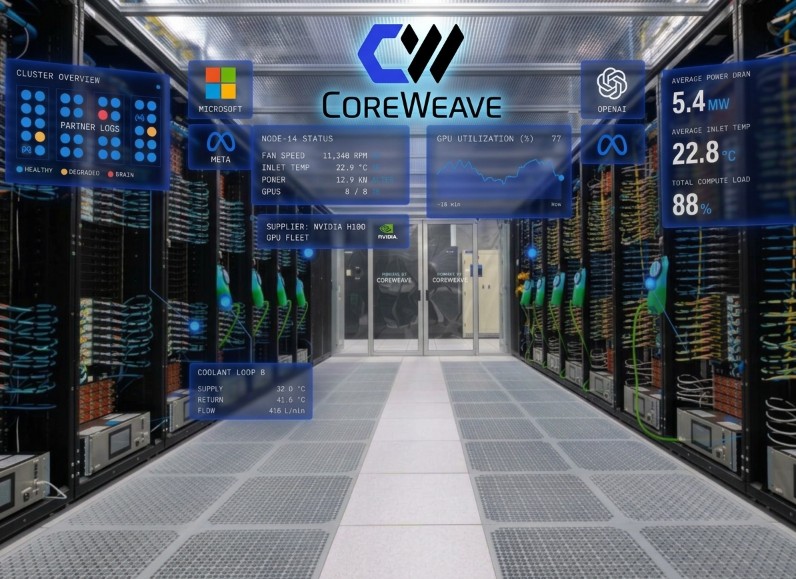
    • Top tier customers: Multibillion dollar commitments from Microsoft, Meta, and OpenAI validate the demand.

    When customers line up years in advance, a company has real leverage in how it structures its financing.

    2. Turning Backlog Into Cash Flow

    Multi year compute contracts turn into revenue gradually, over 3 to 5 years, as data center capacity comes online. As more capacity goes live, the revenue base grows and the financing picture improves with it. The $51.9 billion in total debt and lease obligations funded the buildout of that capacity, and the contracts behind it support the repayment.

    3. The CoreWeave Toolkit for the 2026 to 2027 Window

    CoreWeave has several ways to bridge the gap between near term maturities and long term contract payoffs:

    • Customer prepayments: Large upfront cash from customers, a model peers like IREN use, can fund buildouts without adding more high yield debt. With demand this strong, CoreWeave is well positioned to ask for it.
    • Nvidia ecosystem support: As a key hardware partner, Nvidia has a stake in a healthy GPU market, so collateral support or equity linked financing is a realistic option.
    • Equity and convertibles: Share offerings or convertible bonds dilute existing holders, but they offer a direct way to pay down senior debt and reduce interest costs.
    • Refinancing on better terms: As contracted revenue turns into reported cash flow, lenders get more evidence that the backlog is real, which can open the door to lower cost debt over time.

    The $10.6 billion due over the next 24 months is sizable, but it sits against a $104 billion backlog.

    4. Looking at CoreWeave Through a Fundamental Lens

    Credit matters, but it helps to separate two kinds of problems.

    Credit is something every company has to manage. It is a controllable element, handled through refinancing, prepayments, equity raises, and better contract terms. A business with strong demand has more ways to fix it than a business without demand.

    What actually breaks a long term investment case looks different:

    • Fraud or accounting problems: Trust in the numbers is gone.
    • Revenue and growth rolling over: Demand is fading.
    • Earnings per share falling quarter after quarter: The business is getting weaker, not just more expensive to finance.
    • Rising debt with no progress: More borrowing, but no new capacity, customers, or revenue to show for it.

    Right now, none of these is the story. Revenue is growing, backlog is expanding, and new debt is going toward capacity that customers have already contracted for.

    The current credit stress also looks more like a macro problem than a company problem. High inflation and high interest rates put pressure on any high growth company that funds expansion with debt. That pressure tends to ease as rates settle, and it hits fast growers hardest before the cash flows arrive.

    So I do not see this as the time to sell. The signals that would change my mind are about the business itself, not the temporary cost of financing it.

    5. Why the Market Is Still Moving in CoreWeave’s Favor

    CoreWeave is part of a broader shift in AI cloud infrastructure, where scarce capacity is gaining value.

    Leveraged neoclouds (e.g., CoreWeave)Vertically integrated infrastructure (e.g., NBIS, IREN)
    StrengthFast deployment and deep customer relationshipsDirect control of power and data center capacity
    Growth driverHyperscalers leasing capacity as fast as it comes onlinePremium pricing on scarce megawatt capacity
    Next stepConvert backlog into cash flow and lower financing costsScale within grid interconnection timelines

    Both models benefit from the same trend: demand for compute is outrunning supply.

    The Bottom Line

    Demand for CoreWeave is clear, and hyperscalers are leasing capacity as fast as it can be deployed. A $104 billion backlog gives the company real negotiating power with customers, partners, and lenders.

    Credit is a real element to watch, but it is a solvable one. The things that would make me sell are fraud, shrinking revenue and growth, steadily falling earnings, or more debt without progress. Until I see those, I treat the credit stress as a high rate environment problem, not a broken business.

    For long term investors, the key things to watch are how much of the backlog converts into revenue, whether customer prepayments become part of new deals, and how the refinancing window plays out. If CoreWeave executes, the same backlog that looks heavy today could become the foundation of a much stronger balance sheet.

    Disclosure: The author has no position in $CRWV and no commercial relationship with the company

    Sources: CoreWeave

  • Celestica (CLS): The Company Solving the Demand for AI Compute Systems

    Celestica (CLS): The Company Solving the Demand for AI Compute Systems

    Celestica is not a name most people talk about at dinner. But if you follow AI stocks, it should be on your list. The latest numbers are strong, and the story has some twists too, including a big share sale in August.

    cls rack

    What does Celestica do?

    Celestica is a Toronto based company that designs and builds hardware for data centers. Its biggest unit, Connectivity and Cloud Solutions, covers networking switches, AI compute systems, and storage for the largest cloud companies. The smaller unit, Advanced Technology Solutions, serves aerospace, defense, industrial, health tech, and capital equipment customers.

    Think of it as the company that builds the pipes and racks inside AI data centers.

    celestica revenue growth

    Celestica’s latest quarter

    Celestica reported Q2 2026 results on July 27. Revenue hit $4.70 billion, up 62% from $2.89 billion a year earlier. Q1 revenue was $4.05 billion, so revenue grew about 16% from one quarter to the next.

    celestica eps growth

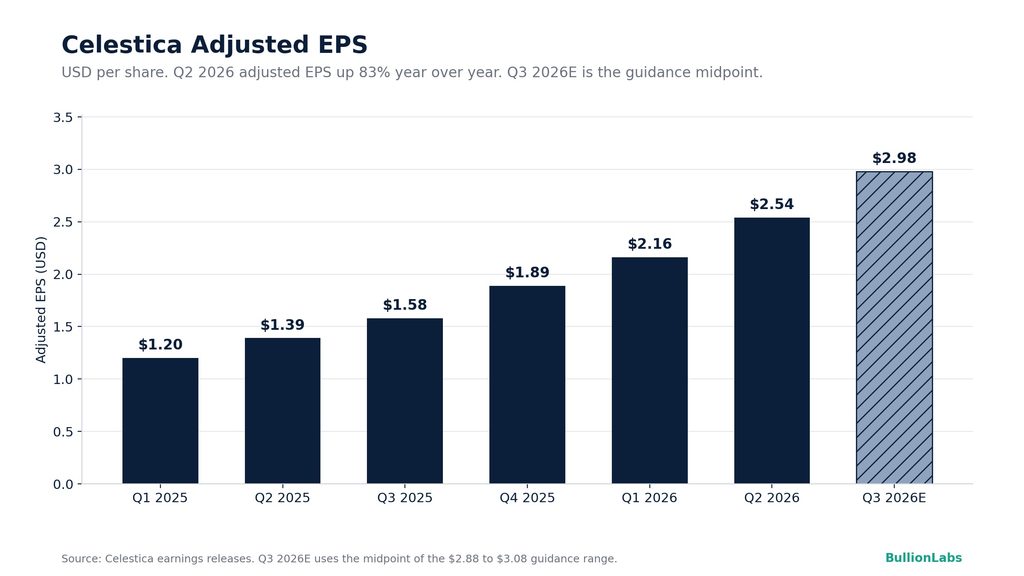
    Earnings per share followed the same path. Adjusted EPS was $2.54, compared to $1.39 a year ago. In Q1 it was $2.16, so EPS grew roughly 18% quarter over quarter and 83% year over year. GAAP EPS was $3.17, but part of that came from a swap gain, so the adjusted number is the cleaner one to watch.

    celestica cash flow

    How is the cash flow?

    It improved. Cash from operations was $410.9 million in Q2, up from $152.4 million a year ago. Free cash flow was $147.1 million, up from $119.9 million. It did not rise as fast because spending on equipment jumped.

    For the year, management now expects free cash flow of $600 million, up from $500 million.

    Celestica spending, funding, and cash runway

    Growth costs money. Celestica plans about $1 billion of capital spending in 2026 and is expanding sites in Thailand, Japan, and Texas. A rough placeholder for 2027 is $1.5 billion. Spending is already running at about $260 million per quarter.

    At the end of June, cash was $535.7 million, against roughly $810 million of borrowings. Then came the big move. In August, Celestica priced an equity offering of 9,677,419 shares at $310 each, for about $3 billion. The money is meant for working capital and capital spending.

    My math: the raise roughly covers the planned 2026 and 2027 spending combined, so cash runway is not a worry. The cost is dilution of about 8% in share count. The stock dropped after the news.

    Technology: near term, long term, and the goal

    Short term, the story is faster networking. The CEO said there are 10 active 1.6T programs, while 800G and 400G products keep growing. The 1.6T programs begin production in the second half of 2026.

    Long term, the bigger prize is AI compute. Management pointed to new programs with OpenAI, AMD, and Broadcom, including custom accelerator racks. Management expects these to scale in 2027.

    The goal is clear. Celestica wants to be a core design and build partner for AI data centers, not just a contract assembler. The CEO said capacity planning is already set for 2026 and 2027.

    Is it on track? So far, yes. Q2 revenue and adjusted EPS both landed above the high end of guidance. Back in October 2025, the 2026 outlook was $16 billion in revenue. It is now $20.5 billion. The main limit is not demand. It is component supply.


    Supply is the part to watch. Celestica says demand is not the problem, parts are. AI compute systems need a lot of memory, and memory makers know it. Many of them are now signing long term agreements to lock in customers for years. That shows how tight supply is across the AI chain. It also explains why Celestica has to plan its capacity so far ahead.

    Guidance

    Near term, Q3 revenue is guided to $5.25 billion to $5.55 billion, with adjusted EPS of $2.88 to $3.08.

    celestica outlook backlog

    For the full year, the outlook is $20.5 billion in revenue, $11.30 in adjusted EPS, and an 8.4% adjusted operating margin. That implies growth of 65% in revenue and 87% in EPS.

    Longer term, management expects 2027 revenue growth to beat 65%, with EPS growing even faster. There is no formal target past 2027.

    celestica ownership pie

    What are institutions doing?

    Big money is clearly involved. MarketBeat shows institutions own about 67% of the stock, and 606 institutions held shares over the past two years. They bought about 47 million shares in the last 24 months.

    Why Celestica may be worth a look

    Growth is the first reason. Revenue is up 62% and still accelerating, with guidance pointing to even faster growth in 2027.

    Quality is the second. Margins are at record highs, and the return on invested capital was 55.5% in Q2 on the company’s own measure.

    Funding is the third. Free cash flow is positive, and the $3 billion raise removes most financing worries.

    Visibility is the fourth. Ten separate 1.6T programs spread the risk across many projects instead of one.

    celestica price targets

    Celestica stock price targets from Wall Street

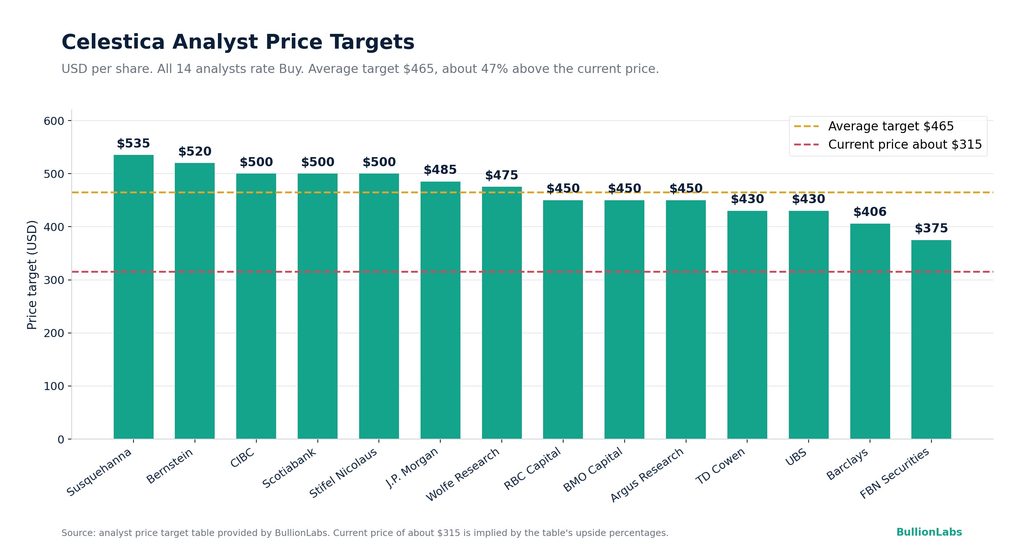
    Wall Street is bullish on Celestica. Every analyst in my table rates it a Buy.

    The highest target is $535 from Susquehanna. The lowest is $375 from FBN Securities. The average sits near $465, about 47% above the recent price.

    Targets are opinions, not promises, so keep watching the next earnings report.

    What to watch

    Dilution is real. Component shortages could slow shipments. Customers are concentrated among a few giant cloud and AI names, so a pullback in their spending would hit hard. Leadership is also changing, with a new structure starting October 1.

    Q3 results are due soon, so the next update will test whether the guidance holds.

    Disclosure: The author holds a long position in $CLS stock at the time of writing

    Sources: Investing.com, Celestica, Tradingview, MarketBeat

  • Memory Chip Makers Are Locking In Customers for Years. Here Is What the Deals Actually Say

    Memory Chip Makers Are Locking In Customers for Years. Here Is What the Deals Actually Say

    Memory has a famous habit. Prices soar, makers build too much, prices crash, and everyone suffers. A table of memory chip long term agreements from the biggest memory makers suggests the industry is trying to break that pattern.

    memory lta agreements at a glance

    One note on the data first. Micron’s figures are as of the third quarter of calendar 2026, while the others are as of the second quarter.

    Real money is changing hands

    Micron reports US$32 billion in deposits and commitments, up from US$22 billion at the second quarter, plus about US$150 billion in remaining contract value from its signed agreements. An unnamed US NAND maker reports US$59.8 billion in remaining contract value at quarter end, rising to US$91.1 billion once contracts signed after quarter end are included. It also cites US$16.8 billion in financial guarantees, but those are mostly held by or through third party institutions, so they are not the same as cash in the bank. Samsung says it has received about a quarter of its prepayments so far, with more expected. SK hynix says deposits are part of its contracts but gives no amounts.

    Chart of remaining contract value and share of volume covered by long term agreements

    Price floors, and sometimes ceilings

    Samsung has set a minimum price floor for mainstream products, designed to reduce future investment risk. The US NAND maker uses a mix of fixed and variable pricing, where the variable part has both a floor and a ceiling, and it says gross margin stays around 80% even at trough pricing. Micron said in the second quarter that it had a guaranteed gross margin above any prior cycle peak. SK hynix describes a pricing band to cope with volatility, but says pricing will not be uniform across customers.

    The ceilings matter. Customers are getting protection too, so part of the upside is capped.

    How long, and how binding

    Micron’s agreements run through 2031, with five years for data center and consumer customers and three years for automotive. Samsung’s are five years but renegotiated annually on a rolling basis. SK hynix averages about five years, and the US NAND maker offers up to five years with a weighted average above four.

    How binding they are also differs. Micron explicitly uses take or pay with binding volume commitments. Samsung and Kioxia describe binding contract terms for both sides. SK hynix talks about long term volume commitments plus deposits. The US NAND maker sets supply commitments each year by quarter. So “locked in” means different things at different companies.

    Coverage is still partial

    In the second quarter, Micron’s agreements covered about 20% of DRAM shipments and about a third of NAND shipments. It expects about 35% of revenue to be covered by 2030, with a goal of 50%. Samsung puts coverage at 60 to 70% of capacity, with agreements finalized with its top five data center customers and five more in final stages. The US NAND maker expects about half of bit volume covered in its fiscal 2027 and two thirds in 2028, and Kioxia targets 50% of shipments by calendar 2028. The spot market still matters.

    Where the demand comes from

    Most of it is data center and AI related. SK hynix lists server DRAM, HBM and enterprise SSD, Samsung is HBM focused, and Kioxia and the US NAND maker name hyperscale and AI infrastructure customers. Micron also includes consumer and automotive.

    What the table does not tell you

    It says nothing about whether customers can afford to honor these deals if demand weakens, or how firmly each clause would hold up. It is a snapshot from company data, not a guarantee.

    My takeaway

    These agreements give memory makers more visibility and some downside protection than they had in past cycles. But the coverage is partial, the terms vary, and some of the upside is capped. I would call it a smoother ride, not the end of the cycle.

    Want more on the companies behind these agreements? Here are my earlier posts:

    And for the demand side, the AI infrastructure buildout that these contracts are meant to serve:

    Disclosure: The author holds a long position in $MU and $SKHY stock at the time of writing.