Micron closed at $977.50 on September 17, 2026. That’s up 5.5% on the day. In fact, the stock has been on a wild run this year, and the analyst notes keep piling up in its favor.
Analysts Are Overwhelmingly Bullish
Since the last earnings report on June 24th, most major firms have either reiterated or raised their price targets on $MU. Out of the 27 ratings tracked here, only Goldman Sachs is sitting on a Hold. Meanwhile, everyone else has a Buy.
The targets are spread pretty wide. For instance, Melius Research is the most bullish at $2,200. Similarly, Cantor Fitzgerald, Barclays, and Susquehanna are all sitting at $2,000. A lot of firms bumped their numbers up fast over the summer. As an example, Barclays went from $1,175 to $2,000. Likewise, Phillip Securities jumped from $530 all the way to $1,870. Even Melius itself moved from $1,100 to $2,200 in just a few months.
The Real Story Is Memory
The bigger story behind all this is memory. To begin with, Nvidia confirmed it’s raising AI server prices by more than 15%, and the reason is simple. Server DRAM roughly doubled in price during Q1 2026. In addition, some reports show an 80 to 90% jump across DRAM, NAND, and HBM in that same stretch.
Micron sits right in the middle of this. Along with Samsung and SK Hynix, it’s one of only three companies that actually make the high bandwidth memory these AI chips need. As a result, that gives it real pricing power. Furthermore, analysts expect this shortage to stick around too. Gartner sees it lasting into 2027, while Deloitte thinks AI server DRAM prices could roughly quadruple this year.
Demand Keeps Outpacing Supply
There’s a demand side to this too. For example, Nebius, an AI cloud provider, has been benefiting from rising GPU rental rates, with H100 pricing up about 20% year to date. Overall, it’s another sign that compute demand is outpacing supply across the board, which only adds more pressure on the memory side where Micron plays.
The Takeaway
Put it all together and the setup looks straightforward. Heavy AI demand is pushing up GPU and server prices. Consequently, that’s tightening memory supply. Ultimately, that’s putting Micron in a strong position heading into the rest of the year.
Every few years, a new company promises to fix the battery problem that lithium ion cannot solve. Most fade. Eos Energy Enterprises (NASDAQ: EOSE) is different. It has gotten products into the ground. It has built a factory. It has started signing serious contracts. And it is doing all of this on a chemistry almost nobody else is scaling: zinc.
This piece covers what the company does, why AI data center developers are suddenly paying attention, and where the business stands today. It draws on the company’s own filings and recent reporting, not investor hype.
What Eos Energy Actually Does
Eos was founded in 2008. The company is now headquartered in Pennsylvania, after relocating from Edison, New Jersey. Eos designs, manufactures, and sells long duration battery energy storage systems, usually shortened to BESS. In plain terms, these are large batteries. Utilities, industrial sites, and commercial customers use them to store electricity and release it over several hours, rather than seconds or minutes.
The Znyth Chemistry
A zinc based aqueous battery, called Znyth, sits at the core of the technology. It powers the company’s newest battery module, the Z3. Znyth uses just five commodity materials. None of them are rare earth or conflict minerals, and that sets it apart from lithium, cobalt, and other materials that are often imported and geopolitically sensitive.
The process is simple to describe. During charging, zinc deposits onto the battery’s electrodes. During discharge, it dissolves back into the electrolyte. Engineers have understood this electrochemical idea for decades. Eos spent years turning it into something that can be manufactured at volume and sold at a competitive price.
The Product Line
The finished systems carry names like the Eos Cube, Hangar, and Indensity. Eos builds them for 3 to 16 plus hour discharge windows. The industry generally calls this long duration or mid duration storage.
What Makes the Technology Different
Lithium ion dominates the battery storage market today. Tesla, Fluence, CATL, and Sungrow control the large majority of installed capacity worldwide. Lithium performs well at short bursts, typically two to four hours. But it hits real limits past that window. Cost per stored megawatt hour climbs. Fire risk becomes a bigger operational concern at scale. And the supply chain runs mostly through overseas mining and processing.
Eos pitches zinc as a direct answer to those pain points. A few things stand out.
Safety and Durability
The system is non flammable. Its aqueous, water based chemistry avoids the thermal runaway risk that defines lithium ion. That means the Z3 skips the costly fire suppression and active cooling equipment that lithium installations typically require.
The battery also holds up over time. Eos rates its cells for roughly 6,000 charge and discharge cycles, which works out to about 20 to 25 years of service. The company says the batteries deliver full depth of discharge with very little capacity fade as the years go on.
Domestic Sourcing and Incentives
Eos builds and sources the batteries entirely in the United States. That qualifies them for domestic content rules and for federal incentives, including the Section 45X production credit and the Section 48E investment tax credit under the Inflation Reduction Act. Together, these credits are worth an estimated 90 million dollars or more per 2 GWh production line each year.
The systems are also simpler to run day to day. They need no active thermal management, they tolerate a wide operating temperature range, and they carry lower ongoing maintenance overhead than a lithium fleet of similar size.
None of this makes zinc a universal replacement. Lithium still wins on very short, high power bursts. Eos is chasing the multi hour middle ground instead, roughly 4 to 16 plus hours of discharge. That happens to be exactly what grid operators, utilities, and increasingly data centers are short on.
The AI and Data Center Angle
AI data centers pull enormous, sustained amounts of power. The U.S. Energy Information Administration expects power demand to hit record highs in both 2026 and 2027, largely because of AI driven load growth. Global data center electricity demand could roughly triple by 2030.
The real challenge for hyperscalers is not simply finding more electricity. It is finding firm, reliable, long duration capacity fast, often faster than the traditional grid interconnection process can deliver. That challenge lines up naturally with what Eos already builds. AI workloads need power for longer stretches than lithium’s two to four hour profile comfortably covers, and they need it now rather than in five years.
How Eos Is Capturing This Demand
Eos has gone after AI power demand in two main ways.
First, data center customers now make up roughly a fifth of the company’s total commercial pipeline. That segment barely existed for Eos two years ago.
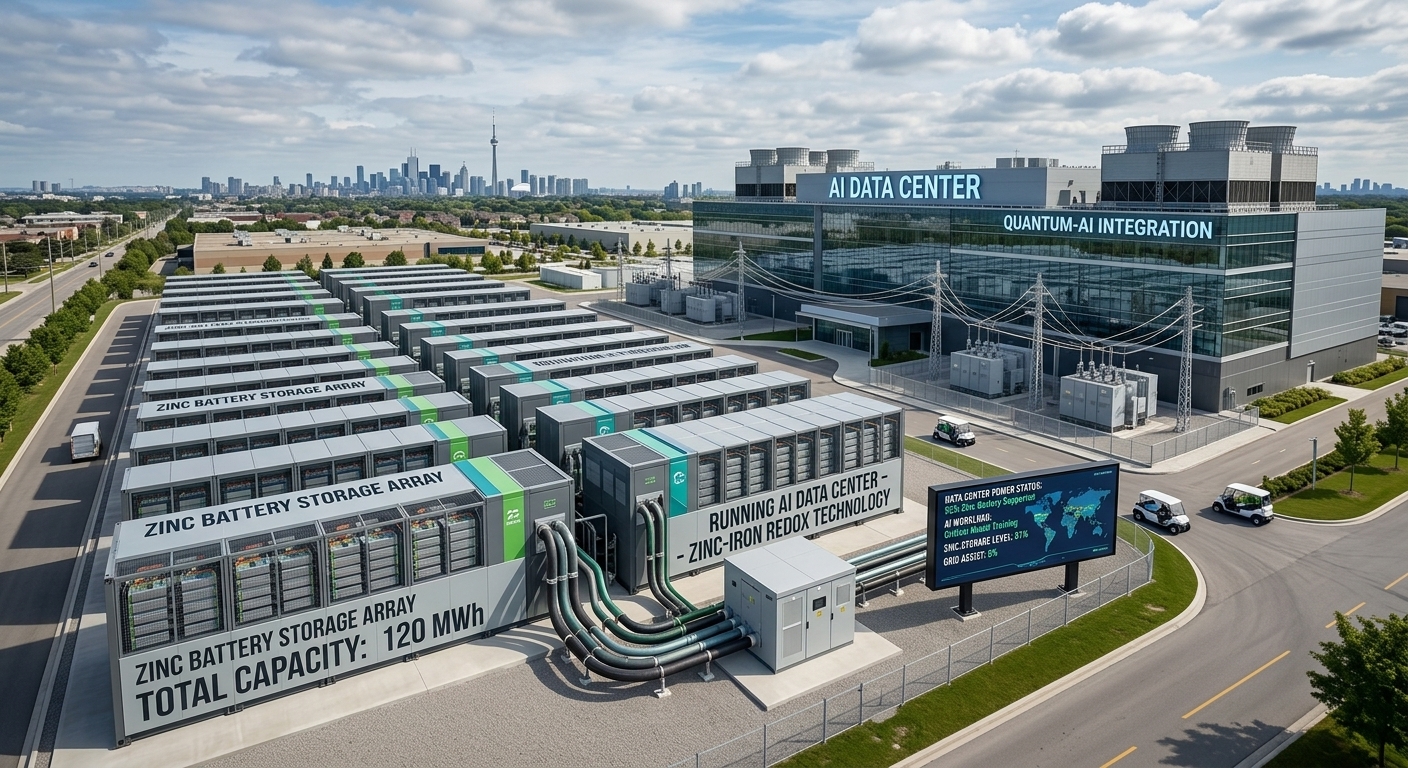
Second, in April 2026, Eos signed a joint development agreement with TURBINE-X Energy. The partnership builds behind the meter private power infrastructure for AI data centers, pairing gas fired generation with Eos’s Indensity battery architecture. The goal is firm, dispatchable, on site power delivered in months rather than years. TURBINE-X is targeting up to 2 GWh of Eos battery storage across a 36 month rollout, with initial deployments expected in 2027. Eos CEO Joe Mastrangelo has called AI data center demand an accelerant for the company’s business.
This positions Eos alongside much bigger players serving hyperscale data centers, names like NextEra Energy Resources and Fluence Energy. That is a real jump in visibility for a company that, until fairly recently, was mostly known as a struggling grid storage upstart.
Production and Manufacturing
Eos manufactures in Pennsylvania, mainly at its Thorn Hill facility in Marshall Township, near Pittsburgh. The company commissioned a second battery production line there in mid 2026, and it already runs faster cycle times and higher yields than the first line. Eos is consolidating manufacturing into Thorn Hill specifically to cut conversion costs. The facility is targeting roughly 4 GWh of annual production capacity by the end of 2026.
A separate U.S. Department of Energy Loan Programs Office loan guarantee, worth up to roughly 305 million dollars, is financing two additional manufacturing lines for next generation zinc bromine systems. Eos could add two more lines on top of that, for four in total, across Turtle Creek and Duquesne, Pennsylvania. The DOE says this build out could reach over 8 GWh of annual storage capacity by 2026, enough to instantaneously power more than 300,000 average U.S. homes.
Costs are moving in the right direction too. Eos reported a 12.5 percent material cost reduction on the Z3 product. It achieved that reduction in under a year through supplier renegotiation and simpler design choices.
Backlog, Pipeline, and Financials
Looking at the most recent reporting from Q2 2026, a few numbers stand out.
Backlog and Pipeline
Backlog sits at approximately 807 million dollars. That figure is up 25 percent from the prior quarter and 20 percent year over year, representing 3.4 GWh of contracted storage capacity. It is a company record.
The commercial opportunity pipeline tells a similar story. It includes proposals and letters of intent rather than signed contracts, and it has grown to approximately 24.6 billion dollars. That is up 31 percent year over year, spanning roughly 112 GWh across utility, industrial, commercial, and data center customers.
Think of the pipeline as a measure of demand in the room. The backlog is the portion of that demand actually locked into paper. The chart below shows how the pipeline has grown over the past year.
Revenue and Guidance
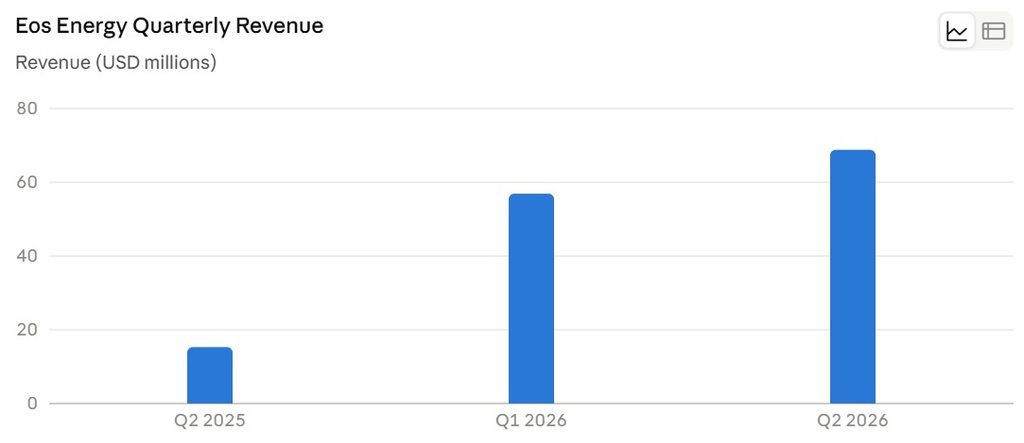
Revenue reached 68.8 million dollars in Q2 2026 alone, up 351 percent year over year. First half 2026 revenue of 125.7 million dollars already surpassed everything the company brought in during all of 2025. Full year 2026 guidance was tightened to a range of 300 to 350 million dollars, down from a prior 300 to 400 million dollar range. Eos attributes the change mainly to its planned manufacturing consolidation into Thorn Hill.
Cash, Losses, and Frontier Power USA
Cash on hand stood at approximately 364 million dollars as of June 30, 2026, including restricted cash. Profitability, though, remains a real problem. Q2 2026 gross margin came in around negative 71 percent. The net loss for the quarter reached 275.7 million dollars, driven mostly by fair value accounting adjustments, and the adjusted EBITDA loss came in at 71.4 million dollars. Eos is scaling its top line quickly while still burning a lot of cash to get there.
One structural piece worth understanding is Frontier Power USA, often shortened to FPUSA. Eos formed this joint venture with Cerberus Capital Management and Hudson Bay Capital Management. FPUSA raised 263 million dollars to support an estimated 1 billion dollars in project deployment capital. It acts as a financing arm that turns Eos’s project pipeline into built, operating assets faster than Eos could fund on its own. FPUSA has already converted its first purchase order, the Redbird project in Texas, against a 2 GWh capacity reservation agreement it holds with Eos.
Well Known Customers and Contracts
The customer base spans utilities, renewable developers, and, more recently, data center infrastructure players.
Bridgelink Investments, also known as Bridgelink Commodities, is a large renewable developer with more than 8 GW of projects in development. It holds a 1 GWh master supply agreement with Eos tied to grid resilience and energy curtailment recapture in the ERCOT market in Texas.
Frontier Power USA is the co funded joint venture described above. It holds a 2 GWh firm capacity reservation agreement plus a broader 12 to 16 GWh development pipeline across ERCOT, PJM, CAISO, and MISO.
Duke Energy was an early pilot customer, going back to a 1 MW, 4 MWh installation in 2019. It later became a booked order customer as well. Ameresco, Blue Ridge Power, Pine Gate Renewables, and Center Line Electric placed booked orders during the company’s earlier growth phase. TURBINE-X Energy is the joint development partner for AI data center power infrastructure. And Verdant Microgrid was an early microgrid deployment partner in California, back when the whole platform was much smaller.
The Road Ahead
Eos sits at an inflection point. On the surface, this looks like a boring hardware business. Underneath, there is real backlog growth, a large and diversifying demand pipeline, a factory that is actually scaling, and a policy backdrop that currently favors domestic, non lithium chemistries. Independent analysts have floated a wide range of outcomes here, from a modest re rating if the company simply keeps executing, to a meaningfully higher valuation if pipeline conversion speeds up and margins finally turn positive.
The risks are just as real, and worth stating plainly. Eos is still losing significant money on every dollar of revenue. It remains reliant on capital markets to fund its growth. It has faced a securities fraud lawsuit tied to past manufacturing execution problems. And it depends on a fairly small number of large customers and financing partners, FPUSA among them, for near term revenue. Scaling automated battery manufacturing lines is genuinely difficult work, and Eos has stumbled on execution before.
Still, the bigger trend behind all of this is not going away anytime soon. AI driven power demand keeps climbing. The grid badly needs longer duration storage. U.S. industrial policy keeps pushing toward domestic battery manufacturing. Whether Eos ends up capturing that opportunity at real scale, or just one of several companies competing for a slice of it, probably depends less on the chemistry itself. The chemistry does appear to genuinely work. It depends more on whether the team can keep turning its growing pipeline into profitable, delivered projects.
The world’s top AI memory supplier is riding an unprecedented upcycle and already eyeing what comes after data centers.
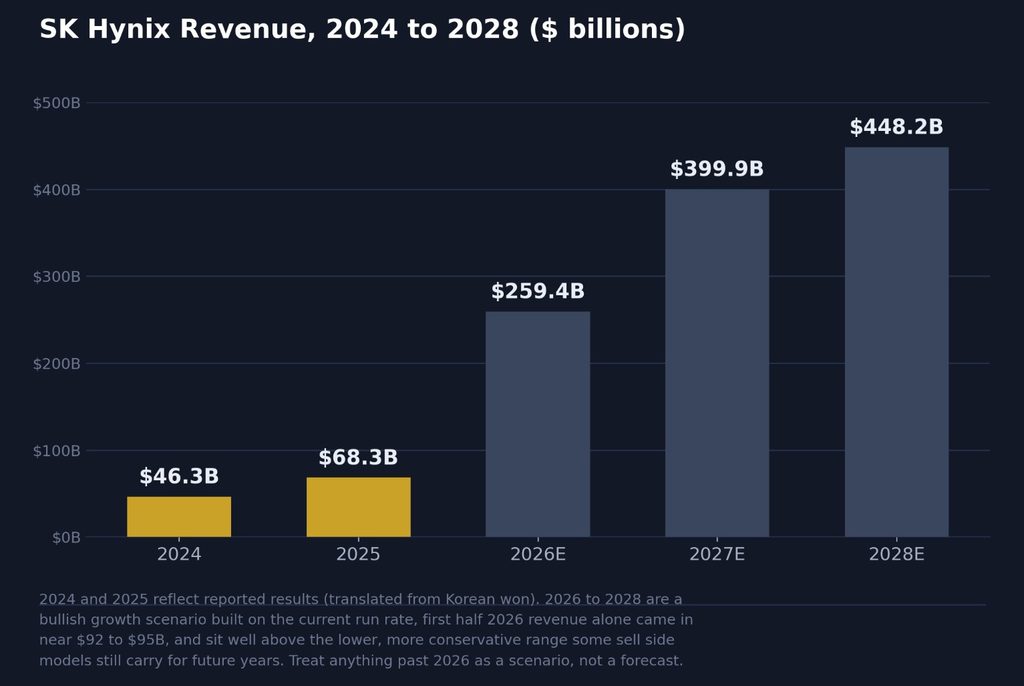
SK Hynix has spent the better part of three decades as a cyclical also ran to Samsung a memory maker whose fortunes rose and fell with the brutal boom bust rhythm of the DRAM market. That reputation no longer fits. Since Nvidia’s GPUs began shipping with SK Hynix’s high-bandwidth memory (HBM) stacked directly alongside the compute die, the company has become one of the more consequential suppliers in the entire AI hardware stack not a chipmaker riding the AI boom so much as one of the physical constraints on how fast that boom can grow.
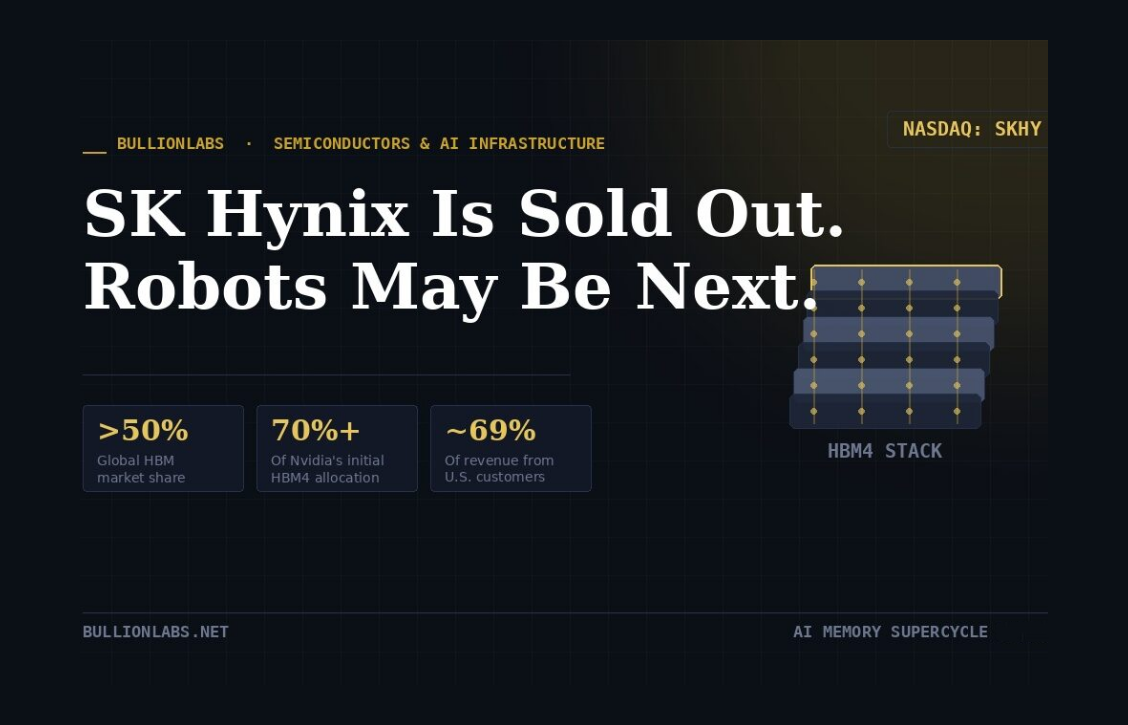
The company controls a majority of the global HBM market and, by most industry counts, supplies more than 70% of Nvidia’s initial orders for HBM4, the next-generation standard now ramping toward volume production. Samsung is chasing hard, and Micron has carved out a smaller but growing share of the same market but for the moment, SK Hynix is setting the pace.
From training runs to permanent memory
For the first few years of the generative-AI boom, the bottleneck was compute raw GPU throughput for training ever larger models. That story is shifting. As AI systems move from pure training toward persistent inference, agents, and retrieval heavy workloads, the industry increasingly needs somewhere to keep data close to the processor, not just crunch it once and discard it. Every additional data center built to serve that shift needs more memory, not just more compute, and the major chipmakers Nvidia, AMD, Micron, Samsung, and SK Hynix among them have been consistent on one point: the memory shortage now underway is a structural feature of this cycle, not a temporary supply hiccup, and it’s expected to persist for the next several years.
That raises the obvious question hanging over every AI infrastructure stock: what happens when the current wave of data center construction matures and spending normalizes? SK Hynix’s own answer, echoed by much of the industry, is that data centers are only the first leg. The next is physical a coming wave of AI-enabled robotics that would extend memory and compute demand well beyond racks in a warehouse and into cars, factories, and eventually homes. Whether that materializes on the timeline bulls expect is very much an open question, but it’s the thesis increasingly used to justify capital spending plans that would have looked reckless in any previous memory cycle.
Beyond HBM: the next memory tier
SK Hynix’s HBM lead is well established. Less understood is what the company is building next. Alongside SanDisk, it has been co-developing a technology called High-Bandwidth Flash, or HBF and it’s worth being precise about what that actually is, because it’s often described loosely. HBF does not stack HBM chips on top of each other. It stacks layers of NAND flash memory using the same through silicon via packaging techniques HBM pioneered, creating a new tier that sits between fast but limited HBM and large but slow SSD storage.
The point of HBF is capacity, not raw speed: a single stack can hold many times more data than HBM at a fraction of the cost, which matters enormously for AI inference, where a model’s cached context can balloon into the hundreds of gigabytes. SK Hynix and SanDisk released the first open HBF specification in mid-2026 under the Open Compute Project, with Google and AI-chip startup Tenstorrent joining the effort a sign hyperscalers see real value in a cheaper, denser memory tier for inference workloads. Samsung appears to be pursuing a related but distinct approach of its own, stacking memory differently rather than adopting the HBF standard outright, while Micron has not yet detailed a competing product in this specific category.
“The HBM era is ending the HBF era is coming,” one SK Hynix executive told an industry conference in late 2025, previewing what the company hopes becomes the next multi-year growth leg once HBM itself matures.
Who’s actually buying this
Geographically, SK Hynix’s customer base is heavily concentrated a fact that cuts both ways. The United States, driven almost entirely by hyperscaler and AI-accelerator demand, accounts for roughly two-thirds to seventy percent of total revenue depending on the quarter, with China a distant but resurgent second on the back of mobile and NAND demand. That concentration means SK Hynix’s results are unusually sensitive to a handful of customers Nvidia chief among them, alongside at least one large, unnamed hyperscaler that has separately grown into a top-tier customer in its own right and to any shift in U.S.–China trade policy or export controls.
What management is promising
SK Hynix’s own guidance has become the thing to watch each quarter, if only because the company keeps having to raise it. Capital expenditure for 2026 has been pushed up repeatedly through the year into the low to mid $30 billion range by the most recent count, with some estimates, once packaging and infrastructure commitments are included, pushing past $35 billion. That’s a record for the company and among the largest capex programs in the memory industry’s history.
HBM and technology leadership: Management continues to guide to more than 50% global HBM share, with over 70% of Nvidia’s initial HBM4 allocation locked in.
Shipments and migration: Double digit sequential DRAM bit growth guided for the second half of 2026, alongside a push to get 321 layer NAND to roughly half of total NAND capacity by year end.
Fab scaling: Plans to expand 1c nanometer DRAM output toward 170,000–200,000 wafers per month by early 2027, and a new advanced packaging facility under construction in West Lafayette, Indiana, at a cost north of $4 billion.
Contract backlog: Multi year supply agreements now in place with roughly ten major hyperscale customers reportedly including Nvidia, AWS, and Google several of which include upfront cash deposits that lock in pricing years in advance.
What the market is paying for it
Wall Street’s enthusiasm shows up most clearly in earnings-per-share growth, which the sell side expects to keep compounding even as the revenue base gets much larger. On a per common share basis (SK Hynix’s Nasdaq listed ADRs represent one-tenth of a common share, so divide by ten for the per ADR equivalent), consensus estimates have EPS climbing sharply through 2026 before growth normalizes into 2027 and 2028.
Target prices: three ways of looking at the same stock
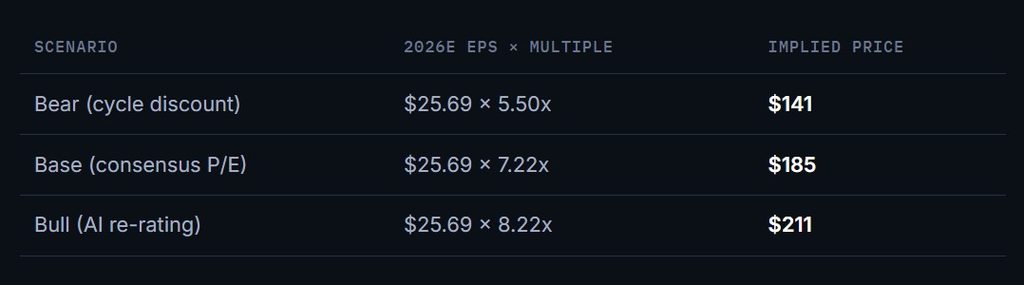
Because so much of the bull case rests on how long the current pricing power lasts, target-price models for SK Hynix tend to spread out unusually wide. A simple earnings multiple framework 2026 consensus EPS multiplied by a range of forward P/E multiples illustrates just how much the multiple assumption matters more than the earnings number itself:
The bear case assumes the market eventually re-applies the discount it has historically given Korean memory stocks and cyclical semiconductor names generally. The bull case assumes SK Hynix keeps re-rating toward the multiples U.S. peers like Micron have commanded during past AI-driven upcycles. Roll the same framework forward to 2027 EPS and the spread is similar in shape, just shifted higher anywhere from roughly $147 in a trough-multiple scenario to $237 if SK Hynix holds its 2026 multiple into the following year.
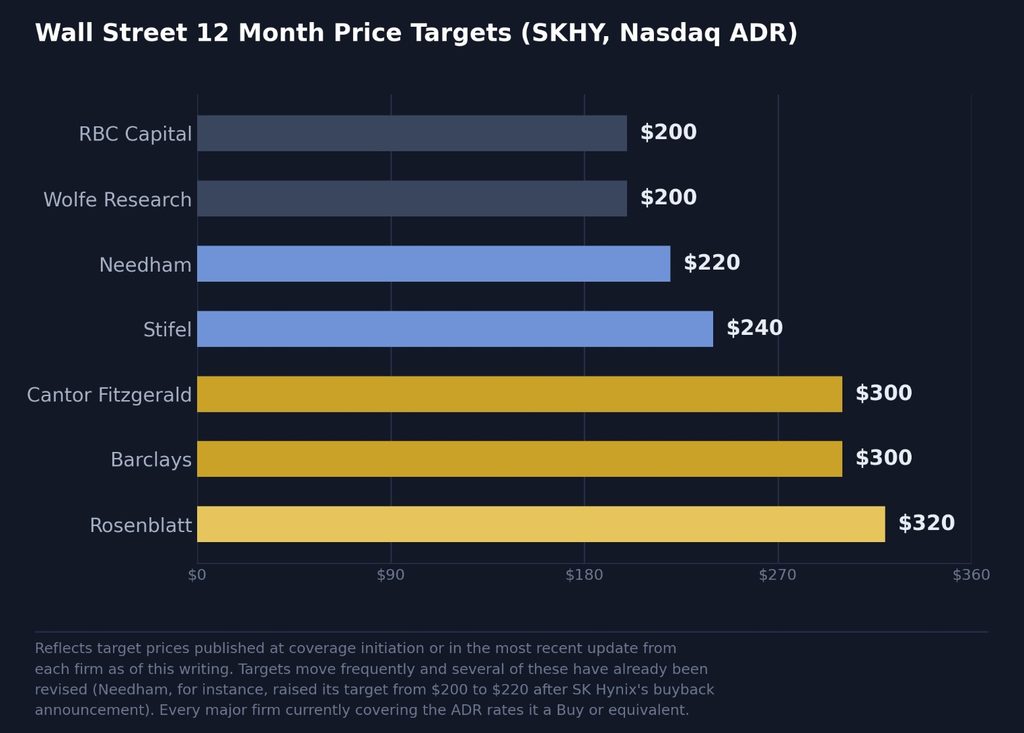
Every analyst currently covering SK Hynix’s Nasdaq ADR rates it a buy, with targets clustered between $200 and $320 a genuinely unusual amount of one directional consensus for a memory stock, and arguably a risk in itself. When an entire sell side community agrees this strongly, the disagreement that matters has usually moved into how far and how long the cycle runs, not whether the stock is a buy today.
Who owns it
Ownership is one area where the original draft’s figures didn’t hold up well against SK Hynix’s own disclosures, so it’s worth restating cleanly. SK Square the SK Group holding entity spun out of SK Telecom in 2021 remains the controlling shareholder with roughly 20% of shares outstanding. South Korea’s National Pension Service holds around 7–8%, and foreign institutional investors collectively led by BlackRock, Vanguard, and Singapore’s GIC own more than half the company, on the order of 54–56%. The remainder is split between domestic institutions and retail shareholders. Insider and employee ownership, by contrast, is minimal, consistent with a company of this scale.
Inside IREN’s $30 Billion Bet: How a Bitcoin Miner is Building the Future of AI
If you haven’t been paying attention to the data center space lately, you might still think of IREN Limited (formerly Iris Energy) as just another crypto mining stock. But behind the scenes, this company is pulling off one of the most aggressive and fascinating business pivots in modern tech.
Let’s break down exactly what IREN is doing right now, how their technology and financials are tracking, and whether their massive gamble is actually worth your investment.
What Does This Company Actually Do?
At its core, IREN builds, owns, and operates next-generation data centers. Originally, they made their money by plugging thousands of high-powered computers into 100% renewable energy sources to mine Bitcoin.
However, they realized that the exact same infrastructure needed for Bitcoin mining—massive power capacity, advanced cooling, and cheap electricity—is exactly what the world desperately needs for Artificial Intelligence. Today, IREN is rapidly transitioning from a pure-play Bitcoin miner into a massive, tier-one AI Cloud infrastructure provider.
The Pivot: Successes and the Hidden “Moat”
The Short-Term Success: IREN just crossed a massive psychological and financial milestone. In their fiscal fourth quarter of 2026, their AI Cloud Services revenue hit $70.5 million, officially eclipsing their Bitcoin mining revenue ($66.7 million) for the very first time. They also locked in staggering partnerships, including a $9.7 billion cloud contract with Microsoft and a potential multi-gigawatt deployment with NVIDIA.
The Long-Term Success: IREN is successfully shaking off the volatile “crypto stock” label to become a foundational pillar of the AI boom.
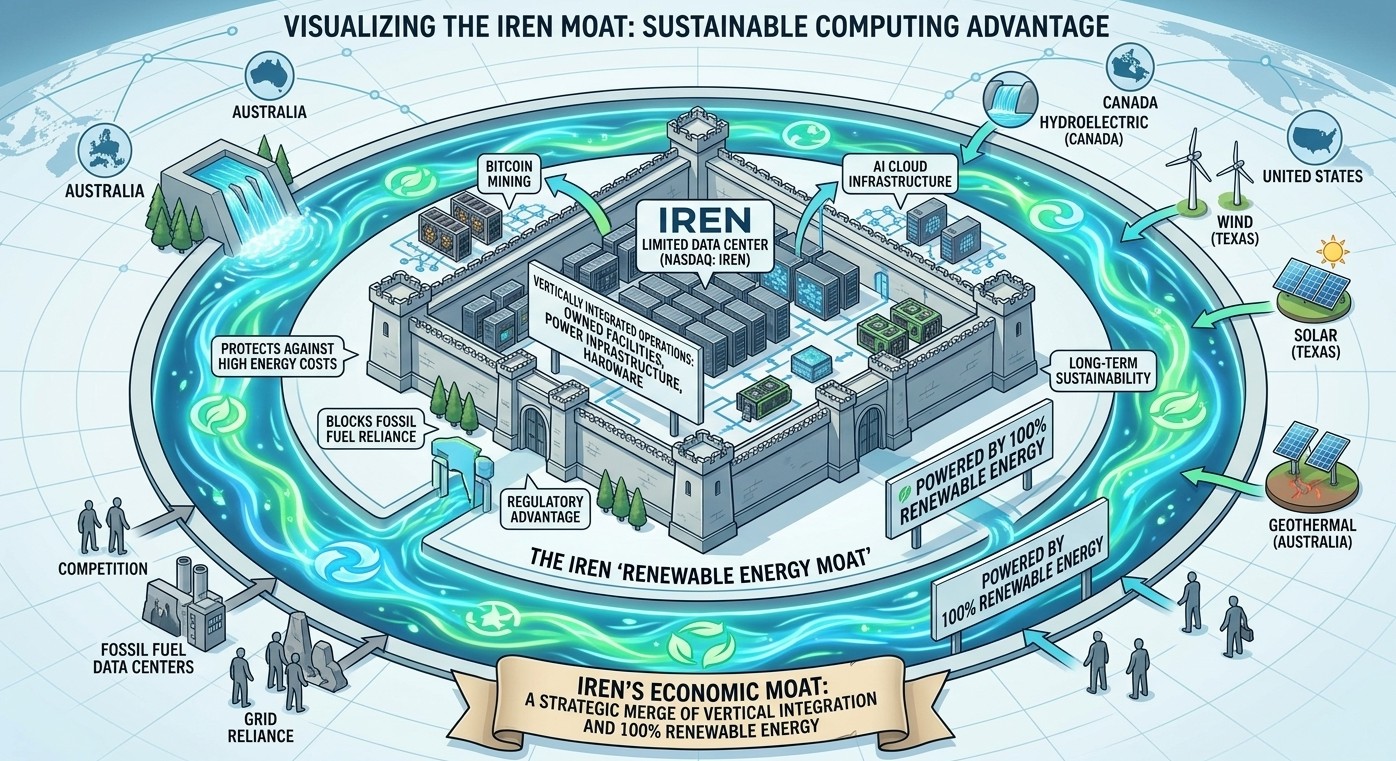
The Moat: In the AI world, the biggest bottleneck isn’t getting computer chips; it’s getting electricity. IREN’s ultimate moat is its access to ridiculously cheap, 100% renewable energy (averaging roughly $0.033/kWh) and their pre-existing grid connections. While traditional tech companies are waiting years for utility companies to approve grid hookups, IREN already has the power flowing and has secured a pipeline of roughly 5 Gigawatts (GW) of grid connections for future deployments.
Technology Progress and the Roadmap
Short-Term Progress: Right now, IREN is operating about 40 Megawatts (MW) of AI Cloud capacity, while still running 23.2 Exahashes per second (roughly 380MW) of Bitcoin mining equipment. They’ve recently acquired companies like Nostrum and Mirantis to instantly beef up their software capabilities and expand their physical footprint into Europe.
Long-Term Progress & Goals: Their ultimate goal is to transition the vast majority of their power capacity away from crypto and into high-margin AI compute. They are aiming for substantial completion of this massive transition by December 31, 2026.
Are they on track? Absolutely. They are executing flawlessly on the physical build-out, purposefully decommissioning older Bitcoin miners to make physical space and free up electricity for incredibly lucrative AI GPU clusters.
The Official Guidance: Short and Long Term
When management released their recent FY2026 report, they laid out crystal clear guidance for what investors should expect over the next 18 to 24 months.
Short-Term (End of 2026): The immediate catalyst is that their 2026 AI compute capacity is already effectively sold out. Their strict deadline is to completely decommission all remaining Bitcoin mining operations by December 31, 2026, delivering roughly 300 Megawatts (0.3GW) of pure AI IT load. Financially, management expects their contracted Annual Recurring Revenue (ARR) to rocket from the $1 billion operating today to over $4 billion by the end of December. Be prepared for a short-term hit to operating margins: cash SG&A costs are expected to jump $40–$50 million next quarter as they aggressively hire to manage the AI transition.
Long-Term (2027 and Beyond): For 2027, IREN is targeting 800 Megawatts (0.8GW) of cumulative delivery, pushing toward a gross AI capacity of 1.2 Gigawatts. They are currently in late-stage negotiations to lock in new customers for that upcoming 2027 capacity. To fund the $25 to $30 billion in planned CapEx, they have already lined up roughly $14 billion via cash, customer prepayments, and existing GPU financing, and are actively targeting another $8 billion in new asset-backed financing. Zooming out further, they are developing a multi-year global pipeline of over 5 Gigawatts of secured grid connections to support next-generation, liquid-cooled data centers globally.
The Financial Reality: Cash, Burn, and a $30 Billion Bill
This is where the story gets both terrifying and exhilarating. Pivoting to AI is not cheap.
CapEx (Capital Expenditure): IREN management dropped a bombshell on their recent earnings call, issuing fiscal 2027 CapEx guidance between $25 billion and $30 billion. This money is needed to buy massive amounts of GPUs and build out the physical data centers.
Cash Status & Runway: How on earth does a company fund that? Over the last 12 months, IREN has secured roughly $19 billion in funding, including a massive $3.6 billion investment-grade facility backed by their Microsoft contract. They ended FY2026 with roughly $5.89 billion in unrestricted cash.
Debt: To fund this, long-term debt skyrocketed from under $1 billion to over $7.4 billion in just 12 months.
Path to Profitability: Because they are spending money faster than they make it to build out this infrastructure, true bottom-line profitability will take time. They posted a net loss in FY2026, driven largely by non-cash impairments as they write down old crypto hardware. They currently have about $4 billion in contracted annual recurring revenue (ARR) lined up for their AI capacity, which will dictate their cash flow generation as these centers come online.
Revenue, EBITDA, and EPS Growth
Let’s look at the actual operational numbers for Fiscal Year 2026:
YoY Revenue: Excellent. Full-year revenue jumped 41.2% year-over-year, from $501 million to $707 million.
QoQ Revenue: Q4 2026 total revenue dipped slightly to $137.2 million (from $144.8 million in Q3). However, the AI portion of that revenue more than doubled sequentially, growing from $33.6 million to $70.5 million in a single quarter.
EBITDA & Cashflow: Operating cash flow is strong thanks to high hardware gross margins, but full-year adjusted EBITDA actually slipped by 8.9% (down to $245.7 million). This is a natural side effect of the heavy transition costs of shifting the business model.
EPS (Earnings Per Share): EPS took a beating. Thanks to massive non-cash impairment charges and heavy share dilution to raise cash, FY2026 EPS fell to $(2.22), down from a positive $0.39 the year prior.
Institutional Confidence & Wall Street Price Targets
If you want to know if a company’s vision is believable, follow the “smart money.” Over the last few years, institutional investors have aggressively bought into IREN’s pivot. In the last 12 months alone, institutions have poured $3.03 billion into the stock, compared to just $662.5 million in outflows. Today, institutional ownership sits at a very healthy 41%.
Following IREN’s latest earnings report, major Wall Street research firms overwhelmingly reiterated bullish ratings and aggressive price targets, projecting upside potential exceeding 180%:
The Verdict: Why is it Worth Investing?
Investing in IREN right now is a high-risk, high-reward execution play.
It is worth investing because the market is still catching up to the pivot. Because IREN still mines Bitcoin, many retail algorithms and traditional investors treat it like a volatile crypto stock. However, when you look at their $4 billion in contracted AI revenue and institutional support from firms like Bernstein and Cantor Fitzgerald setting target prices near $100, the upside potential is massive.
If management can manage the massive $30 billion debt and CapEx load without drowning, IREN is positioned to be one of the premier landlords of the AI revolution.
Disclosure: The author holds a long position in $IREN stock at the time of writing
At its core, AMD is a fabless semiconductor designer. They don’t build the factories (foundries like TSMC do that); instead, they design the brainpower behind modern computing. Their lineup spans four core areas:
Data Center: EPYC server CPUs and Instinct AI GPUs.
Client Computing: Ryzen processors for laptops and desktop PCs.
Gaming: Radeon graphics cards and custom chips powering the PlayStation 5 and Xbox Series X.
Embedded/Networking: Adaptive SoC chips from their Xilinx acquisition and Pensando networking hardware.
The Power of the Pivot: Survival to AI Challenger
AMD’s history is defined by two major pivots:
Long-Term Pivot (The Turnaround): A decade ago under CEO Dr. Lisa Su, AMD pivoted away from failing PC architectures to focus on its chiplet-based EPYC server processors. That move saved AMD from potential bankruptcy, systematically eating away at Intel’s market share in cloud data centers.
Short-Term Pivot (The AI Acceleration): Over the past two years, AMD rapidly shifted engineering weight toward AI training and inference hardware. Pivoting from purely general-purpose CPUs to purpose-built AI accelerators like the Instinct MI300 and MI350 series allowed AMD to capture urgent demand from hyperscalers seeking alternatives to NVIDIA.
Tech Progress & Roadmap: Are They on Track?
AMD is currently executing on a strict annual cadence for AI hardware and core architecture:
Short-Term Tech Progress: Rollout of the CDNA4 architecture, featured in the Instinct MI350 and MI355X accelerators with up to 288GB of HBM3E memory. On the CPU side, their Zen 5 architecture is shipping across consumer and server platforms.
Long-Term Tech Progress & Goals: The upcoming MI400 series paired with HBM4 memory, alongside the “Helios” rack-scale AI architecture—integrating EPYC “Venice” CPUs, MI400 GPUs, and Pensando AI NICs into unified AI racks.
Roadmap Track Record: Yes, AMD is fully on track. They have hit every major milestone on time, closing the performance and software gap through continuous updates to their open-source ROCm software stack.
Financial Status: Cash Flow, Profits, and Growth
Unlike pre-revenue startups, AMD operates from a position of financial strength:
Profitability Status: AMD is already highly profitable and has been for years. They generate billions in net income annually.
Revenue Progress:
Q2 Revenue:$11.54 Billion, representing +50.1% YoY growth and a strong +12.6% QoQ increase over Q1 ($10.25B).
Diluted EPS:$1.66, beating Wall Street consensus ($1.62).
Cash Flow & Capital Expenditure:
Free Cash Flow: Strong positive cash conversion, generating $2.6 Billion in a single quarter.
CapEx Spending: Reached ~$808 Million per quarter as they ramp up supply chain capacity for AI chips.
Capital Needs & Runway: AMD requires zero outside funding or emergency financing. Operating cash flows fully fund CapEx, and their $8+ billion cash balance means runway is indefinite under current operations.
Short-Term Guidance: Management projects Q3 revenue to climb further into the $12.4B to $13.3B range (centered around $12.8B), driven by accelerating AI chip shipments.
Institutional Backing & The Economic Moat
Institutional Growth: Institutional ownership stands at ~71%–75%. Over the last three years, institutional funds have steadily expanded their positions as AMD proved its viability as a long-term AI play.
Why Invest / AMD’s Moat:
x86 Cross-License: AMD holds one of only two licenses on Earth to build x86 processors, creating an insurmountable barrier to entry for prospective CPU competitors.
Chiplet Architecture: Pioneer in modular 3D chiplet stacking, allowing higher manufacturing yields and lower costs.
Full-Stack Ecosystem: AMD is one of the few silicon companies capable of supplying an entire end-to-end data center—CPUs, GPUs, SmartNICs, and custom FPGAs.
Disclosure: The author holds a long position in $AMD stock at the time of writing