IonQ, Inc. (NYSE: IONQ)
The Quantum Leap: Why IonQ (IONQ) is Pulling Away from the Pack in 2026
If you’ve been following the quantum computing sector, you know it’s a space full of enormous promises and equally massive capital expenditures. But based on the latest 2026 earnings and strategic moves, one company is turning those sci-fi promises into tangible business realities: IonQ, Inc. (NYSE: IONQ).
Whether you are already an investor or just doing your due diligence, here is a deep dive into what IonQ is doing, their financial health, and why they might just be the most compelling quantum play on the market right now.
What Does IonQ Actually Do?
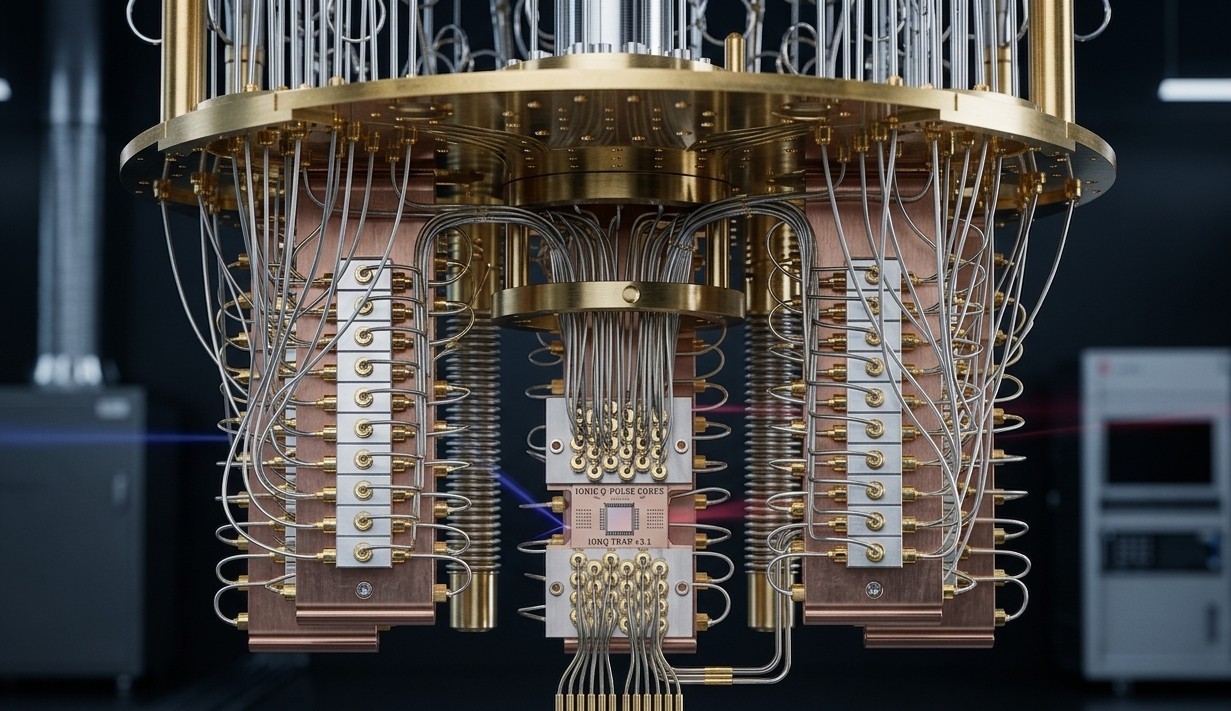
At its core, IonQ builds quantum computers. Unlike companies using superconducting qubits (like IBM or Google), IonQ uses trapped-ion technology. They trap individual atoms in 3D space using lasers to perform calculations. This approach traditionally offers longer coherence times and lower error rates, making their qubits incredibly accurate. They offer their quantum computing power as a service via major cloud providers (AWS, Google Cloud, Azure) and through direct enterprise deployments.
The Ultimate Pivot: The SkyWater Acquisition
The biggest strategic success for IonQ—both short and long term—has been their aggressive pivot from being purely a hardware design and software company to a vertically integrated full-stack quantum powerhouse.
In July 2026, IonQ completed a massive $1.8 billion acquisition of SkyWater Technology.
- Short-term win: They immediately secured their own semiconductor fabrication pipeline, insulating themselves from global supply chain bottlenecks.
- Long-term win: They now own the manufacturing process for their advanced quantum networking chips and custom substrates. By controlling the hardware from the silicon level up to the cloud interface, they have created a massive barrier to entry for competitors.
Technology Progress: Turning Ambition into Reality
Are they on track with their roadmap? Absolutely. IonQ has historically hit or exceeded their technical milestones, and 2025/2026 has been no different.
- Short-Term Progress: They successfully deployed their enterprise-grade IonQ Tempo quantum computers globally. Furthermore, they recently hit their critical milestone of 99.99% two-qubit gate fidelity, which is essentially the gold standard for quantum accuracy.
- Long-Term Progress & Goal: Their ultimate goal is achieving true, commercial-scale fault-tolerant quantum computing. Instead of trying to build one impossibly massive quantum chip, IonQ is using a modular approach—connecting smaller, highly functional trapped-ion systems via photonic quantum networking. This makes scaling up both practical and cost-effective.
Financial Status: A $3.1 Billion Fortress
The biggest risk in quantum computing is running out of money before the technology matures. IonQ has virtually eliminated this risk.
- Cash on Hand & Runway: IonQ exited early 2026 with a staggering $3.1 billion in cash, cash equivalents, and investments.
- Burn Rate & Funding Need: Their annual burn rate sits around $283 million (roughly $70 million per quarter).
- Longevity: At this current burn rate, IonQ has an astonishing 11+ years of cash runway. Even better, that cash pile generates roughly $56 million a year just in interest income. They do not need to raise additional funds anytime soon.
- Profitability: While they are not yet profitable (quantum is deeply capital intensive), their timeline to profitability is safely covered by their massive runway. Capital expenditures (CapEx) remain manageable relative to their cash, historically hovering in the double-digit millions annually, though expected to scale as they integrate SkyWater’s facilities.
Revenue, Cashflow, and Earnings Growth
IonQ is transitioning from a research firm into a revenue-generating machine.
- Revenue Growth: In Q2 2026, IonQ reported record revenues, growing an eye-popping 287% Year-Over-Year (YoY).
- Quarter-over-Quarter (QoQ): Sequential growth remains strong, driven by high cloud utilization and the physical deliveries of their Tempo systems.
- Guidance: Management is highly confident, officially raising their full-year 2026 revenue guidance to an impressive $280 – $290 million.
- EBITDA & EPS: As expected for a hyper-growth tech company, EPS remains negative. Their Q2 2026 Adjusted EBITDA was a loss of roughly $120 million, reflecting the heavy R&D costs and the integration of their new acquisitions. Cashflow remains negative, but the top-line revenue explosion is what the market cares about right now.
Institutional Conviction
If you want to know if a company is legit, follow the “smart money.” Over the last three years, institutional ownership in IonQ has skyrocketed. In the last 24 months alone, institutions have bought over 120 million shares, representing over $6.2 billion in transaction volume. There are now nearly 1,200 institutional owners backing the company, showing massive Wall Street conviction in IonQ’s roadmap.
The Investor Takeaway: Why Invest?
What is IonQ’s Moat?
It comes down to three things:
- Unmatched Balance Sheet: $3.1 billion in cash means they can outlast and outspend almost any pure-play quantum startup.
- Vertical Integration: Buying SkyWater makes them the only full-stack, vertically integrated quantum platform company.
- Superior Tech: Their trapped-ion modular networking approach is proving to be the most viable path to fault-tolerant quantum scaling.
IonQ is no longer just a speculative bet on physics; it is a rapidly scaling, well-funded business executing a brilliant long-term strategy.
Disclosure: The author has no position in $IONQ and no commercial relationship with the company