Xanadu Quantum Technologies Inc. (NASDAQ: XNDU)
What does Xanadu actually do?
XNDU stock represents Xanadu Quantum Technologies, a Toronto company founded in 2016. It builds quantum computers that run on light. Most rivals cool their chips to near absolute zero. Xanadu’s photonic chips work at room temperature and can be made in chip factories. That is the core pitch.
It also sells software. PennyLane is its open source library for programming quantum computers and linking them to machine learning tools. Catalyst helps compile and speed up that code. Customers can also reach its X series machines through the cloud.
The team is about 252 people. The company went public in March 2026 through a merger with a SPAC called Crane Harbor. It now trades on Nasdaq and the TSX. The deal brought in roughly $302 million, well below the $500 million first hoped for.
What have they achieved lately?
In the short term, the story is about proof points. Over the past year Xanadu has shown:
- Aurora, a modular and networked photonic quantum computer.
- Error resistant light qubits, called GKP states, made on a chip and published in Nature.
- 12 logical GKP qubits with real time error correction.
- A move up to Stage B of the DARPA Quantum Benchmarking Initiative, worth up to $15 million.
- This year, ultra low loss chip packaging in June, a new quantum memory algorithm called QROM in May, and a 20 qubit fluid dynamics run with AMD that was 25 times faster than a CPU workflow.
They are also building. The Inception facility in Toronto is 158,000 square feet, with 65,000 square feet of cleanrooms for chip packaging and module assembly.
Where is it heading?
The goal is a fault tolerant quantum computer. In plain words, a machine that fixes its own errors and can run long, useful programs. Management talks about a quantum data center in Canada by 2029.
The roadmap they shared on August 31 runs like this:
- 2026 to 2027: build the qubit factory.
- 2028 to 2029: reach the fault tolerance threshold.
- 2029 to 2030: launch the quantum data center, with up to 200 logical qubits in 2029.
- 2030 to 2031 and beyond: 500 logical qubits in 2030, then more than 1,000 in 2031.
The key number is photon loss. Light gets lost inside chips, and that is the main source of errors. The plan is to cut loss from 24.1 times above the needed threshold in 2026 down to 1.0 times by 2030. That is a big climb.
The latest news speaks to that gap. On September 9, 2026, Xanadu and ASML announced a collaboration on advanced lithography for Xanadu’s photonic chips. ASML is a leading supplier to the semiconductor industry. The work looks at how lithography and process choices affect line edge roughness, which scatters light out of the chip and adds optical loss. Cleaner patterning could help push loss down toward the roadmap target. It is described as joint exploration, so treat it as a technical positive, not a revenue event.
Are they on track?
By their own scorecard, yes. The milestones they announce keep landing. DARPA moved them to Stage B, and the new roadmap is more detailed than the old one. Earlier they spoke of up to 500 logical qubits in 2029 to 2030. The new version spreads that out, with 200 in 2029 and 500 in 2030. I read that as a clearer schedule, but it is worth watching.
The honest caveat is that nobody outside the company has verified the hard part yet. Xanadu itself says it has not built a large scale fault tolerant machine. A 24 times gap on photon loss is the real test. DARPA’s Stage B review is a year long and started in November 2025, so a decision could come around the end of this year or early next. That is my estimate, not a company date.
Is revenue growing?
Yes, but it is small and lumpy. Full year revenue was $2.5 million in 2023, $1.6 million in 2024 and $4.6 million in 2025. That is up about 190 percent in 2025 after a dip in 2024. Trailing twelve month revenue is $7.2 million.

Quarter by quarter in 2026:
- Q1 revenue was $2.83 million, about four times the year before.
- Q2 revenue was $1.51 million. That is down 46.6 percent from Q1, but up 42.5 percent from $1.06 million in Q2 2025.
- For the first half, revenue was $4.34 million versus $1.76 million a year ago. That is up about 147 percent.

Most of the money comes from government work, mainly DARPA, so it moves in steps. Gross margin looks great at about 93 percent, but the base is tiny. One more thing. Analysts expect $9.21 million for 2026. After $4.34 million in the first half, the second half needs about $4.9 million. That is roughly double the Q2 pace.
What about earnings per share?
The EPS history is messy because of the merger. Some sites show a 2025 loss of $14.29 per share. That uses the old share count of about 4.9 million, so ignore it. On today’s share count, 2025 was a loss of about $1.07 per share.

Q2 2026 was a loss of 14 cents per share. Net loss was $42.05 million, up from $20.6 million in Q1 and $15.14 million in Q2 2025.
Analysts see these full year losses per share:
- 2026: 50 cents.
- 2027: 32 cents, which is about 35 percent better.
- 2028: 34 cents.
- 2029: 66 cents, per one tracker.
So EPS is not improving in a straight line. Only two to four analysts cover each year, so treat these as rough. The next report is expected around early December, with a loss of about 9 cents and revenue near $2.79 million.
Did EBITDA and cash flow improve?
No. Both got worse as the company spent more to build.
Net loss was $35.6 million in 2023, $46.0 million in 2024, $70.7 million in 2025 and $106.0 million over the last twelve months. EBITDA losses went from $38.0 million to $45.7 million to $63.5 million, and $87.7 million over the last twelve months. Adjusted EBITDA loss was $13.9 million in Q1 and $21.3 million in Q2.
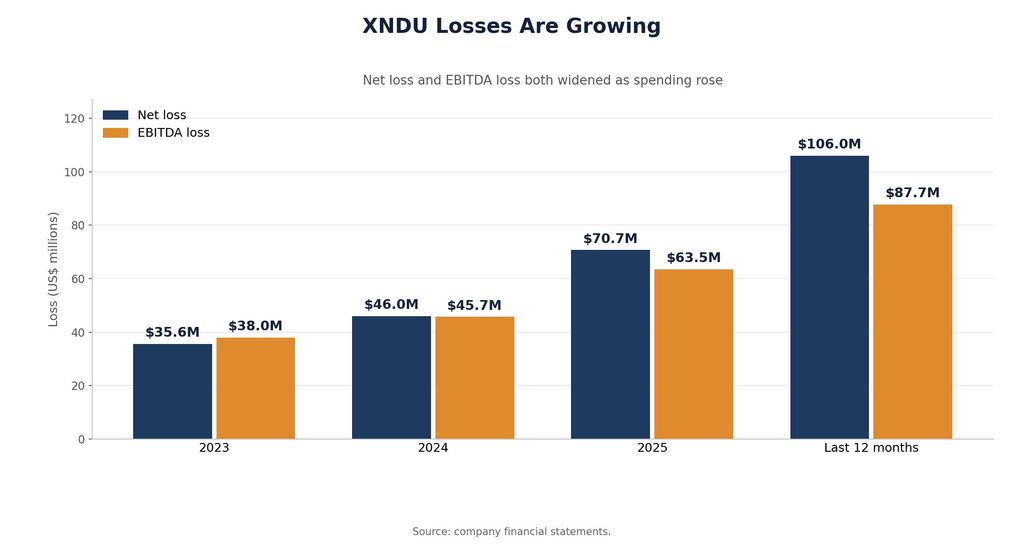
Where did the extra spending go? Research and development was $69.6 million over the last twelve months, up from $55.2 million in 2025. Selling and admin costs were $34.3 million, more than double the $16.6 million in 2025. Life as a public company is not cheap.
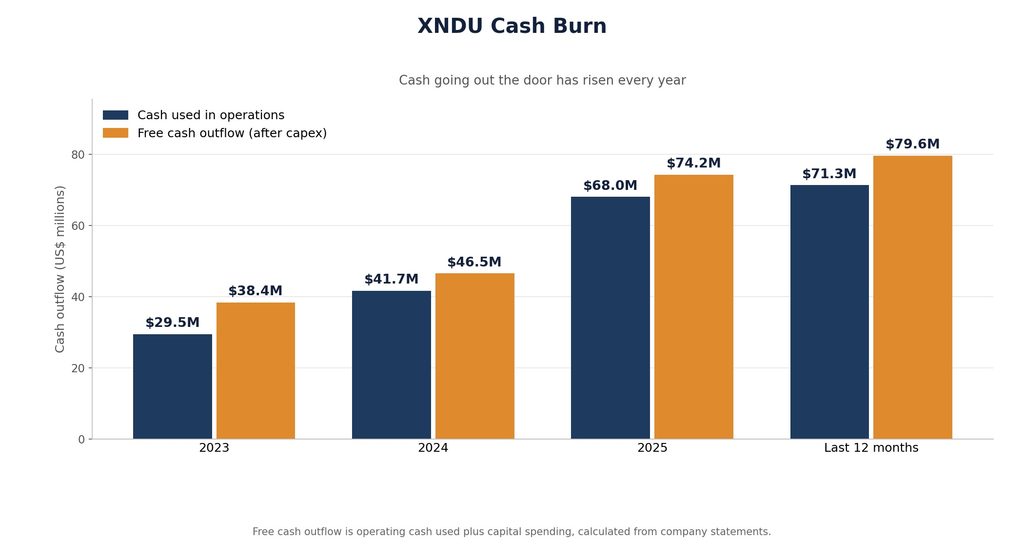
Cash used in operations was $29.5 million in 2023, $41.7 million in 2024, $68.0 million in 2025 and $71.3 million over the last twelve months. Add capex, and free cash flow outflow rose from about $38 million to $47 million to $74 million, then $80 million. Those last figures are my own math from the statements.
The cash balance looks great only because of financing. Cash is $312.8 million, up from $16.2 million at the end of 2025. Nearly all of that came from selling shares.
What is the financial status?
The balance sheet is solid for a company at this stage. Cash is $312.8 million. Total debt is $59.1 million, made up of $32.4 million of long term debt and about $26.8 million of leases. That leaves net cash of about $254 million. Equity is $313.1 million, and the old convertible preferred stock is gone. Cash is about a quarter of the market cap.

The company also lists about $686 million of total available capital. That counts the cash, a $140.2 million Canadian government grant (CAD $195 million) and $232.8 million still available under a share sale facility with Yorkville. The grant is money that does not dilute shareholders. The share facility does.
How much cash does XNDU burn, and how long will it last?
In Q2, adjusted EBITDA loss was $21.3 million and capex was $6.4 million. That is about $28 million a quarter. It lines up with the cash change too. Cash rose $40.3 million even after they raised $67.2 million from share sales, which implies a burn near $27 million.
Capex jumped from $0.3 million in Q1 to $6.4 million in Q2. Over the last twelve months it was $8.3 million. The CFO said capex should rise further in the second half as they buy tools and run more chip tapeouts. Hiring is also going up.
Here is my rough runway math. These are my estimates, not company numbers.
- At $28 million a quarter, cash alone lasts about 11 quarters, into early 2029.
- If burn climbs to $45 million a quarter, cash alone lasts about 7 quarters, into early 2028.
- At that higher burn, the full $686 million lasts about 15 quarters, into early 2030.
Management says the capital funds them through the 2029 to 2030 milestones. That may be fair. But the share facility depends on the stock price. At $4.30, selling the remaining $232.8 million would mean about 54 million new shares. That is roughly 18 percent more shares. I would plan for more dilution and probably another raise before real revenue shows up.
When could they turn profitable?
Not soon. Analyst revenue estimates are $9.2 million for 2026, $11.5 million in 2027 and $16.5 million in 2028. Then comes the leap, with $65.8 million in 2029, $255 million in 2030 and $743 million in 2031. Those late numbers come from very few analysts, and the ranges are wide. EPS estimates still show losses through 2029. My read is that profit is unlikely before 2030 and more likely 2031 or later, and only if the roadmap works.

What is the guidance for XNDU stock?
There is no formal numeric guidance. The CFO said they are not giving explicit targets yet, but the direction is clear. More engineers, more tapeouts, more capex in the second half. He also said more detailed spending guidance would come later.
On the technology side, the long term guidance is the roadmap above. Fault tolerance in 2028 to 2029, a data center by 2029 to 2030, and 1,000 plus logical qubits in 2031.
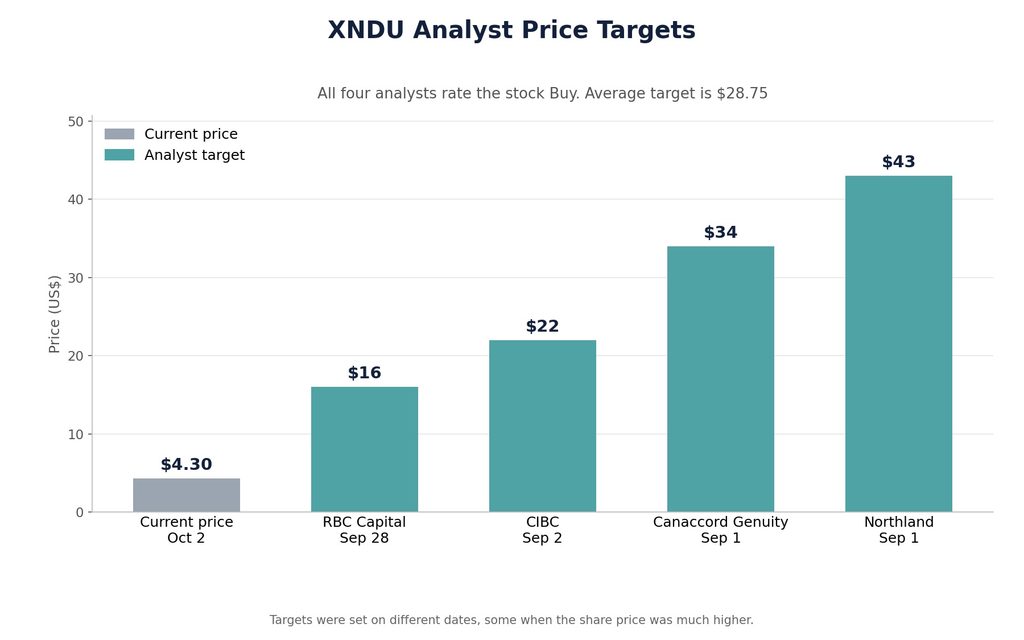
Wall Street is upbeat on XNDU stock. Recent price targets are $16 from RBC Capital, $22 from CIBC, $34 from Canaccord Genuity and $43 from Northland. All four say Buy. Remember that the stock has fallen a lot since some of these were set.
Who owns XNDU stock?
Here is what we can see now. One data source shows institutions holding 34.03 percent, or 103.57 million shares. Insiders hold 17.31 percent, private equity and venture firms 24.73 percent, and the public 23.94 percent. Other trackers give different splits, with institutions anywhere from about 8 percent to 31 percent, depending on how they count. Treat the exact number loosely.


The direction is up. One tracker counted 22 institutional holders as of Q1 2026. Another showed about 41 by early July, with funds adding. Founder and CEO Christian Weedbrook is the largest holder at about 15.6 percent, which is a good sign for alignment.
The big risk here is supply. Earlier this year Xanadu registered about 293.6 million shares for resale by early holders. The stock fell roughly 68 percent in a day on the news. Those shares can still weigh on the price.
Is XNDU stock worth investing in?
The bull case is simple. If photonic quantum computing works at scale, Xanadu is one of the few public pure plays, which is the core appeal of XNDU stock. The stock has already reset hard. Cash is about a quarter of the market cap. And the roadmap has real checkpoints to measure.
The bear case is just as clear. At $4.30 and 2026 revenue of about $9 million, the stock trades near 140 times forward sales. Losses are growing. Revenue is lumpy. The technology still has a big gap to close. More dilution is likely. And rivals such as IBM, Google and PsiQuantum are well funded.
Other quantum stocks take different routes. For comparison, read the deep dives on IonQ and trapped ion quantum computing platforms and Quantinuum and integrated quantum hardware with cybersecurity software.
This is a venture style bet in a public stock. Size it that way.
What is the moat?
I see five layers, with different strengths.
- The approach. Light based chips run at room temperature and can use chip factories. That could make scaling cheaper, if the loss problem is solved.
- PennyLane. About 30.8 percent of surveyed developers used it, second only to IBM’s Qiskit. It sees about 1.1 million installs a month and over 1,890 public code projects depend on it. Users and partners include Lockheed Martin, Rolls Royce, Toyota, Volkswagen, AMD and Mitsubishi Chemical.
- Government backing. DARPA Stage B, a CAD $195 million grant and a spot in Canada’s Quantum Champions Program.
- Manufacturing. The Inception facility and tool partners such as ASMPT, Bluefors, DISCO, EVG, FiconTEC and MPI. In September 2026 it also teamed up with ASML on lithography.
- Talent and leadership. A founder led team with deep research roots.
The weak spot is that PennyLane is open source and works with other hardware too. It builds mindshare, but turning that into revenue is not proven yet. The hardware moat only becomes real if they deliver on the roadmap.
What I would watch next
- The DARPA Stage B outcome.
- Proof that photon loss is falling toward the target, including any results from the ASML lithography work.
- The detailed spending guidance management promised.
- The Q3 report in early December, and whether revenue gets close to the $2.8 million estimate.
- How much of the share facility they use, and at what price.
- Selling pressure from the resale shares.
Bottom line. XNDU stock comes with real technology, real backing and a decent cash pile. It also has rising losses, no profit in sight for years, and a stock that still swings hard. If you are drawn to it, know why you own it and how much you can afford to lose.
More quantum stock deep dives
- IonQ: trapped ion quantum computing platforms
- Quantinuum: integrated quantum hardware and cybersecurity software
- LAES: post quantum cryptography and secure semiconductors
Sources: Tipranks, SeekingAlpha, Tradingview, Xanadu
Disclosure: The author holds a long position in $XNDU stock at the time of writing
Leave a Reply