Tag: Quantum Hardware

  • $QNT: Integrated Quantum & Cybersecurity

    $QNT: Integrated Quantum & Cybersecurity

    Quantinuum Inc. (NASDAQ: QNT)

    The Quantum Leap

    If you have been watching the deep-tech space, Quantinuum (NASDAQ: QNT) is impossible to ignore right now. The company is the world’s largest integrated quantum computing firm. It designs both high-performance trapped-ion quantum computers and the software needed to run them. In fact, what makes them stand out isn’t just the futuristic tech, it’s how quickly they are translating lab science into boardroom revenue.

    The Pivot: From Isolated Tech to Hybrid AI

    Quantinuum’s smartest move has been pivoting away from the idea that quantum computers will completely replace classical computers. Instead, their “hardware-led and software-enhanced” strategy positions quantum as an essential layer within a hybrid ecosystem.

    Short-Term Success

    This pivot has already paid off massively. Quantinuum recently secured an industry-first partnership to deploy their Helios quantum system directly on Oracle Cloud Infrastructure (OCI). This integration works seamlessly with Oracle’s AI and classical compute workloads. On top of that, they locked in a strategic framework with HPE to combine quantum with high-performance computing (HPC).

    Long-Term Success

    By weaving their hardware directly into existing enterprise AI data centers, Quantinuum is positioning itself as the default quantum engine. That positioning targets a projected $10+ billion end-user market by 2030.

    The Tech: A Tangible Roadmap to 2030

    Quantum computing has a reputation for missed deadlines, but Quantinuum is actively delivering on its promises.

    Short-Term Progress

    They recently achieved a near five-nines (99.999%) logical fidelity on their current Helios system, pushing the boundaries of quantum error correction. They also hit 12 logical qubits on their System Model H2, a joint milestone achieved with Microsoft. Meanwhile, their next-generation Sol 2D QCCD trap chip is already back from the fabrication plant for validation.

    Long-Term Goal

    Their ultimate goal is universal, fully fault-tolerant quantum computing by 2030. They plan to achieve this with their upcoming fifth-generation Apollo system. That system aims to execute circuits with millions of gates, solving complex problems in chemistry, biology, and finance.

    Are They on Track?

    Overall, yes. They are concurrently investing in four generations of systems (Helios, Sol, Apollo, Lumos) and consistently release peer-reviewed data to validate their developmental milestones.

    The Financials: Heavy Burn, Heavy War Chest

    Quantinuum’s Q2 2026 earnings, their first as a public company after a massive $1.7 billion IPO in June, tell a story of aggressive scaling.

    Revenue Growth

    The top line is exploding. Q2 2026 revenue hit $8.0 million, representing a massive 279.4% Year-over-Year (YoY) increase from $2.11 million. Meanwhile, year-to-date bookings, heavily bolstered by the Oracle deal, surged past $81 million, driving immense Quarter-over-Quarter momentum.

    Earnings (EPS) and EBITDA

    Aggressive scaling isn’t cheap, so EBITDA has not yet improved. Adjusted EBITDA loss widened to $68.31 million, up from a $43.5 million loss last year. That widening reflects heavy investment in R&D. However, GAAP EPS was heavily skewed to -$1.93 due to $464 million in one-time stock compensation triggered by the IPO. Adjusted non-GAAP EPS, by contrast, sat at a much cleaner -$0.28.

    Cash Flow and Burn Rate

    Operating cash flow sat at -$66.19 million, a slight 5.23% dip from the prior quarter. Meanwhile, capital expenditures (Capex) cost the company roughly $16.6 million for the quarter. As a result, they are burning roughly $83 million per quarter in total cash.

    Runway and Path to Profit

    Do they need more funds? Absolutely not. Thanks to their IPO, they ended the quarter with $2.1 billion in cash and short-term investments. At their current quarterly burn rate, this cash provides over six years of runway. That gives them plenty of time to execute. Looking ahead, they project reaching positive free cash flow by 2030.

    Guidance

    They raised their full-year 2026 revenue outlook to $28 million to $32 million. Looking further out, management expects 2027 revenue to grow by more than 100%, based on their current backlog.

    Institutional Investment

    The company was privately incubated by Honeywell, which remains the dominant shareholder, until June 2026. As a result, public institutional investment went from zero to billions overnight once Quantinuum debuted on the Nasdaq.

    The Verdict: The Moat and the Investment Case

    For investors, QNT represents a rare pure-play opportunity in deep tech. The primary reason to invest is their unrivaled balance sheet. With $2.1 billion in cash on hand, investors face virtually zero near-term dilution risk. Even so, the company must still execute a highly capital-intensive roadmap.

    In short, their moat is threefold:

    • Hardware Lock-in: A fully scalable quantum charge-coupled device (QCCD) architecture built on trapped-ion technology. It requires highly specialized materials, including isotopes sourced from the U.S. Department of Energy.
    • Full-Stack Integration: They don’t just build the machine. Their proprietary software stacks integrate deeply into global enterprise networks like Microsoft Azure, Oracle Cloud, and Nvidia Cuda-Q. Those integrations create sticky, long-term commercial relationships.
    • Human Capital: They employ roughly 700 people, 40% of whom hold PhDs, creating a massive intellectual property barrier against new entrants.

    Source: Quantinuum

    Disclosure: The author has no position in $QNT and no commercial relationship with the company
  • $IONQ: Trapped-Ion Quantum Computing Platforms

    $IONQ: Trapped-Ion Quantum Computing Platforms

    IonQ, Inc. (NYSE: IONQ)

    The Quantum Leap: Why IonQ (IONQ) is Pulling Away from the Pack in 2026

    If you’ve been following the quantum computing sector, you know it’s a space full of enormous promises and equally massive capital expenditures. But based on the latest 2026 earnings and strategic moves, one company is turning those sci-fi promises into tangible business realities: IonQ, Inc. (NYSE: IONQ).

    Whether you are already an investor or just doing your due diligence, here is a deep dive into what IonQ is doing, their financial health, and why they might just be the most compelling quantum play on the market right now.

    What Does IonQ Actually Do?

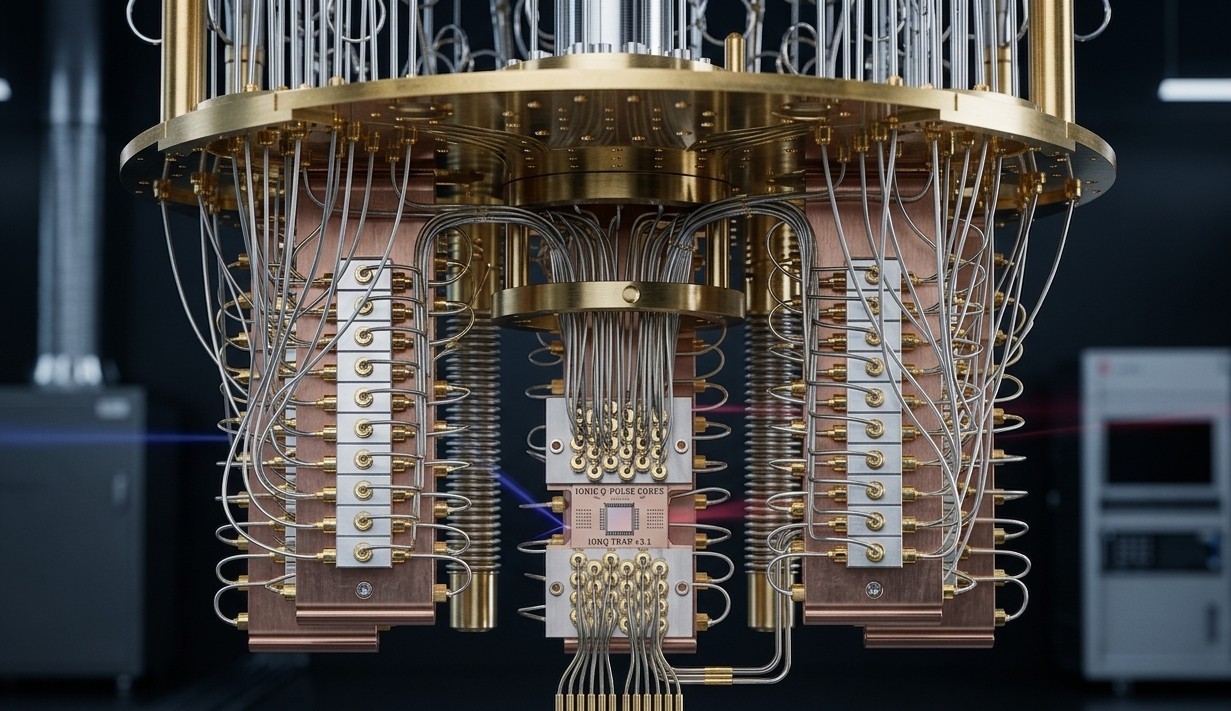
    At its core, IonQ builds quantum computers. Unlike companies using superconducting qubits (like IBM or Google), IonQ uses trapped-ion technology. They trap individual atoms in 3D space using lasers to perform calculations. This approach traditionally offers longer coherence times and lower error rates, making their qubits incredibly accurate. They offer their quantum computing power as a service via major cloud providers (AWS, Google Cloud, Azure) and through direct enterprise deployments.

    The Ultimate Pivot: The SkyWater Acquisition

    The biggest strategic success for IonQ—both short and long term—has been their aggressive pivot from being purely a hardware design and software company to a vertically integrated full-stack quantum powerhouse.

    In July 2026, IonQ completed a massive $1.8 billion acquisition of SkyWater Technology.

    • Short-term win: They immediately secured their own semiconductor fabrication pipeline, insulating themselves from global supply chain bottlenecks.
    • Long-term win: They now own the manufacturing process for their advanced quantum networking chips and custom substrates. By controlling the hardware from the silicon level up to the cloud interface, they have created a massive barrier to entry for competitors.

    Technology Progress: Turning Ambition into Reality

    Are they on track with their roadmap? Absolutely. IonQ has historically hit or exceeded their technical milestones, and 2025/2026 has been no different.

    • Short-Term Progress: They successfully deployed their enterprise-grade IonQ Tempo quantum computers globally. Furthermore, they recently hit their critical milestone of 99.99% two-qubit gate fidelity, which is essentially the gold standard for quantum accuracy.
    • Long-Term Progress & Goal: Their ultimate goal is achieving true, commercial-scale fault-tolerant quantum computing. Instead of trying to build one impossibly massive quantum chip, IonQ is using a modular approach—connecting smaller, highly functional trapped-ion systems via photonic quantum networking. This makes scaling up both practical and cost-effective.

    Financial Status: A $3.1 Billion Fortress

    The biggest risk in quantum computing is running out of money before the technology matures. IonQ has virtually eliminated this risk.

    • Cash on Hand & Runway: IonQ exited early 2026 with a staggering $3.1 billion in cash, cash equivalents, and investments.
    • Burn Rate & Funding Need: Their annual burn rate sits around $283 million (roughly $70 million per quarter).
    • Longevity: At this current burn rate, IonQ has an astonishing 11+ years of cash runway. Even better, that cash pile generates roughly $56 million a year just in interest income. They do not need to raise additional funds anytime soon.
    • Profitability: While they are not yet profitable (quantum is deeply capital intensive), their timeline to profitability is safely covered by their massive runway. Capital expenditures (CapEx) remain manageable relative to their cash, historically hovering in the double-digit millions annually, though expected to scale as they integrate SkyWater’s facilities.

    Revenue, Cashflow, and Earnings Growth

    IonQ is transitioning from a research firm into a revenue-generating machine.

    • Revenue Growth: In Q2 2026, IonQ reported record revenues, growing an eye-popping 287% Year-Over-Year (YoY).
    • Quarter-over-Quarter (QoQ): Sequential growth remains strong, driven by high cloud utilization and the physical deliveries of their Tempo systems.
    • Guidance: Management is highly confident, officially raising their full-year 2026 revenue guidance to an impressive $280 – $290 million.
    • EBITDA & EPS: As expected for a hyper-growth tech company, EPS remains negative. Their Q2 2026 Adjusted EBITDA was a loss of roughly $120 million, reflecting the heavy R&D costs and the integration of their new acquisitions. Cashflow remains negative, but the top-line revenue explosion is what the market cares about right now.

    Institutional Conviction

    If you want to know if a company is legit, follow the “smart money.” Over the last three years, institutional ownership in IonQ has skyrocketed. In the last 24 months alone, institutions have bought over 120 million shares, representing over $6.2 billion in transaction volume. There are now nearly 1,200 institutional owners backing the company, showing massive Wall Street conviction in IonQ’s roadmap.

    The Investor Takeaway: Why Invest?

    What is IonQ’s Moat?

    It comes down to three things:

    1. Unmatched Balance Sheet: $3.1 billion in cash means they can outlast and outspend almost any pure-play quantum startup.
    2. Vertical Integration: Buying SkyWater makes them the only full-stack, vertically integrated quantum platform company.
    3. Superior Tech: Their trapped-ion modular networking approach is proving to be the most viable path to fault-tolerant quantum scaling.

    IonQ is no longer just a speculative bet on physics; it is a rapidly scaling, well-funded business executing a brilliant long-term strategy.

    Disclosure: The author has no position in $IONQ and no commercial relationship with the company