Category: Tech

  • $IREN: Energy Meets AI Infrastructure

    $IREN: Energy Meets AI Infrastructure

    IREN Limited (NASDAQ: IREN)

    Inside IREN’s $30 Billion Bet: How a Bitcoin Miner is Building the Future of AI

    If you haven’t been paying attention to the data center space lately, you might still think of IREN Limited (formerly Iris Energy) as just another crypto mining stock. But behind the scenes, this company is pulling off one of the most aggressive and fascinating business pivots in modern tech.

    Let’s break down exactly what IREN is doing right now, how their technology and financials are tracking, and whether their massive gamble is actually worth your investment.

    What Does This Company Actually Do?

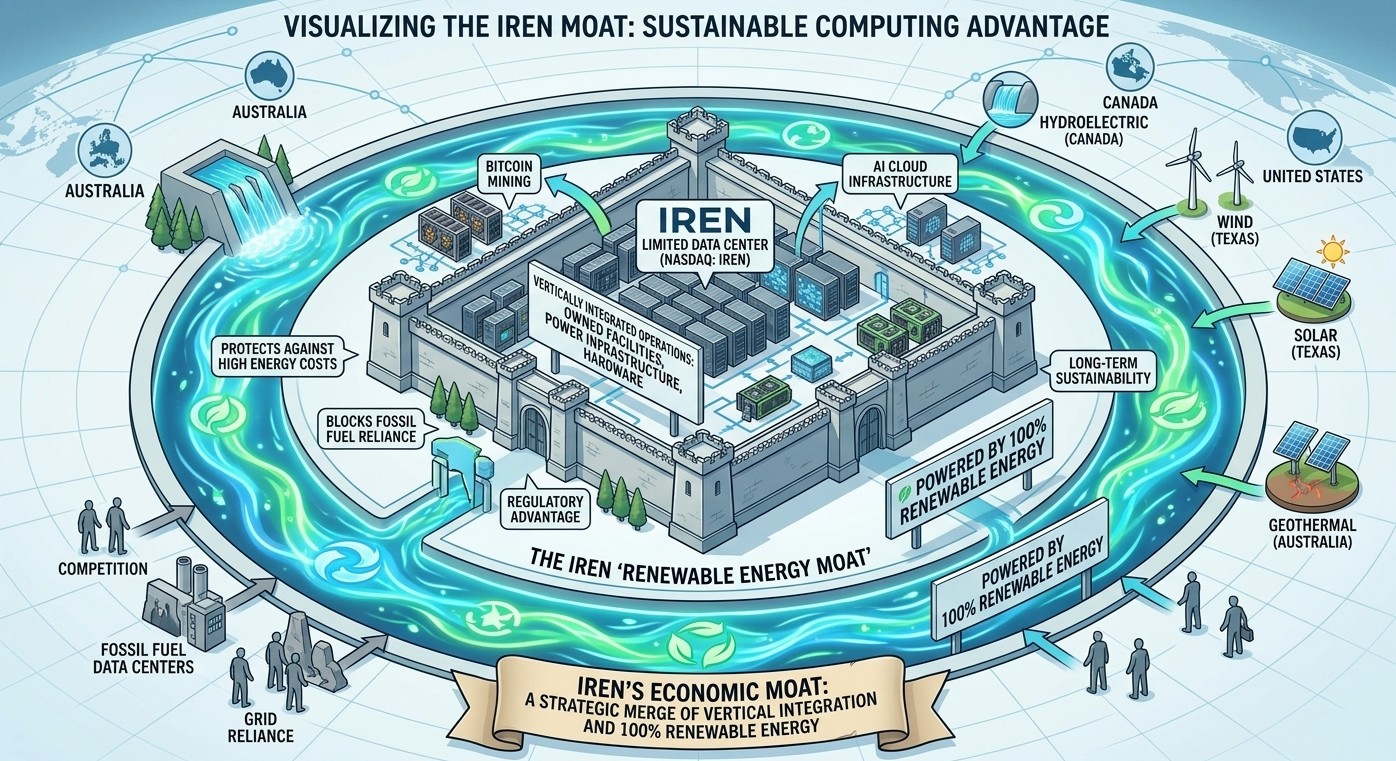
    At its core, IREN builds, owns, and operates next-generation data centers. Originally, they made their money by plugging thousands of high-powered computers into 100% renewable energy sources to mine Bitcoin.

    However, they realized that the exact same infrastructure needed for Bitcoin mining—massive power capacity, advanced cooling, and cheap electricity—is exactly what the world desperately needs for Artificial Intelligence. Today, IREN is rapidly transitioning from a pure-play Bitcoin miner into a massive, tier-one AI Cloud infrastructure provider.

    The Pivot: Successes and the Hidden “Moat”

    The Short-Term Success: IREN just crossed a massive psychological and financial milestone. In their fiscal fourth quarter of 2026, their AI Cloud Services revenue hit $70.5 million, officially eclipsing their Bitcoin mining revenue ($66.7 million) for the very first time. They also locked in staggering partnerships, including a $9.7 billion cloud contract with Microsoft and a potential multi-gigawatt deployment with NVIDIA.

    The Long-Term Success: IREN is successfully shaking off the volatile “crypto stock” label to become a foundational pillar of the AI boom.

    The Moat: In the AI world, the biggest bottleneck isn’t getting computer chips; it’s getting electricity. IREN’s ultimate moat is its access to ridiculously cheap, 100% renewable energy (averaging roughly $0.033/kWh) and their pre-existing grid connections. While traditional tech companies are waiting years for utility companies to approve grid hookups, IREN already has the power flowing and has secured a pipeline of roughly 5 Gigawatts (GW) of grid connections for future deployments.

    Technology Progress and the Roadmap

    Short-Term Progress: Right now, IREN is operating about 40 Megawatts (MW) of AI Cloud capacity, while still running 23.2 Exahashes per second (roughly 380MW) of Bitcoin mining equipment. They’ve recently acquired companies like Nostrum and Mirantis to instantly beef up their software capabilities and expand their physical footprint into Europe.

    Long-Term Progress & Goals: Their ultimate goal is to transition the vast majority of their power capacity away from crypto and into high-margin AI compute. They are aiming for substantial completion of this massive transition by December 31, 2026.

    Are they on track? Absolutely. They are executing flawlessly on the physical build-out, purposefully decommissioning older Bitcoin miners to make physical space and free up electricity for incredibly lucrative AI GPU clusters.

    The Official Guidance: Short and Long Term

    When management released their recent FY2026 report, they laid out crystal clear guidance for what investors should expect over the next 18 to 24 months.

    • Short-Term (End of 2026): The immediate catalyst is that their 2026 AI compute capacity is already effectively sold out. Their strict deadline is to completely decommission all remaining Bitcoin mining operations by December 31, 2026, delivering roughly 300 Megawatts (0.3GW) of pure AI IT load. Financially, management expects their contracted Annual Recurring Revenue (ARR) to rocket from the $1 billion operating today to over $4 billion by the end of December. Be prepared for a short-term hit to operating margins: cash SG&A costs are expected to jump $40–$50 million next quarter as they aggressively hire to manage the AI transition.
    • Long-Term (2027 and Beyond): For 2027, IREN is targeting 800 Megawatts (0.8GW) of cumulative delivery, pushing toward a gross AI capacity of 1.2 Gigawatts. They are currently in late-stage negotiations to lock in new customers for that upcoming 2027 capacity. To fund the $25 to $30 billion in planned CapEx, they have already lined up roughly $14 billion via cash, customer prepayments, and existing GPU financing, and are actively targeting another $8 billion in new asset-backed financing. Zooming out further, they are developing a multi-year global pipeline of over 5 Gigawatts of secured grid connections to support next-generation, liquid-cooled data centers globally.

    The Financial Reality: Cash, Burn, and a $30 Billion Bill

    This is where the story gets both terrifying and exhilarating. Pivoting to AI is not cheap.

    • CapEx (Capital Expenditure): IREN management dropped a bombshell on their recent earnings call, issuing fiscal 2027 CapEx guidance between $25 billion and $30 billion. This money is needed to buy massive amounts of GPUs and build out the physical data centers.
    • Cash Status & Runway: How on earth does a company fund that? Over the last 12 months, IREN has secured roughly $19 billion in funding, including a massive $3.6 billion investment-grade facility backed by their Microsoft contract. They ended FY2026 with roughly $5.89 billion in unrestricted cash.
    • Debt: To fund this, long-term debt skyrocketed from under $1 billion to over $7.4 billion in just 12 months.
    • Path to Profitability: Because they are spending money faster than they make it to build out this infrastructure, true bottom-line profitability will take time. They posted a net loss in FY2026, driven largely by non-cash impairments as they write down old crypto hardware. They currently have about $4 billion in contracted annual recurring revenue (ARR) lined up for their AI capacity, which will dictate their cash flow generation as these centers come online.

    Revenue, EBITDA, and EPS Growth

    Let’s look at the actual operational numbers for Fiscal Year 2026:

    • YoY Revenue: Excellent. Full-year revenue jumped 41.2% year-over-year, from $501 million to $707 million.
    • QoQ Revenue: Q4 2026 total revenue dipped slightly to $137.2 million (from $144.8 million in Q3). However, the AI portion of that revenue more than doubled sequentially, growing from $33.6 million to $70.5 million in a single quarter.
    • EBITDA & Cashflow: Operating cash flow is strong thanks to high hardware gross margins, but full-year adjusted EBITDA actually slipped by 8.9% (down to $245.7 million). This is a natural side effect of the heavy transition costs of shifting the business model.
    • EPS (Earnings Per Share): EPS took a beating. Thanks to massive non-cash impairment charges and heavy share dilution to raise cash, FY2026 EPS fell to $(2.22), down from a positive $0.39 the year prior.

    Institutional Confidence & Wall Street Price Targets

    If you want to know if a company’s vision is believable, follow the “smart money.” Over the last few years, institutional investors have aggressively bought into IREN’s pivot. In the last 12 months alone, institutions have poured $3.03 billion into the stock, compared to just $662.5 million in outflows. Today, institutional ownership sits at a very healthy 41%.

    Following IREN’s latest earnings report, major Wall Street research firms overwhelmingly reiterated bullish ratings and aggressive price targets, projecting upside potential exceeding 180%:

    iren target price

    The Verdict: Why is it Worth Investing?

    Investing in IREN right now is a high-risk, high-reward execution play.

    It is worth investing because the market is still catching up to the pivot. Because IREN still mines Bitcoin, many retail algorithms and traditional investors treat it like a volatile crypto stock. However, when you look at their $4 billion in contracted AI revenue and institutional support from firms like Bernstein and Cantor Fitzgerald setting target prices near $100, the upside potential is massive.

    If management can manage the massive $30 billion debt and CapEx load without drowning, IREN is positioned to be one of the premier landlords of the AI revolution.

    Disclosure: The author holds a long position in $IREN stock at the time of writing

  • $QNT: Integrated Quantum & Cybersecurity

    $QNT: Integrated Quantum & Cybersecurity

    Quantinuum Inc. (NASDAQ: QNT)

    The Quantum Leap

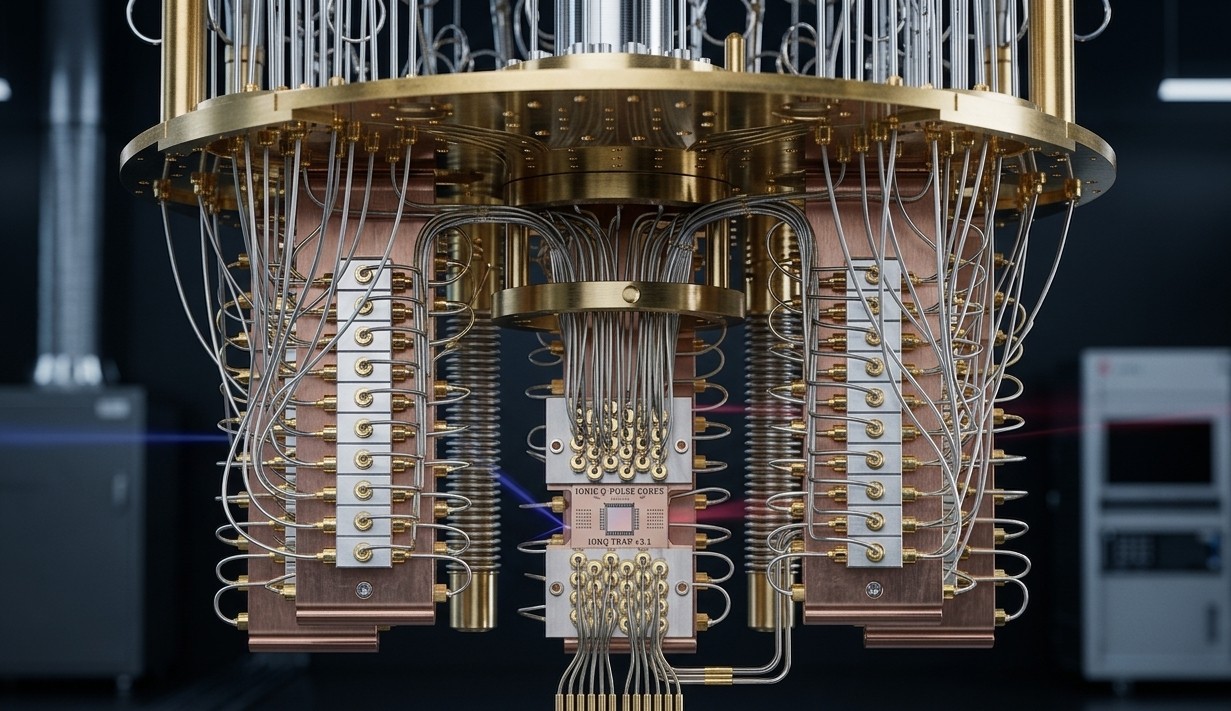
    If you have been watching the deep-tech space, Quantinuum (NASDAQ: QNT) is impossible to ignore right now. The company is the world’s largest integrated quantum computing firm. It designs both high-performance trapped-ion quantum computers and the software needed to run them. In fact, what makes them stand out isn’t just the futuristic tech, it’s how quickly they are translating lab science into boardroom revenue.

    The Pivot: From Isolated Tech to Hybrid AI

    Quantinuum’s smartest move has been pivoting away from the idea that quantum computers will completely replace classical computers. Instead, their “hardware-led and software-enhanced” strategy positions quantum as an essential layer within a hybrid ecosystem.

    Short-Term Success

    This pivot has already paid off massively. Quantinuum recently secured an industry-first partnership to deploy their Helios quantum system directly on Oracle Cloud Infrastructure (OCI). This integration works seamlessly with Oracle’s AI and classical compute workloads. On top of that, they locked in a strategic framework with HPE to combine quantum with high-performance computing (HPC).

    Long-Term Success

    By weaving their hardware directly into existing enterprise AI data centers, Quantinuum is positioning itself as the default quantum engine. That positioning targets a projected $10+ billion end-user market by 2030.

    The Tech: A Tangible Roadmap to 2030

    Quantum computing has a reputation for missed deadlines, but Quantinuum is actively delivering on its promises.

    Short-Term Progress

    They recently achieved a near five-nines (99.999%) logical fidelity on their current Helios system, pushing the boundaries of quantum error correction. They also hit 12 logical qubits on their System Model H2, a joint milestone achieved with Microsoft. Meanwhile, their next-generation Sol 2D QCCD trap chip is already back from the fabrication plant for validation.

    Long-Term Goal

    Their ultimate goal is universal, fully fault-tolerant quantum computing by 2030. They plan to achieve this with their upcoming fifth-generation Apollo system. That system aims to execute circuits with millions of gates, solving complex problems in chemistry, biology, and finance.

    Are They on Track?

    Overall, yes. They are concurrently investing in four generations of systems (Helios, Sol, Apollo, Lumos) and consistently release peer-reviewed data to validate their developmental milestones.

    The Financials: Heavy Burn, Heavy War Chest

    Quantinuum’s Q2 2026 earnings, their first as a public company after a massive $1.7 billion IPO in June, tell a story of aggressive scaling.

    Revenue Growth

    The top line is exploding. Q2 2026 revenue hit $8.0 million, representing a massive 279.4% Year-over-Year (YoY) increase from $2.11 million. Meanwhile, year-to-date bookings, heavily bolstered by the Oracle deal, surged past $81 million, driving immense Quarter-over-Quarter momentum.

    Earnings (EPS) and EBITDA

    Aggressive scaling isn’t cheap, so EBITDA has not yet improved. Adjusted EBITDA loss widened to $68.31 million, up from a $43.5 million loss last year. That widening reflects heavy investment in R&D. However, GAAP EPS was heavily skewed to -$1.93 due to $464 million in one-time stock compensation triggered by the IPO. Adjusted non-GAAP EPS, by contrast, sat at a much cleaner -$0.28.

    Cash Flow and Burn Rate

    Operating cash flow sat at -$66.19 million, a slight 5.23% dip from the prior quarter. Meanwhile, capital expenditures (Capex) cost the company roughly $16.6 million for the quarter. As a result, they are burning roughly $83 million per quarter in total cash.

    Runway and Path to Profit

    Do they need more funds? Absolutely not. Thanks to their IPO, they ended the quarter with $2.1 billion in cash and short-term investments. At their current quarterly burn rate, this cash provides over six years of runway. That gives them plenty of time to execute. Looking ahead, they project reaching positive free cash flow by 2030.

    Guidance

    They raised their full-year 2026 revenue outlook to $28 million to $32 million. Looking further out, management expects 2027 revenue to grow by more than 100%, based on their current backlog.

    Institutional Investment

    The company was privately incubated by Honeywell, which remains the dominant shareholder, until June 2026. As a result, public institutional investment went from zero to billions overnight once Quantinuum debuted on the Nasdaq.

    The Verdict: The Moat and the Investment Case

    For investors, QNT represents a rare pure-play opportunity in deep tech. The primary reason to invest is their unrivaled balance sheet. With $2.1 billion in cash on hand, investors face virtually zero near-term dilution risk. Even so, the company must still execute a highly capital-intensive roadmap.

    In short, their moat is threefold:

    • Hardware Lock-in: A fully scalable quantum charge-coupled device (QCCD) architecture built on trapped-ion technology. It requires highly specialized materials, including isotopes sourced from the U.S. Department of Energy.
    • Full-Stack Integration: They don’t just build the machine. Their proprietary software stacks integrate deeply into global enterprise networks like Microsoft Azure, Oracle Cloud, and Nvidia Cuda-Q. Those integrations create sticky, long-term commercial relationships.
    • Human Capital: They employ roughly 700 people, 40% of whom hold PhDs, creating a massive intellectual property barrier against new entrants.

    Source: Quantinuum

    Disclosure: The author has no position in $QNT and no commercial relationship with the company

  • $TE: Clean Energy Generation & Power Distribution

    $TE: Clean Energy Generation & Power Distribution

    T1 Energy Inc. (NYSE:TE)

    T1 Energy (NYSE: TE): The Big Pivot, Q2 Earnings, and What’s Next

    If you’ve been tracking energy transition plays, T1 Energy Inc. (NYSE: TE) has likely popped up on your radar. Originally rooted in European battery manufacturing (formerly known as FREYR Battery), the company completed a massive strategic pivot in 2024 to re-emerge as a vertically integrated U.S. solar supply chain provider.

    Here is a breakdown of their recent Q2 2026 performance, technology roadmap, and overall financial health to help you evaluate the investment thesis.

    The Business & Strategic Pivot

    • What They Do: T1 Energy focuses on building a vertically integrated domestic solar supply chain in the U.S..
    • Short-Term Pivot Success: They successfully shifted away from their legacy European battery plans, securing a foothold in the U.S. solar market and accelerating the buildout of key facilities like G2_Austin.
    • Long-Term Pivot Success: T1 is positioning itself as a one-stop U.S. alternative to imported solar hardware, allowing it to fully capitalize on IRA Section 45X tax credits.

    Technology Execution & Roadmap

    • Short-Term Tech Progress: T1 is actively scaling up capacity and reported an enhanced production outlook for the second half of the year.
    • Long-Term Tech Progress & Goal: The company has laid out a clear three-year strategic roadmap focused on deep vertical integration—meaning they want to control everything from raw material processing to final solar module assembly.
    • Are They on Track? Yes. Management recently highlighted steady progress at their G2_Austin facility and affirmed their 2026 production guidance, proving they are hitting their operational milestones.

    Financial Health: Q2 2026 Deep Dive

    T1 Energy released its Q2 2026 results in August 2026. While the company is in a highly capital-intensive buildout phase, top-line growth has been explosive.

    MetricQ2 2026 Snapshot
    Cash on Hand$149 million (including cash equivalents and restricted cash)
    Adjusted EBITDAExpected around -$14.5 million as they scale operations
    Earnings Per Share (EPS)-$0.14 per share, slightly beating expectations
    Revenue Growth (YoY)Massive growth. For context, FY2025 revenue hit $755.3M—up over 25,000% from the prior year.

    Cash Burn & Profitability Timeline: T1 Energy is spending heavily on CapEx to build its gigafactories. The timeline to reach net profitability hinges entirely on how quickly they can scale this new capacity and lift their gross margins. With $149 million in liquidity, they have the runway to fund near-term operations, though future capital raises are a standard risk for growth-stage energy infrastructure companies.

    The Moat & Institutional Backing

    • The Economic Moat: T1’s primary moat is its domestic supply chain. Because utility-scale developers are hungry for U.S.-made components to unlock maximum government tax advantages (like Section 45X), T1 enjoys a structural preference over foreign competitors facing tariffs.
    • Institutional Ownership: Wall Street is paying attention. T1 Energy currently has 469 institutional owners who have filed 13D/G or 13F forms, showing sustained smart-money interest in their post-pivot strategy.

    Ultimately, T1 Energy is a high-conviction, pure-play bet on American solar re-shoring. If management continues to execute flawlessly against its operational roadmap, the long-term upside could be substantial.

    Disclosure: The author has no position in $TE and no commercial relationship with the company

  • $IONQ: Trapped-Ion Quantum Computing Platforms

    $IONQ: Trapped-Ion Quantum Computing Platforms

    IonQ, Inc. (NYSE: IONQ)

    The Quantum Leap: Why IonQ (IONQ) is Pulling Away from the Pack in 2026

    If you’ve been following the quantum computing sector, you know it’s a space full of enormous promises and equally massive capital expenditures. But based on the latest 2026 earnings and strategic moves, one company is turning those sci-fi promises into tangible business realities: IonQ, Inc. (NYSE: IONQ).

    Whether you are already an investor or just doing your due diligence, here is a deep dive into what IonQ is doing, their financial health, and why they might just be the most compelling quantum play on the market right now.

    What Does IonQ Actually Do?

    At its core, IonQ builds quantum computers. Unlike companies using superconducting qubits (like IBM or Google), IonQ uses trapped-ion technology. They trap individual atoms in 3D space using lasers to perform calculations. This approach traditionally offers longer coherence times and lower error rates, making their qubits incredibly accurate. They offer their quantum computing power as a service via major cloud providers (AWS, Google Cloud, Azure) and through direct enterprise deployments.

    The Ultimate Pivot: The SkyWater Acquisition

    The biggest strategic success for IonQ—both short and long term—has been their aggressive pivot from being purely a hardware design and software company to a vertically integrated full-stack quantum powerhouse.

    In July 2026, IonQ completed a massive $1.8 billion acquisition of SkyWater Technology.

    • Short-term win: They immediately secured their own semiconductor fabrication pipeline, insulating themselves from global supply chain bottlenecks.
    • Long-term win: They now own the manufacturing process for their advanced quantum networking chips and custom substrates. By controlling the hardware from the silicon level up to the cloud interface, they have created a massive barrier to entry for competitors.

    Technology Progress: Turning Ambition into Reality

    Are they on track with their roadmap? Absolutely. IonQ has historically hit or exceeded their technical milestones, and 2025/2026 has been no different.

    • Short-Term Progress: They successfully deployed their enterprise-grade IonQ Tempo quantum computers globally. Furthermore, they recently hit their critical milestone of 99.99% two-qubit gate fidelity, which is essentially the gold standard for quantum accuracy.
    • Long-Term Progress & Goal: Their ultimate goal is achieving true, commercial-scale fault-tolerant quantum computing. Instead of trying to build one impossibly massive quantum chip, IonQ is using a modular approach—connecting smaller, highly functional trapped-ion systems via photonic quantum networking. This makes scaling up both practical and cost-effective.

    Financial Status: A $3.1 Billion Fortress

    The biggest risk in quantum computing is running out of money before the technology matures. IonQ has virtually eliminated this risk.

    • Cash on Hand & Runway: IonQ exited early 2026 with a staggering $3.1 billion in cash, cash equivalents, and investments.
    • Burn Rate & Funding Need: Their annual burn rate sits around $283 million (roughly $70 million per quarter).
    • Longevity: At this current burn rate, IonQ has an astonishing 11+ years of cash runway. Even better, that cash pile generates roughly $56 million a year just in interest income. They do not need to raise additional funds anytime soon.
    • Profitability: While they are not yet profitable (quantum is deeply capital intensive), their timeline to profitability is safely covered by their massive runway. Capital expenditures (CapEx) remain manageable relative to their cash, historically hovering in the double-digit millions annually, though expected to scale as they integrate SkyWater’s facilities.

    Revenue, Cashflow, and Earnings Growth

    IonQ is transitioning from a research firm into a revenue-generating machine.

    • Revenue Growth: In Q2 2026, IonQ reported record revenues, growing an eye-popping 287% Year-Over-Year (YoY).
    • Quarter-over-Quarter (QoQ): Sequential growth remains strong, driven by high cloud utilization and the physical deliveries of their Tempo systems.
    • Guidance: Management is highly confident, officially raising their full-year 2026 revenue guidance to an impressive $280 – $290 million.
    • EBITDA & EPS: As expected for a hyper-growth tech company, EPS remains negative. Their Q2 2026 Adjusted EBITDA was a loss of roughly $120 million, reflecting the heavy R&D costs and the integration of their new acquisitions. Cashflow remains negative, but the top-line revenue explosion is what the market cares about right now.

    Institutional Conviction

    If you want to know if a company is legit, follow the “smart money.” Over the last three years, institutional ownership in IonQ has skyrocketed. In the last 24 months alone, institutions have bought over 120 million shares, representing over $6.2 billion in transaction volume. There are now nearly 1,200 institutional owners backing the company, showing massive Wall Street conviction in IonQ’s roadmap.

    The Investor Takeaway: Why Invest?

    What is IonQ’s Moat?

    It comes down to three things:

    1. Unmatched Balance Sheet: $3.1 billion in cash means they can outlast and outspend almost any pure-play quantum startup.
    2. Vertical Integration: Buying SkyWater makes them the only full-stack, vertically integrated quantum platform company.
    3. Superior Tech: Their trapped-ion modular networking approach is proving to be the most viable path to fault-tolerant quantum scaling.

    IonQ is no longer just a speculative bet on physics; it is a rapidly scaling, well-funded business executing a brilliant long-term strategy.

    Disclosure: The author has no position in $IONQ and no commercial relationship with the company

  • $AMD: High-Performance Compute & Accelerated Silicon

    $AMD: High-Performance Compute & Accelerated Silicon

    Advanced Micro Devices, Inc. (NASDAQ: AMD)

    What Does AMD Do?

    At its core, AMD is a fabless semiconductor designer. They don’t build the factories (foundries like TSMC do that); instead, they design the brainpower behind modern computing. Their lineup spans four core areas:

    • Data Center: EPYC server CPUs and Instinct AI GPUs.
    • Client Computing: Ryzen processors for laptops and desktop PCs.
    • Gaming: Radeon graphics cards and custom chips powering the PlayStation 5 and Xbox Series X.
    • Embedded/Networking: Adaptive SoC chips from their Xilinx acquisition and Pensando networking hardware.

    The Power of the Pivot: Survival to AI Challenger

    AMD’s history is defined by two major pivots:

    • Long-Term Pivot (The Turnaround): A decade ago under CEO Dr. Lisa Su, AMD pivoted away from failing PC architectures to focus on its chiplet-based EPYC server processors. That move saved AMD from potential bankruptcy, systematically eating away at Intel’s market share in cloud data centers.
    • Short-Term Pivot (The AI Acceleration): Over the past two years, AMD rapidly shifted engineering weight toward AI training and inference hardware. Pivoting from purely general-purpose CPUs to purpose-built AI accelerators like the Instinct MI300 and MI350 series allowed AMD to capture urgent demand from hyperscalers seeking alternatives to NVIDIA.

    Tech Progress & Roadmap: Are They on Track?

    AMD is currently executing on a strict annual cadence for AI hardware and core architecture:

    • Short-Term Tech Progress: Rollout of the CDNA4 architecture, featured in the Instinct MI350 and MI355X accelerators with up to 288GB of HBM3E memory. On the CPU side, their Zen 5 architecture is shipping across consumer and server platforms.
    • Long-Term Tech Progress & Goals: The upcoming MI400 series paired with HBM4 memory, alongside the “Helios” rack-scale AI architecture—integrating EPYC “Venice” CPUs, MI400 GPUs, and Pensando AI NICs into unified AI racks.
    • Roadmap Track Record: Yes, AMD is fully on track. They have hit every major milestone on time, closing the performance and software gap through continuous updates to their open-source ROCm software stack.

    Financial Status: Cash Flow, Profits, and Growth

    Unlike pre-revenue startups, AMD operates from a position of financial strength:

    • Profitability Status: AMD is already highly profitable and has been for years. They generate billions in net income annually.
    • Revenue Progress:
      • Q2 Revenue: $11.54 Billion, representing +50.1% YoY growth and a strong +12.6% QoQ increase over Q1 ($10.25B).
      • Diluted EPS: $1.66, beating Wall Street consensus ($1.62).
    • Cash Flow & Capital Expenditure:
      • Free Cash Flow: Strong positive cash conversion, generating $2.6 Billion in a single quarter.
      • CapEx Spending: Reached ~$808 Million per quarter as they ramp up supply chain capacity for AI chips.
    • Capital Needs & Runway: AMD requires zero outside funding or emergency financing. Operating cash flows fully fund CapEx, and their $8+ billion cash balance means runway is indefinite under current operations.
    • Short-Term Guidance: Management projects Q3 revenue to climb further into the $12.4B to $13.3B range (centered around $12.8B), driven by accelerating AI chip shipments.

    Institutional Backing & The Economic Moat

    • Institutional Growth: Institutional ownership stands at ~71%–75%. Over the last three years, institutional funds have steadily expanded their positions as AMD proved its viability as a long-term AI play.
    • Why Invest / AMD’s Moat:
      1. x86 Cross-License: AMD holds one of only two licenses on Earth to build x86 processors, creating an insurmountable barrier to entry for prospective CPU competitors.
      2. Chiplet Architecture: Pioneer in modular 3D chiplet stacking, allowing higher manufacturing yields and lower costs.
      3. Full-Stack Ecosystem: AMD is one of the few silicon companies capable of supplying an entire end-to-end data center—CPUs, GPUs, SmartNICs, and custom FPGAs.

    Disclosure: The author holds a long position in $AMD stock at the time of writing

  • $LAES: Post-Quantum Cryptography & Secure Semiconductor

    $LAES: Post-Quantum Cryptography & Secure Semiconductor

    SEALSQ Corp (NASDAQ: LAES)

    Hardware-Level Security and Quantum-Resistant Silicon

    Beyond the Quantum Threat: Is SEALSQ ($LAES) the Sleeper Semiconductor Play of the Decade?

    Quantum computing is set to render traditional encryption (RSA and ECC) obsolete. While most security companies are trying to fix this issue with software patches, SEALSQ Corp (NASDAQ: LAES) is taking a radically different route: embedding quantum-resistant cryptography directly into microchip hardware.

    Below is an in-depth breakdown of $LAES’s technology, financials, pivot success, and investment thesis.

    1. What Does SEALSQ Do?

    SEALSQ is a fabless semiconductor and cybersecurity company. They specialize in three core pillars:

    • Post-Quantum Cryptography (PQC) Semiconductors: Next-generation microchips designed to withstand attack from future quantum computers.
    • Public Key Infrastructure (PKI) & Provisioning: Digital identity solutions that verify devices across IoT networks, medical hardware, automotive systems, and defense platforms.
    • Custom ASIC Design & Space Security: Custom silicon engineering through their French subsidiary, IC’Alps, combined with quantum-secure satellite IoT communications via WISeSat.

    2. The Strategic Pivot: From Legacy Chips to Quantum Dominance

    SEALSQ’s evolution from a legacy secure-element provider into a specialized post-quantum hardware player represents one of the sharpest strategic pivots in the microchip sector.

    • Short-Term Pivot Success: The August 2025 acquisition of French ASIC design firm IC’Alps. This instantly added over $3.5M in high-margin engineering revenue and gave SEALSQ full in-house custom ASIC capabilities to meet sovereign semiconductor demands in Europe.
    • Long-Term Pivot Success: Transitioning from static hardware encryption to Hardware-Native Post-Quantum Security-as-a-Service. Instead of selling one-off chips, SEALSQ is building an integrated ecosystem spanning hardware Roots of Trust, PQC lifecycle updates, and secure space satellite connectivity (WISeSat).

    3. Technology Progress & Roadmap Status

    SEALSQ is burning NIST-standardized algorithms (ML-KEM-1024, ML-DSA-87) directly into hardware.

    • Short-Term Tech Progress: Production sampling of its first-generation QS7001 V1 Secure Element and QVault TPM-183 chips began in March 2026.
    • Long-Term Tech Progress: The upcoming QS7001 V2 chip (in wafer manufacturing as of early 2026) extends hardware protection to the full cryptographic API level.
    • Technology Goal: To establish the world’s leading “hardware-native” post-quantum security architecture.
    • Roadmap Status: On Track. All major PQC products are currently tracking green across Common Criteria (CC), FIPS 140-3, and TCG certification schedules through Q4 2026.
    Product LineCurrent Status (2026)Key Target MilestoneCertification Status
    QS7001 V1Production Samples ShippedCC Hardware Test ReportOn Track (Green)
    QS7001 V2Wafer Fab / Engineering SamplesFull PQC API CC Approval (Q3/Q4)On Track (Green)
    QVault TPM-183Production Samples AvailableFIPS 140-3 & TCG ApprovalOn Track (Green)

    4. Financial Deep Dive: Cash Runway, Revenue, and Growth

    SEALSQ’s balance sheet is defined by an massive cash buffer that virtually eliminates bankruptcy risk while funding aggressive R&D.

    Financial Health & Runway Summary

    • Cash & Liquid Investments: Approximately $495M – $525M (as of mid-2026).
    • Quarterly Cash Burn: ~$7.5M to $8M per quarter (~$31M operating cash outflow annually).
    • Additional Funding Needed: $0. They are fully funded for organic operations.
    • CapEx Spending: Very light (~$743K in FY2025) due to their fabless model.
    • Cash Runway: 10+ Years at current operating burn rates.
    • Path to Profitability: Expected as the active $225M+ business pipeline converts into full-scale production orders through 2026–2027.

    Revenue & Profitability Progress

    MetricHistorical PerformanceCurrent Momentum (2026)
    YoY Revenue ProgressFY2025: $18.3M (+66% YoY)H1 2026 Preliminary: ~$11M (+120% YoY vs $5M)
    QoQ Revenue ProgressQ1 2026: ~$4MQ2 2026 Preliminary: ~$7M (+75% QoQ)
    EBITDA / Operating IncomeFY2025 Net Loss: -$34.2M (includes $11.2M non-cash stock comp)Improving operational leverage as revenue accelerates
    EPS ProgressTrailing EPS: -$0.18 to -$0.21Expected to narrow as commercial shipments scale
    FY 2026 Guidance$27M – $36M (Reaffirmed 50% – 100% YoY Growth)

    5. Institutional Investment Expansion (3-Year Trend)

    When SEALSQ spun off in 2023, institutional ownership was minimal (<3%). Over the last three years, institutional participation has expanded significantly:

    • Institutional Shareholding: Grew to approximately 15.95% by mid-2026.
    • Institutional Count: Over 120+ institutional holders now file 13F forms (including major positions and calls from Citadel, Susquehanna, Jane Street, Heights Capital, and Two Sigma).

    6. Why Invest in $LAES? The “Hardware-Native” Moat

    1. Unbreakable “Silicon-Level” Moat: Software PQC solutions suffer from massive latency penalties. SEALSQ’s QS7001 Quantum Shield bakes post-quantum algorithms directly into microchips, offering up to 10x performance improvements.
    2. Asymmetric Valuation Cushion: With ~$495M+ in cash/short-term assets, a significant portion of SEALSQ’s market capitalization is backed by pure cash, meaning investors get the PQC technology, ASIC designs, and $225M+ pipeline at a steep enterprise-value discount.
    3. Regulatory Mandates: Global standards bodies and governments are mandating post-quantum migration for critical infrastructure by 2026–2030, creating a mandatory multi-billion-dollar market replacement cycle.

    Disclosure: The author holds a long position in $LAES stock at the time of writing