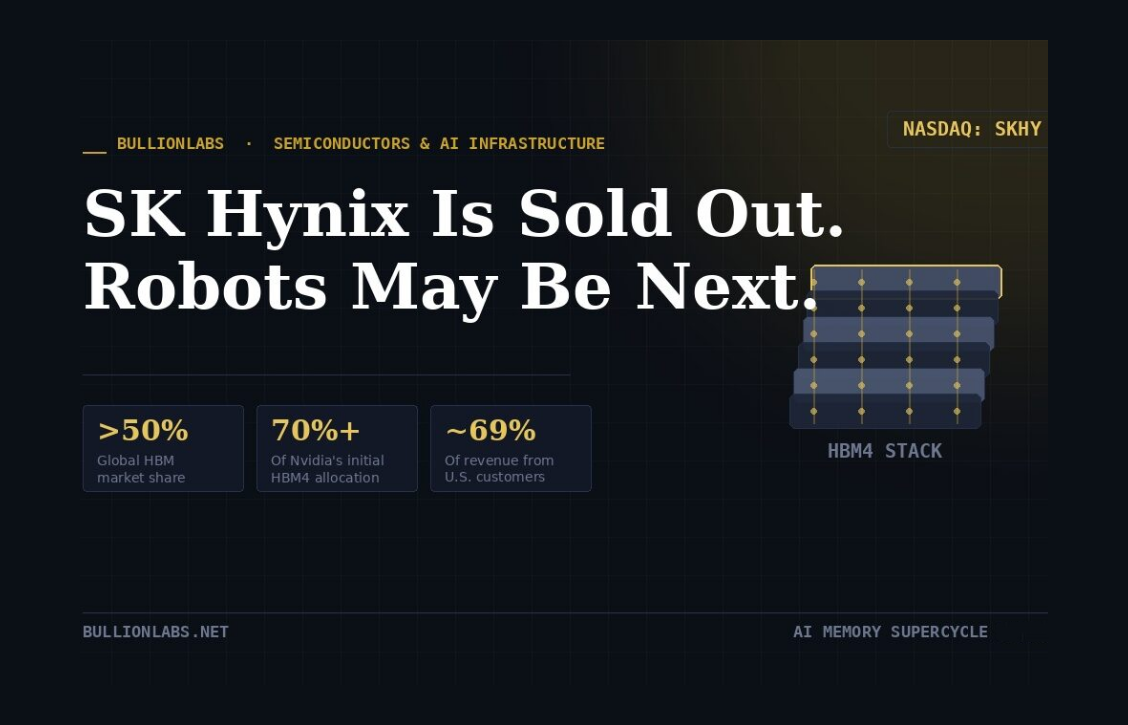
SK Hynix Inc. – ADR (NASDAQ: SKHY)
The world’s top AI memory supplier is riding an unprecedented upcycle and already eyeing what comes after data centers.
SK Hynix has spent the better part of three decades as a cyclical also ran to Samsung a memory maker whose fortunes rose and fell with the brutal boom bust rhythm of the DRAM market. That reputation no longer fits. Since Nvidia’s GPUs began shipping with SK Hynix’s high-bandwidth memory (HBM) stacked directly alongside the compute die, the company has become one of the more consequential suppliers in the entire AI hardware stack not a chipmaker riding the AI boom so much as one of the physical constraints on how fast that boom can grow.
The company controls a majority of the global HBM market and, by most industry counts, supplies more than 70% of Nvidia’s initial orders for HBM4, the next-generation standard now ramping toward volume production. Samsung is chasing hard, and Micron has carved out a smaller but growing share of the same market but for the moment, SK Hynix is setting the pace.
From training runs to permanent memory
For the first few years of the generative-AI boom, the bottleneck was compute raw GPU throughput for training ever larger models. That story is shifting. As AI systems move from pure training toward persistent inference, agents, and retrieval heavy workloads, the industry increasingly needs somewhere to keep data close to the processor, not just crunch it once and discard it. Every additional data center built to serve that shift needs more memory, not just more compute, and the major chipmakers Nvidia, AMD, Micron, Samsung, and SK Hynix among them have been consistent on one point: the memory shortage now underway is a structural feature of this cycle, not a temporary supply hiccup, and it’s expected to persist for the next several years.
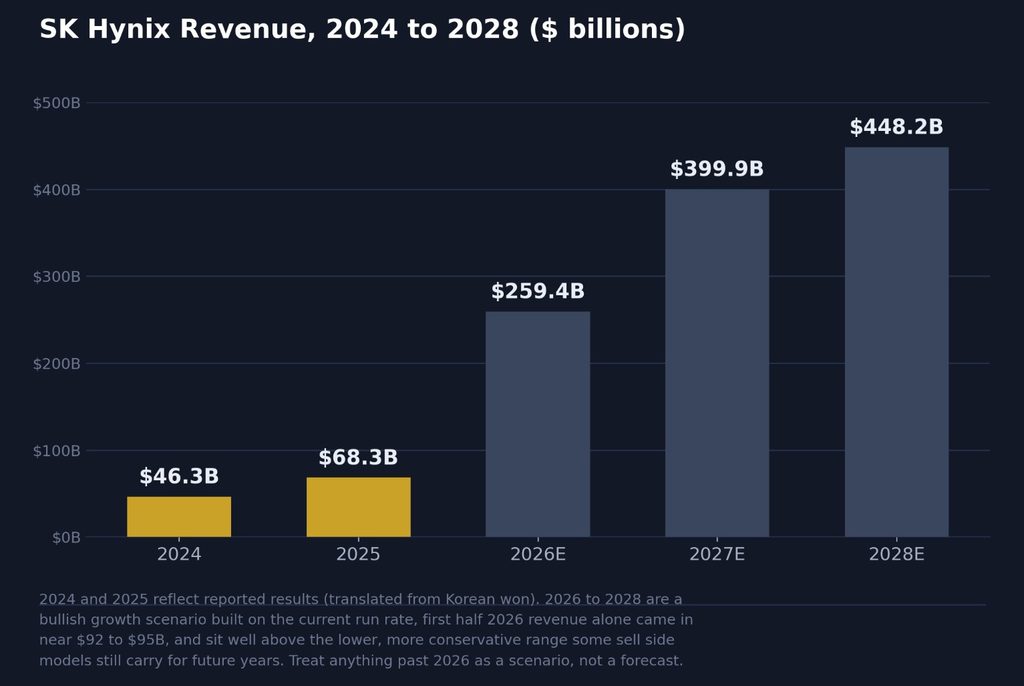
That raises the obvious question hanging over every AI infrastructure stock: what happens when the current wave of data center construction matures and spending normalizes? SK Hynix’s own answer, echoed by much of the industry, is that data centers are only the first leg. The next is physical a coming wave of AI-enabled robotics that would extend memory and compute demand well beyond racks in a warehouse and into cars, factories, and eventually homes. Whether that materializes on the timeline bulls expect is very much an open question, but it’s the thesis increasingly used to justify capital spending plans that would have looked reckless in any previous memory cycle.
Beyond HBM: the next memory tier
SK Hynix’s HBM lead is well established. Less understood is what the company is building next. Alongside SanDisk, it has been co-developing a technology called High-Bandwidth Flash, or HBF and it’s worth being precise about what that actually is, because it’s often described loosely. HBF does not stack HBM chips on top of each other. It stacks layers of NAND flash memory using the same through silicon via packaging techniques HBM pioneered, creating a new tier that sits between fast but limited HBM and large but slow SSD storage.
The point of HBF is capacity, not raw speed: a single stack can hold many times more data than HBM at a fraction of the cost, which matters enormously for AI inference, where a model’s cached context can balloon into the hundreds of gigabytes. SK Hynix and SanDisk released the first open HBF specification in mid-2026 under the Open Compute Project, with Google and AI-chip startup Tenstorrent joining the effort a sign hyperscalers see real value in a cheaper, denser memory tier for inference workloads. Samsung appears to be pursuing a related but distinct approach of its own, stacking memory differently rather than adopting the HBF standard outright, while Micron has not yet detailed a competing product in this specific category.
“The HBM era is ending the HBF era is coming,” one SK Hynix executive told an industry conference in late 2025, previewing what the company hopes becomes the next multi-year growth leg once HBM itself matures.
Who’s actually buying this
Geographically, SK Hynix’s customer base is heavily concentrated a fact that cuts both ways. The United States, driven almost entirely by hyperscaler and AI-accelerator demand, accounts for roughly two-thirds to seventy percent of total revenue depending on the quarter, with China a distant but resurgent second on the back of mobile and NAND demand. That concentration means SK Hynix’s results are unusually sensitive to a handful of customers Nvidia chief among them, alongside at least one large, unnamed hyperscaler that has separately grown into a top-tier customer in its own right and to any shift in U.S.–China trade policy or export controls.

What management is promising
SK Hynix’s own guidance has become the thing to watch each quarter, if only because the company keeps having to raise it. Capital expenditure for 2026 has been pushed up repeatedly through the year into the low to mid $30 billion range by the most recent count, with some estimates, once packaging and infrastructure commitments are included, pushing past $35 billion. That’s a record for the company and among the largest capex programs in the memory industry’s history.
- HBM and technology leadership: Management continues to guide to more than 50% global HBM share, with over 70% of Nvidia’s initial HBM4 allocation locked in.
- Shipments and migration: Double digit sequential DRAM bit growth guided for the second half of 2026, alongside a push to get 321 layer NAND to roughly half of total NAND capacity by year end.
- Fab scaling: Plans to expand 1c nanometer DRAM output toward 170,000–200,000 wafers per month by early 2027, and a new advanced packaging facility under construction in West Lafayette, Indiana, at a cost north of $4 billion.
- Contract backlog: Multi year supply agreements now in place with roughly ten major hyperscale customers reportedly including Nvidia, AWS, and Google several of which include upfront cash deposits that lock in pricing years in advance.

What the market is paying for it
Wall Street’s enthusiasm shows up most clearly in earnings-per-share growth, which the sell side expects to keep compounding even as the revenue base gets much larger. On a per common share basis (SK Hynix’s Nasdaq listed ADRs represent one-tenth of a common share, so divide by ten for the per ADR equivalent), consensus estimates have EPS climbing sharply through 2026 before growth normalizes into 2027 and 2028.

Target prices: three ways of looking at the same stock
Because so much of the bull case rests on how long the current pricing power lasts, target-price models for SK Hynix tend to spread out unusually wide. A simple earnings multiple framework 2026 consensus EPS multiplied by a range of forward P/E multiples illustrates just how much the multiple assumption matters more than the earnings number itself:
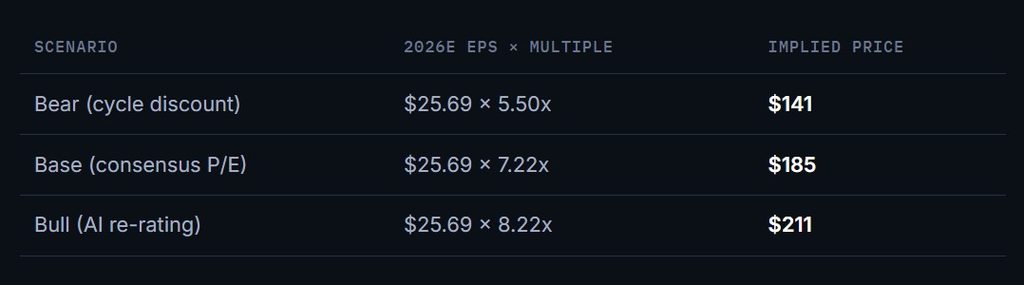
The bear case assumes the market eventually re-applies the discount it has historically given Korean memory stocks and cyclical semiconductor names generally. The bull case assumes SK Hynix keeps re-rating toward the multiples U.S. peers like Micron have commanded during past AI-driven upcycles. Roll the same framework forward to 2027 EPS and the spread is similar in shape, just shifted higher anywhere from roughly $147 in a trough-multiple scenario to $237 if SK Hynix holds its 2026 multiple into the following year.
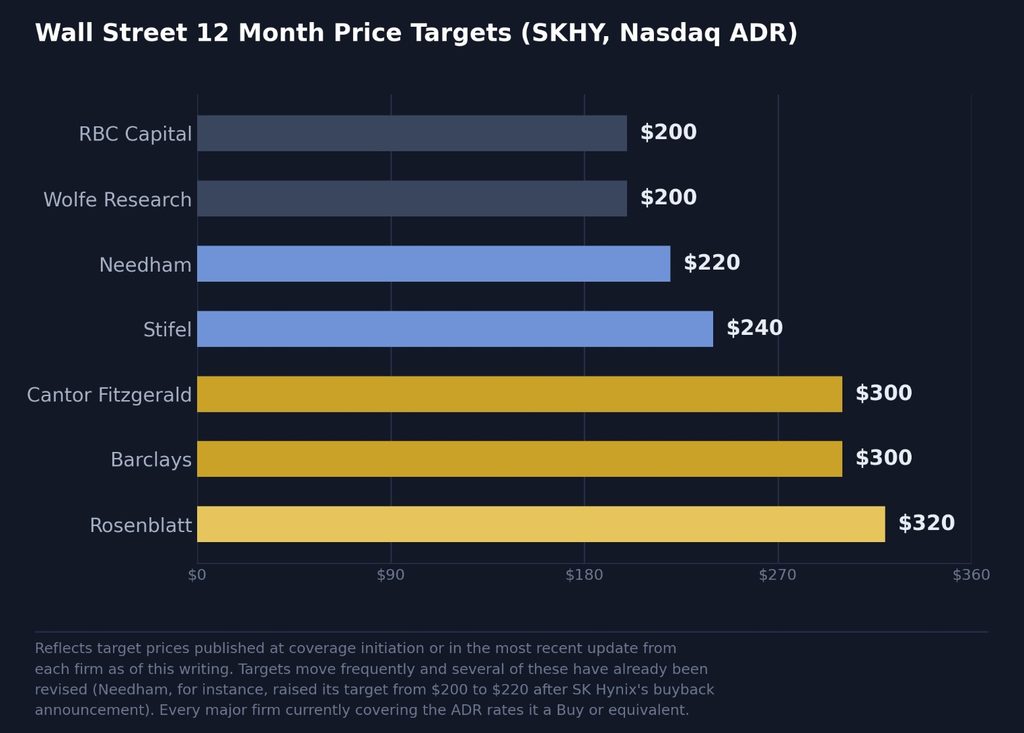
Every analyst currently covering SK Hynix’s Nasdaq ADR rates it a buy, with targets clustered between $200 and $320 a genuinely unusual amount of one directional consensus for a memory stock, and arguably a risk in itself. When an entire sell side community agrees this strongly, the disagreement that matters has usually moved into how far and how long the cycle runs, not whether the stock is a buy today.
Who owns it
Ownership is one area where the original draft’s figures didn’t hold up well against SK Hynix’s own disclosures, so it’s worth restating cleanly. SK Square the SK Group holding entity spun out of SK Telecom in 2021 remains the controlling shareholder with roughly 20% of shares outstanding. South Korea’s National Pension Service holds around 7–8%, and foreign institutional investors collectively led by BlackRock, Vanguard, and Singapore’s GIC own more than half the company, on the order of 54–56%. The remainder is split between domestic institutions and retail shareholders. Insider and employee ownership, by contrast, is minimal, consistent with a company of this scale.
Sources: TradingView, TipRanks, Seeking Alpha, TIKR
Disclosure: The author holds a long position in $SKHY stock at the time of writing