Tag: AI Compute

  • Celestica (CLS): The Company Solving the Demand for AI Compute Systems

    Celestica (CLS): The Company Solving the Demand for AI Compute Systems

    Celestica is not a name most people talk about at dinner. But if you follow AI stocks, it should be on your list. The latest numbers are strong, and the story has some twists too, including a big share sale in August.

    cls rack

    What does Celestica do?

    Celestica is a Toronto based company that designs and builds hardware for data centers. Its biggest unit, Connectivity and Cloud Solutions, covers networking switches, AI compute systems, and storage for the largest cloud companies. The smaller unit, Advanced Technology Solutions, serves aerospace, defense, industrial, health tech, and capital equipment customers.

    Think of it as the company that builds the pipes and racks inside AI data centers.

    celestica revenue growth

    Celestica’s latest quarter

    Celestica reported Q2 2026 results on July 27. Revenue hit $4.70 billion, up 62% from $2.89 billion a year earlier. Q1 revenue was $4.05 billion, so revenue grew about 16% from one quarter to the next.
    celestica eps growth

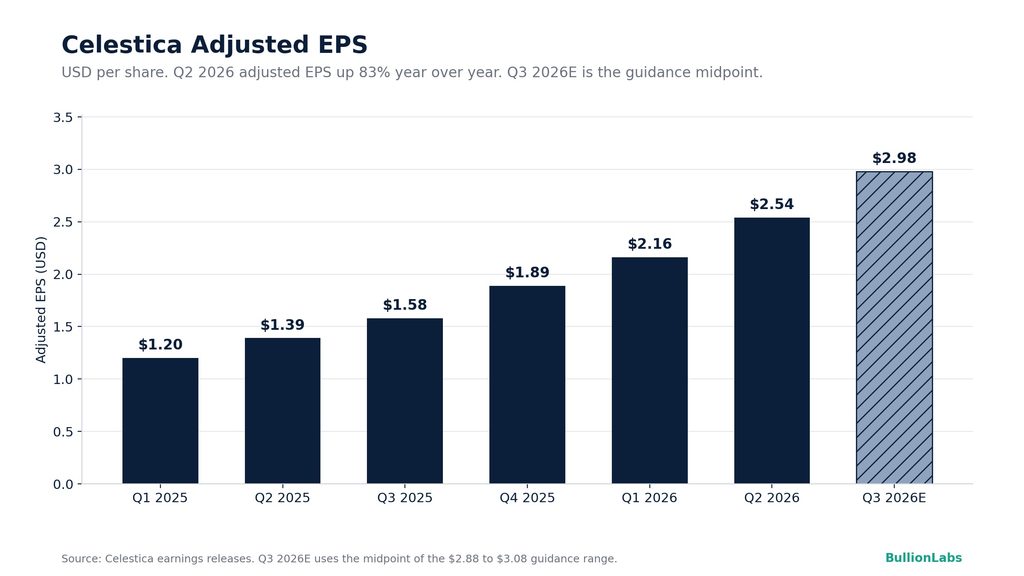
    Earnings per share followed the same path. Adjusted EPS was $2.54, compared to $1.39 a year ago. In Q1 it was $2.16, so EPS grew roughly 18% quarter over quarter and 83% year over year. GAAP EPS was $3.17, but part of that came from a swap gain, so the adjusted number is the cleaner one to watch.

    celestica cash flow

    How is the cash flow?

    It improved. Cash from operations was $410.9 million in Q2, up from $152.4 million a year ago. Free cash flow was $147.1 million, up from $119.9 million. It did not rise as fast because spending on equipment jumped.

    For the year, management now expects free cash flow of $600 million, up from $500 million.

    Celestica spending, funding, and cash runway

    Growth costs money. Celestica plans about $1 billion of capital spending in 2026 and is expanding sites in Thailand, Japan, and Texas. A rough placeholder for 2027 is $1.5 billion. Spending is already running at about $260 million per quarter.

    At the end of June, cash was $535.7 million, against roughly $810 million of borrowings. Then came the big move. In August, Celestica priced an equity offering of 9,677,419 shares at $310 each, for about $3 billion. The money is meant for working capital and capital spending.

    My math: the raise roughly covers the planned 2026 and 2027 spending combined, so cash runway is not a worry. The cost is dilution of about 8% in share count. The stock dropped after the news.

    Technology: near term, long term, and the goal

    Short term, the story is faster networking. The CEO said there are 10 active 1.6T programs, while 800G and 400G products keep growing. The 1.6T programs begin production in the second half of 2026.

    Long term, the bigger prize is AI compute. Management pointed to new programs with OpenAI, AMD, and Broadcom, including custom accelerator racks. Management expects these to scale in 2027.

    The goal is clear. Celestica wants to be a core design and build partner for AI data centers, not just a contract assembler. The CEO said capacity planning is already set for 2026 and 2027.

    Is it on track? So far, yes. Q2 revenue and adjusted EPS both landed above the high end of guidance. Back in October 2025, the 2026 outlook was $16 billion in revenue. It is now $20.5 billion. The main limit is not demand. It is component supply.


    Supply is the part to watch. Celestica says demand is not the problem, parts are. AI compute systems need a lot of memory, and memory makers know it. Many of them are now signing long term agreements to lock in customers for years. That shows how tight supply is across the AI chain. It also explains why Celestica has to plan its capacity so far ahead.

    Guidance

    Near term, Q3 revenue is guided to $5.25 billion to $5.55 billion, with adjusted EPS of $2.88 to $3.08.

    celestica outlook backlog

    For the full year, the outlook is $20.5 billion in revenue, $11.30 in adjusted EPS, and an 8.4% adjusted operating margin. That implies growth of 65% in revenue and 87% in EPS.

    Longer term, management expects 2027 revenue growth to beat 65%, with EPS growing even faster. There is no formal target past 2027.

    celestica ownership pie

    What are institutions doing?

    Big money is clearly involved. MarketBeat shows institutions own about 67% of the stock, and 606 institutions held shares over the past two years. They bought about 47 million shares in the last 24 months.

    Why Celestica may be worth a look

    Growth is the first reason. Revenue is up 62% and still accelerating, with guidance pointing to even faster growth in 2027.

    Quality is the second. Margins are at record highs, and the return on invested capital was 55.5% in Q2 on the company’s own measure.

    Funding is the third. Free cash flow is positive, and the $3 billion raise removes most financing worries.

    Visibility is the fourth. Ten separate 1.6T programs spread the risk across many projects instead of one.
    celestica price targets

    Celestica stock price targets from Wall Street

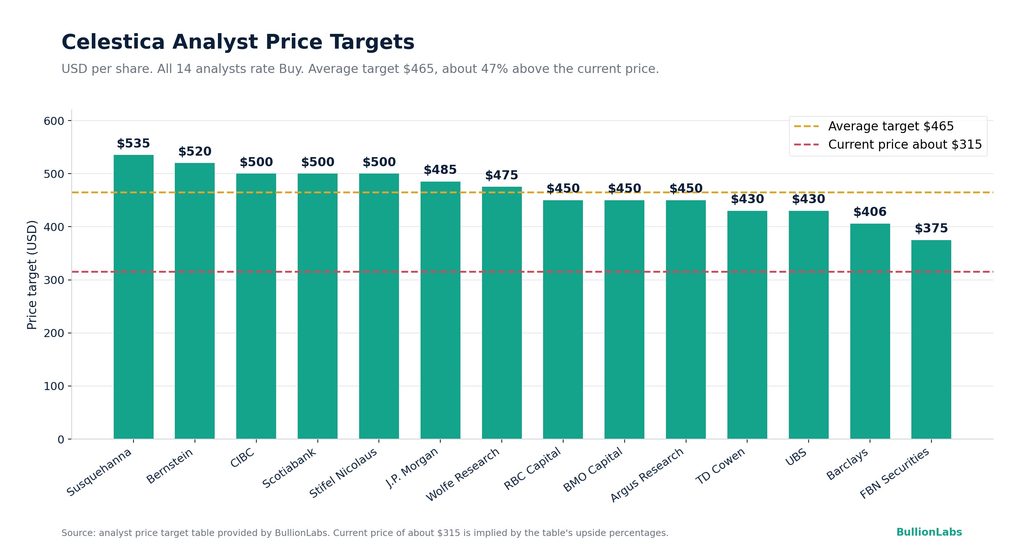
    Wall Street is bullish on Celestica. Every analyst in my table rates it a Buy.

    The highest target is $535 from Susquehanna. The lowest is $375 from FBN Securities. The average sits near $465, about 47% above the recent price.

    Targets are opinions, not promises, so keep watching the next earnings report.

    What to watch

    Dilution is real. Component shortages could slow shipments. Customers are concentrated among a few giant cloud and AI names, so a pullback in their spending would hit hard. Leadership is also changing, with a new structure starting October 1.

    Q3 results are due soon, so the next update will test whether the guidance holds.

    Disclosure: The author holds a long position in $CLS stock at the time of writing

    Sources: Investing.com, Celestica, Tradingview, MarketBeat
  • NBIS Stock Analysis: Is Nebius Worth Buying in 2026?

    NBIS Stock Analysis: Is Nebius Worth Buying in 2026?

    Nebius Group N.V. (NASDAQ: NBIS)

    NBIS stock is up about 180% this year. Revenue is exploding, but so are costs and debt.

    What does Nebius do?

    Nebius is an AI cloud company. It rents out GPU computing power. It is building a full platform for developers and companies, from data and model training to live deployment.

    The AI cloud business makes up about 98% of group revenue. Nebius also owns Avride, an autonomous vehicle platform, and TripleTen, an edtech service. Both are small. Nebius competes in a crowded field of AI cloud and GPU providers, so we also track $IREN.

    Short term technology progress

    Nebius is scaling power and products at the same time.

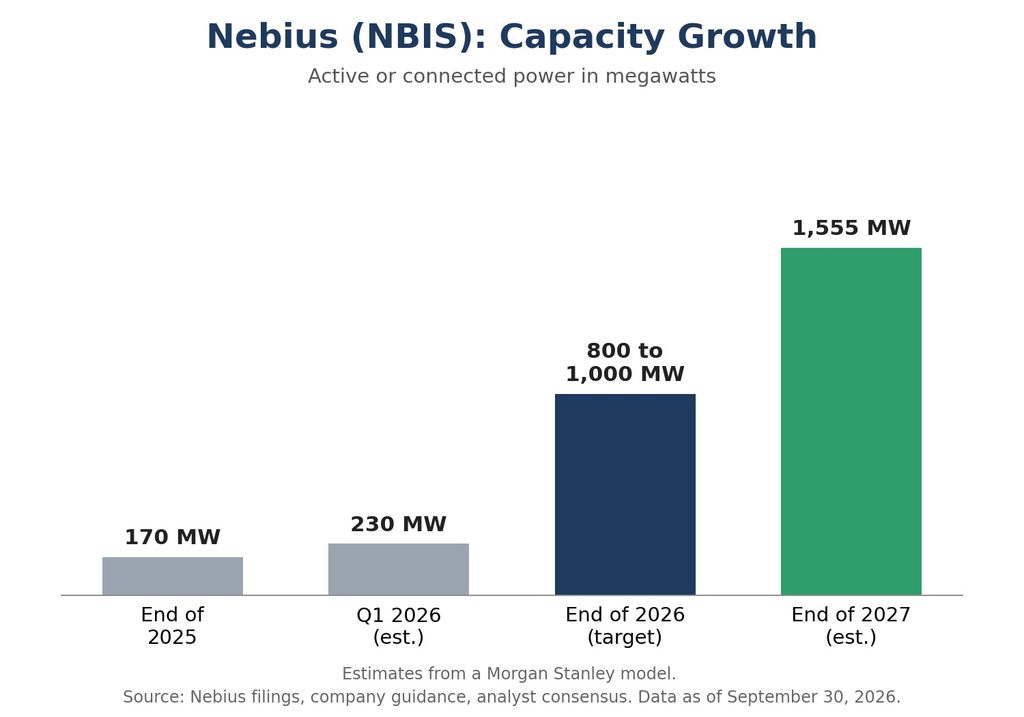
    It ended 2025 with about 170MW of active power, against a target of 100MW. It now targets 800MW to 1GW of connected power by the end of 2026.

    nbis capacity growth

    On the product side, it runs Token Factory, an inference platform with open models such as Kimi K3, GLM 5.2 and Nemotron Ultra. It also plans to use Nvidia’s Groq 3 LPX for fast inference. In September, Palantir named Nebius its preferred sovereign AI infrastructure partner.

    Long term technology progress and goal

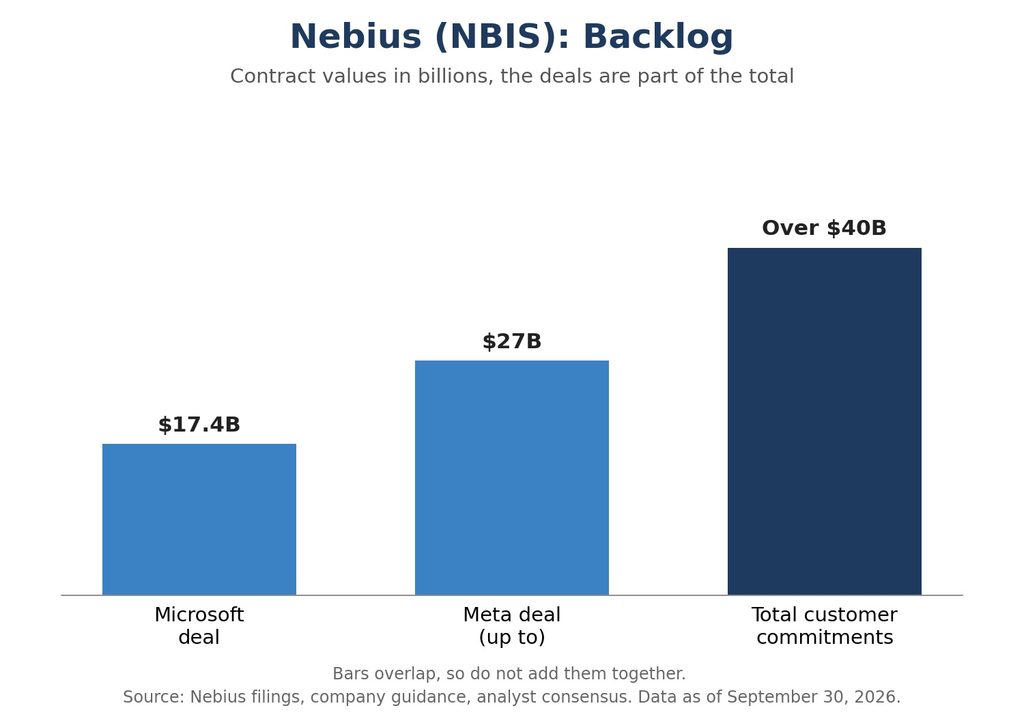
    The next big step is Nvidia’s Vera Rubin chip. Meta signed a five year deal worth up to $27 billion, with $12 billion tied to large Vera Rubin deployments from 2027.

    Nebius also plans a Pennsylvania site. The first 250 to 300 megawatts go live by the end of 2027. The site reaches 1.2 gigawatts by 2030. Contracted power is now guided to 5GW by year end, raised from more than 4GW.

    The goal is simple. Nebius wants to be a full AI hyperscaler that competes with AWS, Azure and Google Cloud.

    Is Nebius on track with its roadmap?

    So far, yes. In 2025, ARR ended at $1.25 billion, ahead of the $900 million to $1.1 billion guidance. In Q2, management reaffirmed all 2026 guidance.

    The hard part is still ahead. ARR must rise from $3.0 billion to $7 billion to $9 billion by December. Most of this year’s capacity comes online in the second half. One Morgan Stanley model has active power near 230MW in Q1 and 780MW by Q4. That is a steep climb.

    Is revenue growing?

    Yes, very fast.

    Q1 revenue was $399.0 million, up 684% from a year earlier. Q2 revenue was $582.3 million, up 454% year over year and 46% from Q1. Annualized run rate revenue hit $3.0 billion in June, up 56% from $1.9 billion in March.

    nbis revenue growth

    Full year 2025 revenue was $529.8 million. Analysts expect $904 million in Q3, which is about 55% growth over Q2 by my math. Nebius reports around October 22.

    How is EPS trending?

    EPS is still negative, but the trend is mixed.

    Reported EPS was a loss of $0.95 in 2024 and a loss of $1.83 in 2025. In Q2, GAAP EPS was a loss of $0.68, while adjusted EPS was a loss of $0.12.

    nbis eps progress

    Do not trust the Q1 headline profit. Net income was $621.2 million, but the adjusted net loss was $100.3 million. In Q2, the adjusted net loss narrowed to $33.2 million, while the GAAP net loss was $190.4 million.

    Analysts expect losses per share of $2.23 in 2026, $3.49 in 2027 and $1.44 in 2028, most likely because depreciation rises with the GPU buildout. The first profit, $10.49 per share, comes in 2029. Only two analysts cover that year, so treat it as a rough guide.

    Did EBITDA improve?

    Yes, a lot. Adjusted EBITDA went from a loss of $21.0 million in Q2 2025 to a gain of $236.2 million in Q2 2026. The margin rose from 32% in Q1 to 41% in Q2.

    Gross margin is a healthy 74% over the last twelve months. But EBIT margin is still negative 37% because GPUs lose value fast.

    How is cash flow?

    Operating cash flow improved sharply. It was positive $2.26 billion in Q1, versus an outflow of $184.1 million a year earlier. Q2 added another $2.3 billion.

    There is a catch. Much of that cash comes from customer prepayments. Deferred revenue rose from $1.58 billion to $5.98 billion in the first half. Free cash flow is still negative. In Q2, $2.3 billion of operating cash minus $5.7 billion of capex leaves a gap of about $3.4 billion.

    How much is Nebius spending on capex?

    Q1 capex was $2.47 billion. Q2 jumped to about $5.7 billion. The 2026 guide is $20 billion to $25 billion.

    nbis capex

    That leaves roughly $12 billion to $17 billion for the second half. That is about $6 billion to $8 billion per quarter by my math.

    How much funding does Nebius need, and how long does cash last?

    Cash fell from $9.3 billion in March to $8 billion in June.

    Management plans to fund growth in layers. It expects more than $9 billion in customer prepayments in 2026. In July it raised $775 million in secured debt at SOFR plus 2.50%, backed by more than $40 billion in customer commitments. It also has an at the market stock program and may issue corporate debt. Earlier this year it raised $4.3 billion in convertible notes and $2 billion in prefunded warrants. One analyst put debt near $8.5 billion.

    My rough math: $8 billion in cash, plus $0.8 billion of new debt, plus about $4 billion to $5 billion of prepayments still to come, totals about $13 billion. That is near the low end of second half capex. So 2026 looks mostly funded, with a possible gap of a few billion dollars. 2027 will need more capital. Expect more debt and more share dilution. This is an estimate, not company guidance.

    When could Nebius become profitable?

    It is already EBITDA positive. Net profit looks about three years away, based on analyst estimates for 2029. Consensus revenue climbs from $3.34 billion in 2026 to $12.3 billion in 2027, $23 billion in 2028 and $36.6 billion in 2029.

    What is the guidance?

    For 2026, Nebius guides to group revenue of $3 billion to $3.4 billion, ARR of $7 billion to $9 billion, an adjusted EBITDA margin near 40% and capex of $20 billion to $25 billion. That implies about $2.0 billion to $2.4 billion of revenue in the second half.

    nbis backlog

    Long term, there is no formal 2027 guide yet. Management says formal guidance comes later this year. The long term story rests on the $40 billion backlog, the Meta and Microsoft contracts and the 5GW power target.

    Are institutions buying NBIS?

    I cannot give a clean three year percentage. Nebius was called Yandex N.V. until August 2024, so older data is not comparable.

    Data providers also disagree. MarketBeat showed 21.9% in October 2025. Fintel shows about 54%. Financhill shows about 66%.

    nbis ownership white

    The direction is clearly up. Institutional holders rose from 283 to 307 last quarter, and shares held rose 27%. Lone Pine and Soros opened new positions in Q2. Situational Awareness LP disclosed a 5.6% stake. Orbis cut its stake sharply.

    What do analysts say?

    Most say buy. Most price targets run from $250 to $410. BTG Pactual is neutral at $223. Northland is at $410, BNP Paribas at $399, Truist at $355, Goldman Sachs at $328 and Citi at $324. D.A. Davidson rates it hold at $250.

    nbis price targets

    The bear case is loud too. Rothschild Redburn started with a Sell and an $84 target. It cites falling GPU rental prices, hyperscalers building their own capacity and costly financing.

    Why NBIS stock may be worth it

    The case for buying is simple.

    1. Demand beats supply. Nebius said it sold out its capacity again in Q1.
    2. It has pricing power. It plans roughly 20% GPU price hikes from October 1.
    3. It has big, named customers and a backlog above $40 billion.
    4. Margins are improving fast.
    5. Nvidia invested $2 billion, which helps with chip access.

    The risks to weigh

    Capex is huge. Debt is rising. Dilution is likely. GPU prices could fall. The stock is up a lot, and a few big customers drive much of the demand. A miss on the second half ramp could hit the price hard.

    NBIS stock fits investors who accept high risk for high growth. Keep position size modest. Watch Q3 results on October 22 and the 2027 guidance.

    Sources: Tipranks, SeekingAlpha, Tradingview, TIKR

    Disclosure: The author holds a long position in $NBIS stock at the time of writing