Eos Energy Enterprises, Inc. (NASDAQ: EOSE)
Every few years, a new company promises to fix the battery problem that lithium ion cannot solve. Most fade. Eos Energy Enterprises (NASDAQ: EOSE) is different. It has gotten products into the ground. It has built a factory. It has started signing serious contracts. And it is doing all of this on a chemistry almost nobody else is scaling: zinc.
This piece covers what the company does, why AI data center developers are suddenly paying attention, and where the business stands today. It draws on the company’s own filings and recent reporting, not investor hype.
What Eos Energy Actually Does
Eos was founded in 2008. The company is now headquartered in Pennsylvania, after relocating from Edison, New Jersey. Eos designs, manufactures, and sells long duration battery energy storage systems, usually shortened to BESS. In plain terms, these are large batteries. Utilities, industrial sites, and commercial customers use them to store electricity and release it over several hours, rather than seconds or minutes.
The Znyth Chemistry
A zinc based aqueous battery, called Znyth, sits at the core of the technology. It powers the company’s newest battery module, the Z3. Znyth uses just five commodity materials. None of them are rare earth or conflict minerals, and that sets it apart from lithium, cobalt, and other materials that are often imported and geopolitically sensitive.

The process is simple to describe. During charging, zinc deposits onto the battery’s electrodes. During discharge, it dissolves back into the electrolyte. Engineers have understood this electrochemical idea for decades. Eos spent years turning it into something that can be manufactured at volume and sold at a competitive price.
The Product Line
The finished systems carry names like the Eos Cube, Hangar, and Indensity. Eos builds them for 3 to 16 plus hour discharge windows. The industry generally calls this long duration or mid duration storage.
What Makes the Technology Different
Lithium ion dominates the battery storage market today. Tesla, Fluence, CATL, and Sungrow control the large majority of installed capacity worldwide. Lithium performs well at short bursts, typically two to four hours. But it hits real limits past that window. Cost per stored megawatt hour climbs. Fire risk becomes a bigger operational concern at scale. And the supply chain runs mostly through overseas mining and processing.
Eos pitches zinc as a direct answer to those pain points. A few things stand out.
Safety and Durability
The system is non flammable. Its aqueous, water based chemistry avoids the thermal runaway risk that defines lithium ion. That means the Z3 skips the costly fire suppression and active cooling equipment that lithium installations typically require.
The battery also holds up over time. Eos rates its cells for roughly 6,000 charge and discharge cycles, which works out to about 20 to 25 years of service. The company says the batteries deliver full depth of discharge with very little capacity fade as the years go on.
Domestic Sourcing and Incentives
Eos builds and sources the batteries entirely in the United States. That qualifies them for domestic content rules and for federal incentives, including the Section 45X production credit and the Section 48E investment tax credit under the Inflation Reduction Act. Together, these credits are worth an estimated 90 million dollars or more per 2 GWh production line each year.
The systems are also simpler to run day to day. They need no active thermal management, they tolerate a wide operating temperature range, and they carry lower ongoing maintenance overhead than a lithium fleet of similar size.
None of this makes zinc a universal replacement. Lithium still wins on very short, high power bursts. Eos is chasing the multi hour middle ground instead, roughly 4 to 16 plus hours of discharge. That happens to be exactly what grid operators, utilities, and increasingly data centers are short on.
The AI and Data Center Angle
AI data centers pull enormous, sustained amounts of power. The U.S. Energy Information Administration expects power demand to hit record highs in both 2026 and 2027, largely because of AI driven load growth. Global data center electricity demand could roughly triple by 2030.
The real challenge for hyperscalers is not simply finding more electricity. It is finding firm, reliable, long duration capacity fast, often faster than the traditional grid interconnection process can deliver. That challenge lines up naturally with what Eos already builds. AI workloads need power for longer stretches than lithium’s two to four hour profile comfortably covers, and they need it now rather than in five years.
How Eos Is Capturing This Demand
Eos has gone after AI power demand in two main ways.
First, data center customers now make up roughly a fifth of the company’s total commercial pipeline. That segment barely existed for Eos two years ago.
Second, in April 2026, Eos signed a joint development agreement with TURBINE-X Energy. The partnership builds behind the meter private power infrastructure for AI data centers, pairing gas fired generation with Eos’s Indensity battery architecture. The goal is firm, dispatchable, on site power delivered in months rather than years. TURBINE-X is targeting up to 2 GWh of Eos battery storage across a 36 month rollout, with initial deployments expected in 2027. Eos CEO Joe Mastrangelo has called AI data center demand an accelerant for the company’s business.
This positions Eos alongside much bigger players serving hyperscale data centers, names like NextEra Energy Resources and Fluence Energy. That is a real jump in visibility for a company that, until fairly recently, was mostly known as a struggling grid storage upstart.
Production and Manufacturing
Eos manufactures in Pennsylvania, mainly at its Thorn Hill facility in Marshall Township, near Pittsburgh. The company commissioned a second battery production line there in mid 2026, and it already runs faster cycle times and higher yields than the first line. Eos is consolidating manufacturing into Thorn Hill specifically to cut conversion costs. The facility is targeting roughly 4 GWh of annual production capacity by the end of 2026.
A separate U.S. Department of Energy Loan Programs Office loan guarantee, worth up to roughly 305 million dollars, is financing two additional manufacturing lines for next generation zinc bromine systems. Eos could add two more lines on top of that, for four in total, across Turtle Creek and Duquesne, Pennsylvania. The DOE says this build out could reach over 8 GWh of annual storage capacity by 2026, enough to instantaneously power more than 300,000 average U.S. homes.
Costs are moving in the right direction too. Eos reported a 12.5 percent material cost reduction on the Z3 product. It achieved that reduction in under a year through supplier renegotiation and simpler design choices.
Backlog, Pipeline, and Financials
Looking at the most recent reporting from Q2 2026, a few numbers stand out.
Backlog and Pipeline
Backlog sits at approximately 807 million dollars. That figure is up 25 percent from the prior quarter and 20 percent year over year, representing 3.4 GWh of contracted storage capacity. It is a company record.

The commercial opportunity pipeline tells a similar story. It includes proposals and letters of intent rather than signed contracts, and it has grown to approximately 24.6 billion dollars. That is up 31 percent year over year, spanning roughly 112 GWh across utility, industrial, commercial, and data center customers.

Think of the pipeline as a measure of demand in the room. The backlog is the portion of that demand actually locked into paper. The chart below shows how the pipeline has grown over the past year.
Revenue and Guidance
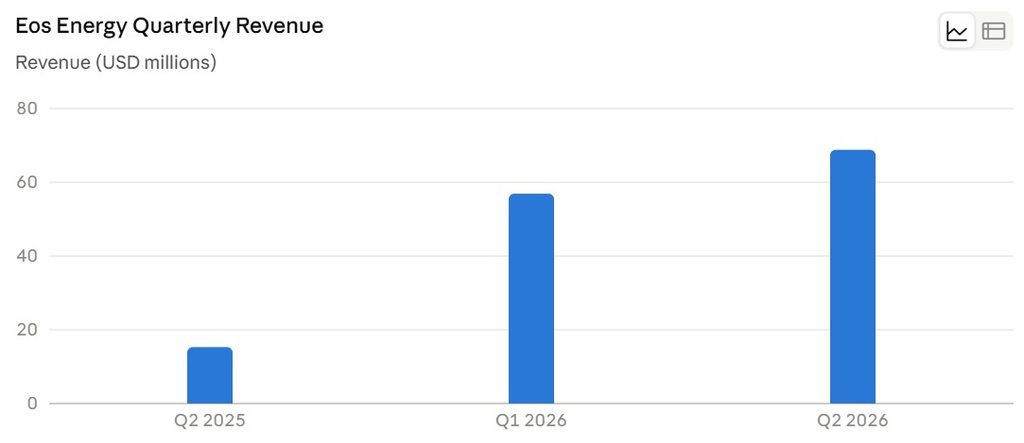
Revenue reached 68.8 million dollars in Q2 2026 alone, up 351 percent year over year. First half 2026 revenue of 125.7 million dollars already surpassed everything the company brought in during all of 2025. Full year 2026 guidance was tightened to a range of 300 to 350 million dollars, down from a prior 300 to 400 million dollar range. Eos attributes the change mainly to its planned manufacturing consolidation into Thorn Hill.
Cash, Losses, and Frontier Power USA
Cash on hand stood at approximately 364 million dollars as of June 30, 2026, including restricted cash. Profitability, though, remains a real problem. Q2 2026 gross margin came in around negative 71 percent. The net loss for the quarter reached 275.7 million dollars, driven mostly by fair value accounting adjustments, and the adjusted EBITDA loss came in at 71.4 million dollars. Eos is scaling its top line quickly while still burning a lot of cash to get there.
One structural piece worth understanding is Frontier Power USA, often shortened to FPUSA. Eos formed this joint venture with Cerberus Capital Management and Hudson Bay Capital Management. FPUSA raised 263 million dollars to support an estimated 1 billion dollars in project deployment capital. It acts as a financing arm that turns Eos’s project pipeline into built, operating assets faster than Eos could fund on its own. FPUSA has already converted its first purchase order, the Redbird project in Texas, against a 2 GWh capacity reservation agreement it holds with Eos.
Well Known Customers and Contracts
The customer base spans utilities, renewable developers, and, more recently, data center infrastructure players.
Bridgelink Investments, also known as Bridgelink Commodities, is a large renewable developer with more than 8 GW of projects in development. It holds a 1 GWh master supply agreement with Eos tied to grid resilience and energy curtailment recapture in the ERCOT market in Texas.
Frontier Power USA is the co funded joint venture described above. It holds a 2 GWh firm capacity reservation agreement plus a broader 12 to 16 GWh development pipeline across ERCOT, PJM, CAISO, and MISO.
Duke Energy was an early pilot customer, going back to a 1 MW, 4 MWh installation in 2019. It later became a booked order customer as well. Ameresco, Blue Ridge Power, Pine Gate Renewables, and Center Line Electric placed booked orders during the company’s earlier growth phase. TURBINE-X Energy is the joint development partner for AI data center power infrastructure. And Verdant Microgrid was an early microgrid deployment partner in California, back when the whole platform was much smaller.
The Road Ahead
Eos sits at an inflection point. On the surface, this looks like a boring hardware business. Underneath, there is real backlog growth, a large and diversifying demand pipeline, a factory that is actually scaling, and a policy backdrop that currently favors domestic, non lithium chemistries. Independent analysts have floated a wide range of outcomes here, from a modest re rating if the company simply keeps executing, to a meaningfully higher valuation if pipeline conversion speeds up and margins finally turn positive.
The risks are just as real, and worth stating plainly. Eos is still losing significant money on every dollar of revenue. It remains reliant on capital markets to fund its growth. It has faced a securities fraud lawsuit tied to past manufacturing execution problems. And it depends on a fairly small number of large customers and financing partners, FPUSA among them, for near term revenue. Scaling automated battery manufacturing lines is genuinely difficult work, and Eos has stumbled on execution before.
Still, the bigger trend behind all of this is not going away anytime soon. AI driven power demand keeps climbing. The grid badly needs longer duration storage. U.S. industrial policy keeps pushing toward domestic battery manufacturing. Whether Eos ends up capturing that opportunity at real scale, or just one of several companies competing for a slice of it, probably depends less on the chemistry itself. The chemistry does appear to genuinely work. It depends more on whether the team can keep turning its growing pipeline into profitable, delivered projects.
Source: Eos Energy
Disclosure: The author holds a long position in $EOSE stock at the time of writing