Bitcoin often drops sharply, then finds a floor before doom predictions come true. Three structural forces explain this pattern, and none of them depend on where the price sits on any given day.
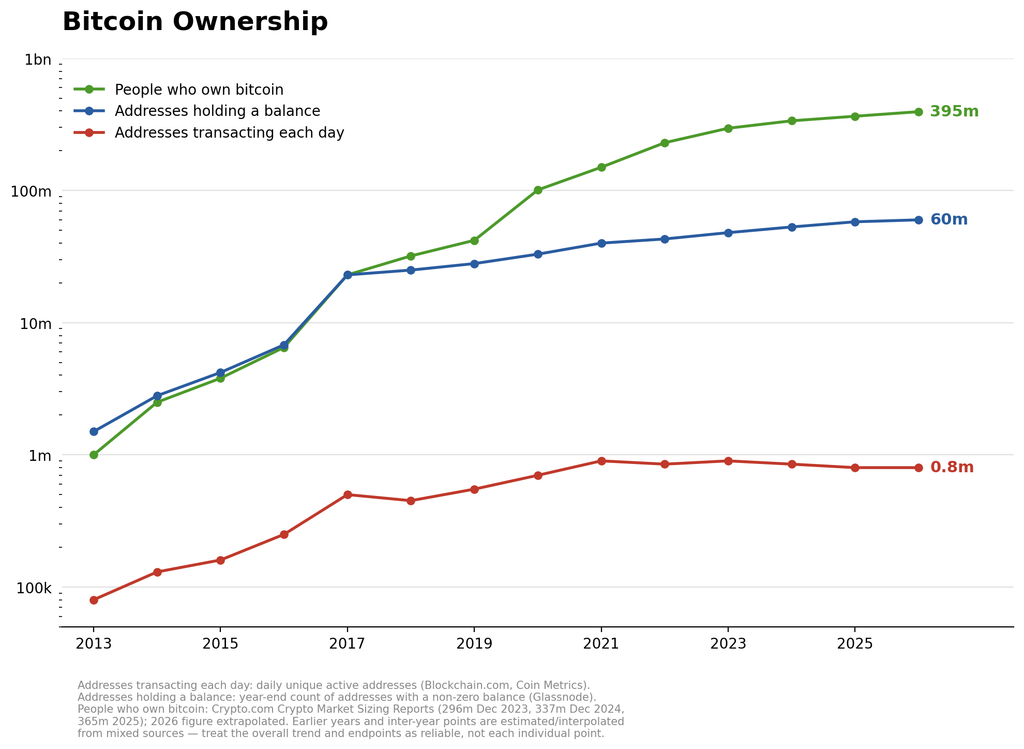
Ownership has climbed steadily for over a decade, while addresses transacting daily have stayed flat for years. That gap drives the first point below.
1. Most holders are investors, not traders
The number of people who own bitcoin keeps climbing steadily, while daily transacting addresses barely move. Most holders don’t buy and sell regularly. They simply hold it, often for years at a time. On chain data shows a large majority of circulating bitcoin sits in wallets untouched for over a year. Analysts call this group long term holders, and their share of supply tends to rise during downturns rather than fall.
This limits how much bitcoin can reach the market at any moment. When most coins sit with people who don’t plan to sell soon, sudden price drops can’t cascade far. There simply isn’t much supply left to dump.
2. Investors treat it like digital gold because supply can’t grow
Bitcoin’s total supply caps out at 21 million coins. No central authority can increase that number, no matter how much demand grows. That hard cap forms the entire foundation of the digital gold comparison.
More bitcoin keeps moving into cold storage, corporate treasuries, and long term investment vehicles instead of sitting on exchanges ready to trade. Institutional buyers, including public companies and exchange traded funds, tend to accumulate and hold rather than actively trade. When investors lock away a large portion of supply this way, only a small fraction remains available to trade on any given day, the same dynamic that supports gold prices.
3. Mining costs provide a natural support level
Producing new bitcoin costs real money, mostly electricity and specialized mining hardware. That cost has climbed recently for reasons beyond bitcoin itself. AI data centers have triggered a global memory chip shortage, pushing component prices sharply higher, and their massive power demand is straining electrical grids in many countries. On top of that, geopolitical conflicts, including the war in Ukraine and tensions involving Iran, have disrupted oil and gas supplies and pushed up wholesale gas prices. Since a large share of electricity in Europe and other regions comes from gas fired power plants, those disruptions flow directly into higher electricity bills. Since mining hardware and grid electricity both compete for the same limited supply, miners are absorbing higher input costs on multiple fronts at once. Industry estimates typically put the average cost to mine one bitcoin somewhere between $70,000 and $90,000, though this figure shifts constantly with electricity prices, equipment costs, and mining difficulty. Less efficient operations can face costs well above that range, while the most efficient miners run comfortably below it.
When the market price drops toward or below production cost, miners face a choice. Some sell reserves to cover costs. Others shut down less efficient operations. Some pivot their infrastructure toward other uses, like renting out computing power. Each response reduces selling pressure and shrinks the pool of active miners.
As weaker miners exit, the network lowers mining difficulty, which improves margins for whoever remains. That process tends to stabilize prices rather than accelerate a decline, which is why analysts often treat the industry wide average mining cost as a rough support zone.
Putting it together
None of these factors make bitcoin immune to further declines. But together, they explain a pattern that keeps showing up. Ownership keeps expanding through downturns. A growing share of supply sits with holders who aren’t interested in selling soon. And production costs create a point where mining economics start working against further declines instead of adding to them.
These forces don’t move with daily headlines. They’re structural, which is why they matter more over the long run than any single week of price action.
Sources: kucoin, theblock, coindesk, yahoo finance, CoinShares, The Central Bulletin, Crypto.com
Disclosure: The author has no position in Bitcoin